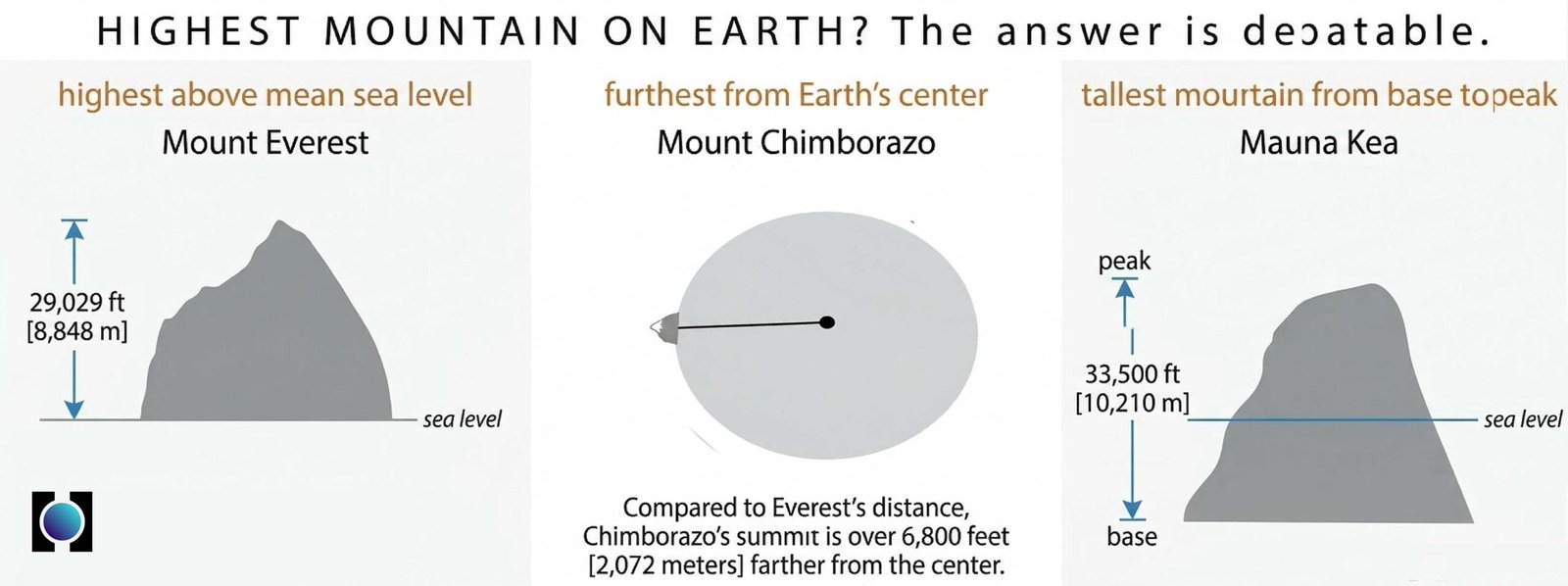
Mount Everest is widely celebrated as the highest mountain on the Earth, with its summit soaring to an impressive 8,848.86 meters (29,031.7 feet) above sea level. For generations, climbers, adventurers, and dreamers have gazed at its snow-capped peak, aspiring to stand at the “top of the world.” Yet, this iconic title comes with an important caveat: Everest holds the crown only when measured from sea level. When we consider other perspectives—such as distance from Earth’s center or total height from base to summit—surprising challengers emerge, revealing how Earth’s unique shape reshapes our understanding of “highest.”
The Highest Mountain on the Earth: From the centre of the earth
Earth is not a perfect sphere. Its rotation creates an equatorial bulge, making the planet slightly flattened at the poles and wider around the equator. This oblate spheroid shape means points near the equator are farther from the planet’s core than those closer to the poles. The difference is significant: sea level at the equator sits about 21–22 kilometers farther from Earth’s center than at the poles.
Enter Mount Chimborazo in Ecuador, a dormant volcano perched just 1° south of the equator. Its summit rises to 6,263–6,268 meters above sea level—far lower than Everest’s towering height. However, because of the equatorial bulge, Chimborazo’s peak sits approximately 6,384.4 kilometers from Earth’s center. In comparison, Everest’s summit is about 6,382.3 kilometers away. This gives Chimborazo a roughly 2,100–2,168 meter advantage in radial distance—equivalent to over 2 kilometers farther from the core.
This distinction makes Chimborazo the farthest point from Earth’s center and, by extension, the closest terrestrial point to the stars (or outer space). Standing atop its summit places you nearer to the cosmos than anyone on Everest. While the difference is modest in astronomical terms, it underscores a fascinating truth: geography and physics can redefine “highest” depending on the reference point.
The Highest Mountain on the Earth: From the base to Summit
Adding another layer to this mountain hierarchy is Mauna Kea, a shield volcano on Hawaii’s Big Island. Above sea level, its peak reaches only about 4,207 meters (13,803 feet), modest by Himalayan standards. But Mauna Kea rises from the ocean floor in the Hawaiian Trough. Measuring from its submarine base to the summit yields a total height of approximately 10,205 meters (over 33,480 feet). This surpasses Everest’s sea-level elevation by more than a kilometer, earning Mauna Kea the title of the tallest mountain from base to peak.
These comparisons highlight how measurement matters. Sea-level elevation remains the standard for “highest” in most contexts—Everest reigns supreme there, a symbol of human endurance and exploration. Yet, Chimborazo claims primacy in radial distance, closer to the heavens due to planetary physics. Mauna Kea dominates in sheer vertical rise, its massive underwater foundation hidden from view.
The Highest Mountain on the Earth: From Mean Sea Level
So, while Mount Everest is undeniably the highest above sea level, it isn’t the tallest overall nor the point farthest from Earth’s center. The next time someone mentions the “highest mountain,” pause and ask: highest by which measure? Earth’s quirks ensure no single peak holds every title.
In a world obsessed with rankings, these mountains remind us that perspective changes everything. Everest inspires awe with its altitude, Chimborazo surprises with its cosmic proximity, and Mauna Kea impresses with its hidden depths. Together, they reveal the beauty of our imperfect, bulging planet—and the endless ways to measure its wonders.
In Summary,
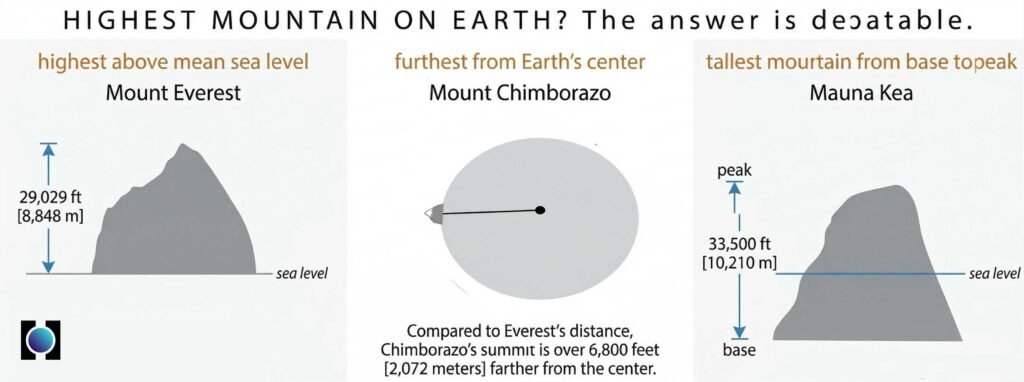
- Farthest from Center (Mount Chimborazo): Because Earth is a flattened sphere (not a perfect sphere), the bulge at the equator makes Mount Chimborazo’s summit the farthest point from Earth’s center.
- Tallest from Base-to-Summit (Mauna Kea): Over half of Mauna Kea is submerged in the Pacific Ocean. When measured from its underwater base to its summit, it is roughly 10,210 meters (33,500 feet) tall, surpassing Everest.
- Highest Above Sea Level (Mount Everest): Measured by altitude (height above sea level), Everest remains the highest peak on Earth at 8,849 meters (29,032 feet).