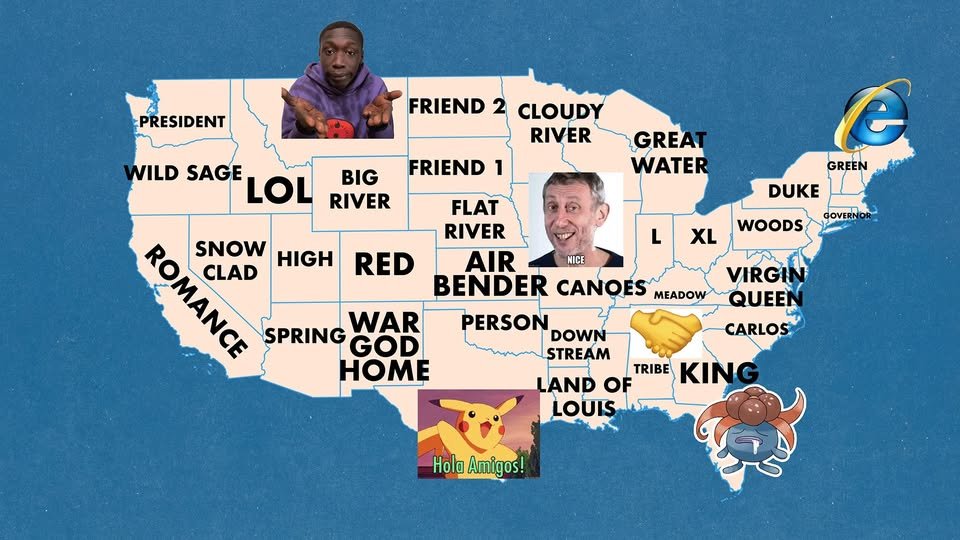
The United States of America has 50 states. But have you ever wondered how each state got its name? Here is the origin of names of US states.
Alaska
Alaska derives its name from the Aleut word alakshak, meaning “great land” or “peninsula.” More literally, it translates to “the object toward which the sea is directed”—the place where the waves hit.
Hawaii
The origin of its name is uncertain. It either comes from Hawaiki, spelt Owhyhee, the mythological homeland of the gods, or it is named after Hawaiʻi Loa, a legendary navigator said to have discovered the islands.
Washington
It is named after George Washington and is the only state named after a U.S. president. When the territory was being formed in 1853, it was originally going to be called Columbia, but it was renamed Washington to avoid confusion with the District of Columbia.
Oregon
The origin of its name is unclear. One theory links it to origanum, a wild sage found along the coast. Another traces it to the Spanish Oregones, meaning “big-eared men,” used for local tribes. Poet Joaquin Miller suggested it came from the Spanish phrase alura agua, meaning “gently falling waters.”
California
The name California is traced to an imaginary island described in a Spanish romance written by Montalvo in his 1510 novel The Adventures of Esplandián.
Nevada
The name Nevada comes from the Spanish word meaning “snow-clad,” referring to the Sierra Nevada mountain range.
Idaho
Most people believe that Idaho is a Native American word meaning “gem of the mountains,” but in reality, it is a made-up name with no actual meaning. It may have stuck because it sounded good and “Indian enough.”
Montana
It is one of the most descriptive names of the U.S. states, and it means “mountainous.” It was supposed to be the name of Idaho, but nevermind…
Wyoming
It gets its name from a green valley in northeast Pennsylvania and comes from a Munsee word meaning “big river flat.”
Utah
The name comes from the Ute tribe that inhabited the region. And it means “people of the highlands”. It likely comes from the Apache word yuttahih, meaning “one that is higher up.”
Arizona
Most people believe the name means an arid region, but that is a misconception. It comes from the Tohono O’odham phrase alĭ ṣonak, meaning “a place of small springs.”
New Mexico
This region became part of the Spanish Kingdom in 1598. Spanish settlers named the land Nuevo México after the Aztec Valley, hoping to find a northern empire as wealthy as the one they had just conquered. Regarding the name Mexico, it is ancient and likely comes from Mexitli, the Aztec god of war, meaning “the place where the god of war lives.”
Colorado
Colorado gets its name from a Spanish word meaning “colored red.” This name was originally given to the Colorado River because of the red sandstone soil in the area, which turned the water a muddy, reddish colour.
North & South Dakota
The word Dakota means “ally” or “friend.” It refers to the alliance of the Native Sioux tribes who lived in the region. These tribes traditionally spoke related languages from the Siouan family: Dakota, Nakota, and Lakota.
Nebraska
The name comes from the Sioux word Ñí Brásge, meaning “flat water,” referring to the river.
Kansas
Kansas takes its name from the river and the tribe of the same name. The name translates as “south wind people” or “wind people.”
Oklahoma
The name comes from two Choctaw words: ukla, meaning people, and humma, meaning red. Together, the name means “Red Nation.”
Watch: Why Oklahoma has a panhandle?
Texas
The name comes from the Caddo word taysha, which means “friend.”
Louisiana
It was named by the French in honour of King Louis XIV and means “Land of Louis.”
Mississippi
The name comes from the Ojibwe words misi-ziibi, meaning “Great River,” or more literally, “gathering in all the waters.”
Arkansas
The name means “People Downstream” and comes from a French term used for the Quapaw people who lived in the region.
Missouri
It is named after the Missouri River and the Native American tribe of the same name. The name means “those who have dugout canoes.”
Iowa
The state is named after the Ioway people, a Native American tribe that once lived in the region. The name is often said to mean “Beautiful Land.”
Minnesota
Its name comes from the Dakota word Mnisota, meaning “cloudy water,” named after the Minnesota River.
Wisconsin
The name comes from an Algonquin river name that the French changed to Ouisconsin and was later adapted into English. It is commonly interpreted as “river that meanders through something red” or “it lies red,” referring to the red sandstone bluffs of the Wisconsin Dells.
Illinois
Contrary to popular belief, the name does not mean “men” or “warriors.” It comes from a French version of the Native word ilenweewa, with “ois” added at the end, and means “to speak normally.”
Indiana
The name simply means “Land of the Indians.”
Michigan
The name comes from the Ojibwe word mishigami. Michi means “great” and gami means “water,” so it means “large water” or “large lake.”
Ohio
The name comes from the Seneca word ohi:yo’, meaning “large creek.”
Kentucky
The origin of the name is uncertain, but it likely comes from an Iroquois word meaning “on the meadow.”
Tennessee
The name comes from a Cherokee village called Tanasi. Its original meaning is unclear, though some believe it meant “meeting place” or “bend in the river.”
Alabama
The state is named after the river and the Native American tribe. In the native language, Albamo referred to a person from that group.
Florida
The Spanish named it La Florida, meaning “the flowery one,” because explorers arrived during a season of heavy blooming.
Georgia
It was named after King George II of Great Britain, as it was established as the 13th and last British colony.
North & South Carolina
The name Carolina honours King Charles I. Carolus is Latin for Charles, and Carolina is the feminine form of that name.
Virginia & West Virginia
Virginia was named after Queen Elizabeth I of England, who was known as the “Virgin Queen.” When the western counties separated during the Civil War, the new state was named West Virginia.
Maryland
It was named after Queen Henrietta Maria, the wife of King Charles I.
Delaware
Delaware derives its name from Lord De La Warr, the first governor of Virginia, who explored the area around the bay in 1630.
New Jersey
The state was named after the British island of Jersey, located in the English Channel. Sir George Carteret was a proprietor who was granted the territory by King Charles II for his loyalty, and Jersey was his homeland.
Pennsylvania
The name means “Penn’s Woods,” combining William Penn’s name with the Latin word sylvania, meaning woodlands.
New York
Originally, it was called New Netherland, but when the English took control, they changed the name to New York in honour of the Duke of York, who later became King James II.
Connecticut
It derives its name from the Eastern Algonquin word quinnitukqut, meaning “land on the long tidal river.” The Algonquins were Indigenous people of the Ottawa River Valley.
Rhode Island
There are two main ideas about how it got its name. One idea is that the explorer Verrazzano thought the land looked like the Greek island of Rhodes. Another idea is that a Dutch explorer named it Roodt Eylandt, which means “reddish island.”
Massachusetts
The name comes from the Algonquian word massa-adchu-es-et. It translates to “at or about the great hill,” likely referring to the Great Blue Hill in Milton.
Vermont
Its name comes from the French words vert, meaning “green,” and mont, meaning “mountain,” referring to the state’s Green Mountain range.
New Hampshire
This area was granted to Captain John Mason in 1629. He named it in honour of the county of Hampshire in England, which was his home.
Maine
The origin of the name is unclear. It may come from early French explorers who named it after the French province of Maine, or from English sailors who referred to the mainland as “the main” to distinguish it from the coastal islands.
Washington, D.C.
A federal district that serves as the national capital. It is named after George Washington, while also honouring Christopher Columbus, as D.C. stands for District of Columbia.