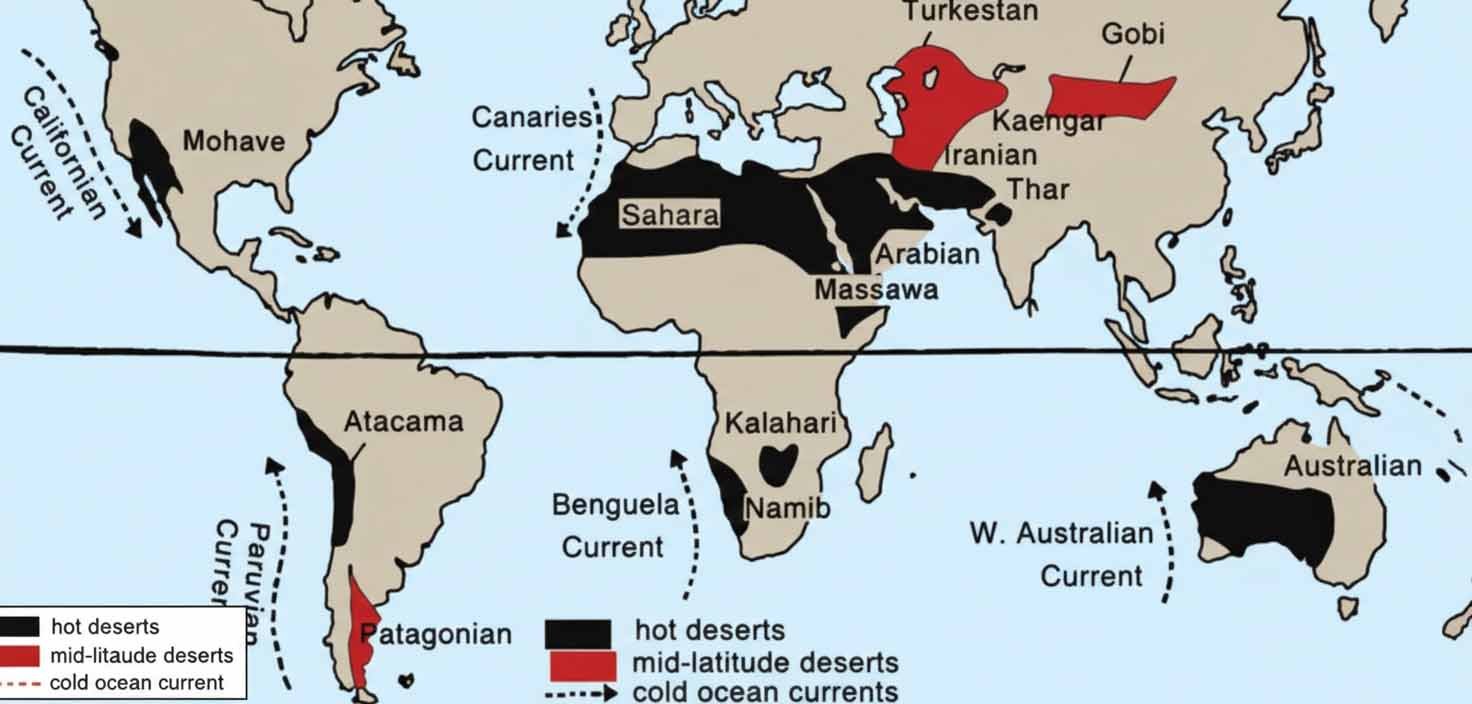
Have you ever wondered why most of the world’s hot deserts—like the Sahara, Kalahari, Thar, Arabian, and Atacama—are located on the western sides of continents? It’s no coincidence; rather, there are some powerful geographical forces at work.
What Are Deserts?
Deserts are regions with scanty rainfall. They can be hot or cold.
The cold desert is rainless because of its interior location in the temperate latitudes where rain-bearing winds fail to reach.
On the other hand, Hot deserts are arid mainly because of the effects of offshore Trade Winds.
Why are major hot deserts located on the western side of the continents?
The major hot deserts of the world are located on the western coast of continents between latitudes 15 degrees and 30 degrees North.
Initially, you might think mountain ranges are the main cause. While mountains can block moisture-laden winds—forcing rain to fall on one side and leaving the other side dry—this doesn’t fully explain the massive deserts in Africa or Australia.
The real reason involves the wind and the waves:
1. The Trade Winds
Because the Earth rotates, global winds (the Trade Winds) generally blow from East to West in the tropics. As these winds pass over the eastern side of a continent, they are full of moisture from the ocean, leading to heavy rain. However, as they travel across the land toward the West, they lose their moisture. By the time they reach the western coast, the air is almost completely dry, creating arid conditions.
The hot deserts lie astride the Horse Latitude (subtropical high-pressure belt). A high-pressure belt means air is descending, a condition least favourable for precipitation of any kind.
2. Cold Ocean Currents
Additionally, cold ocean currents flow along the western coasts of these continents— such as the California Current along North America, the Humboldt Current along South America, the Canary and Benguela currents along Africa, and the West Australian Current along Australia.
These cold currents have a “desiccating” (drying) effect. They chill the air above them, which limits its ability to hold moisture. This often creates coastal fog but prevents actual rainfall, sealing the fate of these regions as deserts.
Read More: Why Namibia has a panhandle?