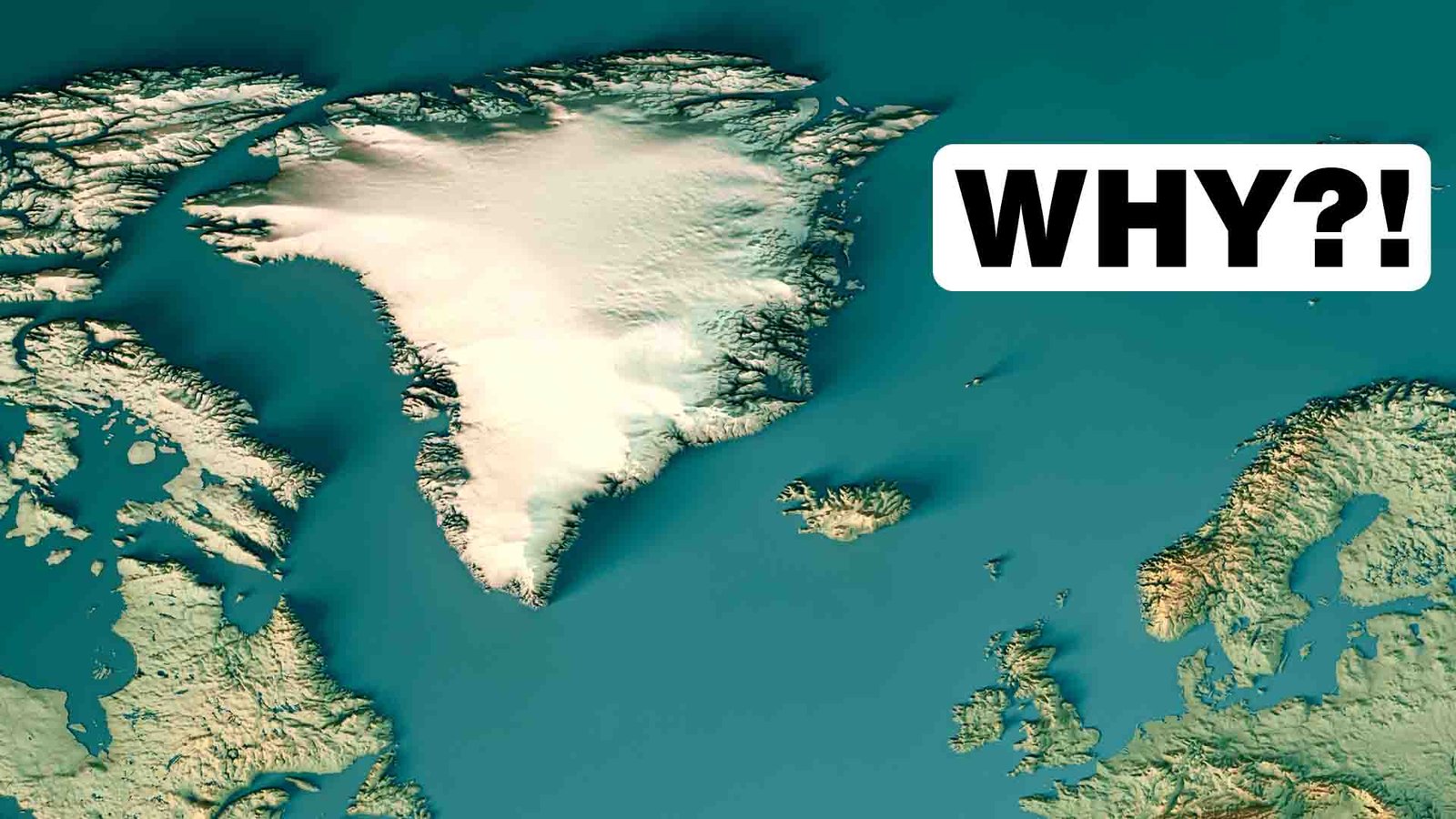
Greenland lies roughly 3,500 km from Denmark—a significant distance across the North Atlantic. Geographically, the island is far closer to North America than to Europe; yet, despite this proximity to the Western Hemisphere, it remains politically anchored to the European continent. Even with a flight time of 6 to 7 hours between the two capitals, Copenhagen and Nuuk, both regions remain unified as part of the Kingdom of Denmark.
This raises the question: Why, despite such vast geographic isolation, is Greenland part of Denmark?
Why Greenland is part of Denmark?
To understand this connection, we need to look back at history. Greenland was first settled by the Inuit people, who migrated from North America thousands of years ago. The first Nordic presence began in the 10th century with Erik the Red, a Norse Viking who was banished from Iceland for manslaughter.
Hoping to build a new colony, he named the icy region “Greenland” as a clever marketing tactic to lure more settlers. The Norse settlements in Greenland eventually became part of a North Atlantic empire ruled from Norway. While these settlers remained for centuries, they vanished with little trace by the start of the 15th century. Historians suggest several possible reasons for this, including a cooling climate that made the island less habitable and growing conflicts with the Inuit, who were moving into the areas where the Norse lived.
Hans Egede and his contribution
In 1721, Hans Egede, a Norwegian priest with support from the united Dano-Norwegian crown, went to Greenland. He hoped to find Norse settlers, but found only the Inuit. He then focused on converting them to Christianity.
This visit began Greenland’s colonial period. Over many years, the Inuit were converted, and Greenland became politically and economically linked to Denmark-Norway.
Greenland: Run-Up to Self-Rule
When Denmark and Norway separated in 1814, Greenland stayed with Denmark. In the 1800s and early 1900s, Denmark controlled Greenland carefully to keep it profitable.
In 1916, the United States confirmed Denmark’s rights to Greenland as part of a deal that facilitated the American purchase of the Danish West Indies. Denmark’s control over Greenland became undisputed in 1933, when the Permanent Court of International Justice ruled against Norwegian claims to parts of Greenland.
Soon after the Second World War, the United Nations began pushing European powers to decolonise their overseas territories, including Greenland. In response, Denmark took a different approach.
In 1953, Greenland was formally incorporated into the Kingdom of Denmark, ending its colonial status. Greenlanders were granted Danish citizenship and given two seats in the Danish Parliament.
However, this change did not fully satisfy Greenland’s demand for self-governance. Many decisions were still made in Copenhagen, with limited local control. As a result, in 1979, Denmark introduced Home Rule (Hjemmestyre) for Greenland. This gave Greenland its own elected government and greater authority over internal affairs, marking a major step toward political autonomy within the Danish realm.
In 2009, Greenland gained Self-Rule, which gave its people the right to decide their own future, including whether to seek independence from Denmark. However, opinion polls have consistently shown that most Greenlanders do not support full independence at present.
Greenland is also economically dependent on Denmark, as it receives an annual block grant of around 600 million dollars, which plays a crucial role in supporting its economy and public services.
So how did the United States enter the picture?
The turning point came on April 9, 1940, when Nazi Germany invaded Denmark. This immediately worried the United States. Greenland’s location, sitting between North America and Europe, was strategically important, and the US feared it could be used by Germany to threaten American security.
At this moment, Denmark could no longer manage Greenland’s defence. Henrik Kauffmann, the Danish ambassador to the United States, stepped in. Acting on his own and without approval from the German-controlled Danish government, Kauffmann signed an agreement allowing the US to establish military bases in Greenland for the duration of the war.
This move brought the United States directly into Greenland for the first time and marked the beginning of a long-term American strategic presence on the island.
From 1949 onward, the United States and Denmark became formal allies after both joined NATO. During the Cold War, Greenland became extremely important for American security. From bases in Greenland, the US tracked Soviet missiles, bomber aircraft, and nuclear-armed submarines moving across the Arctic. Its location made it a key early warning point between the Soviet Union and North America.
US- Greenland Relations After Trump
In recent years, this relationship has come under strain. After Donald Trump came to power, he openly criticised European NATO allies for what he called “free riding” on US security. In this view, Denmark was seen as a weak ally that did not invest enough in defence, while still relying on American protection. Trump even questioned Denmark’s ability to secure Greenland on its own.
Despite this pressure, Greenlanders themselves remain strongly opposed to US control. Surveys show that around 85 per cent of the population does not want Greenland to come under American rule. However, Greenland’s strategic value is rising again. Climate change is melting Arctic ice, opening new shipping routes and access to natural resources. This has once more pushed Greenland to the centre of global politics, making it a small land with outsized importance in a changing world.