
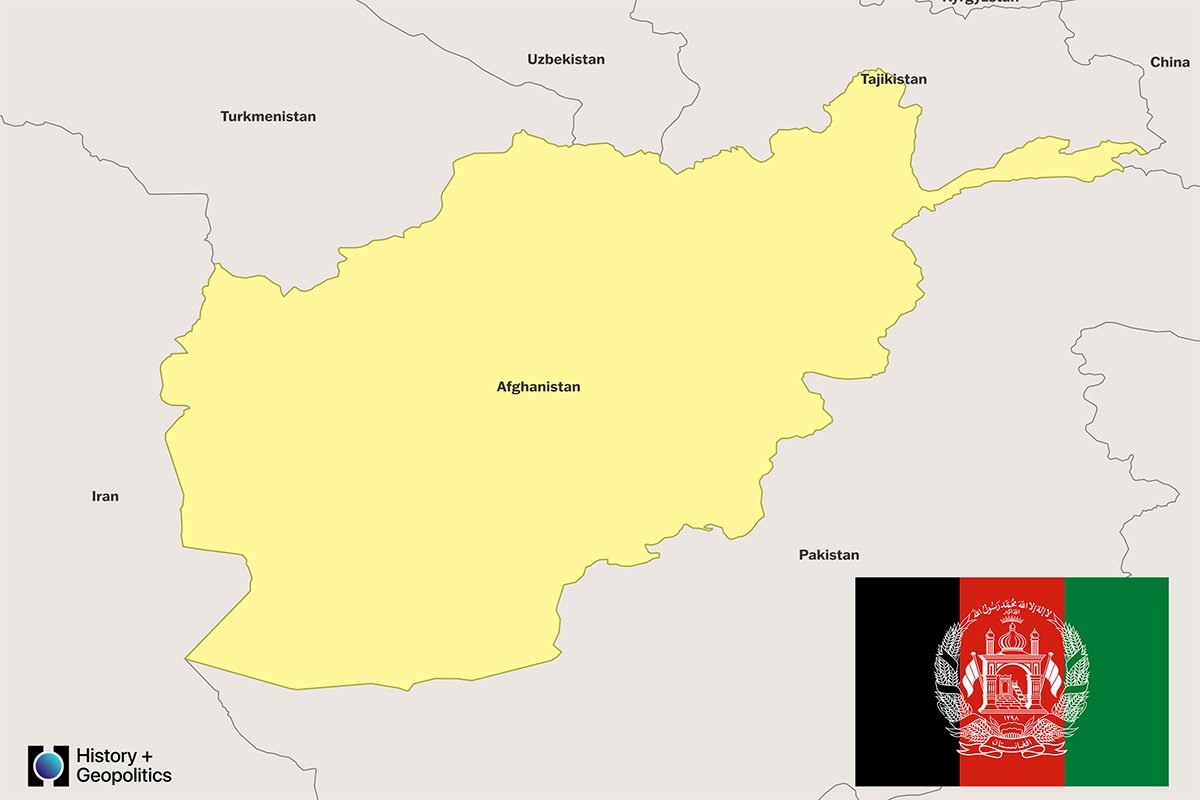
Afghanistan is located in Central Asia with Iran to the west and Pakistan to the east.
Afghanistan Facts
- OFFICIAL NAME: Islamic Republic of Afghanistan
- CAPITAL: Kabul
- POPULATION: 34,940,837 (use latest fig and add year)
- AREA: 652,230 square kilometers
- OFFICIAL LANGUAGES: Dari (Afghan Persian), Pashtu
- CURRENCY: Afghan Afghani
Afghanistan Flag
The flag has three equal vertical stripes: black on the left, red in the middle, and green on the right. In the center of the red stripe is the national emblem in white, which slightly extends into the black and green stripes. The emblem shows a mosque with a pulpit and flags on both sides. Below the mosque is the number 1298, which is the solar year that matches 1919, the year Afghanistan became independent from the United Kingdom. Around the mosque are wheat branches. Above it are the Shahada (the Muslim declaration of faith), rays of the rising sun, and the Takbir, which means “God is great.” At the bottom is a scroll with the name Afghanistan.
Afghanistan Geography
- Located in Central Asia.
- Borders:
- Iran to the west
- Pakistan to the east
- Most of the country is covered by high mountains and dry deserts.
- Mountain peaks are steep and remain snow-covered for much of the year.
- Many people live in fertile valleys between the mountains.
- Main occupations include farming and raising animals.
- Only about 20% of the land is used for agriculture.
- Summers are hot and dry; winters are very cold.
- The Hindu Kush mountain range is an important physical feature.
- Many rivers flow through mountain valleys and gorges.
- Snowmelt and rainwater from the Hindu Kush collect in low-lying areas and do not reach the ocean.
- Mountain passes provide routes for travel across Asia.
- Afghanistan was an important part of the ancient Silk Road trade route.
- The Silk Road connected China, India, and Europe for over 2,000 years.
Afghanistan Government
- Afghanistan is currently ruled by the Taliban.
- The Taliban first ruled Afghanistan from 1996 to 2001.
- In August 2021, they regained control of the country after taking over major cities, including Kabul.
- Taliban means “students” in the Pashto language.
History of Afghanistan
- Afghanistan has a long history and was settled around 7000 B.C.
- In 330 B.C., Alexander the Great conquered the region.
- In 1747, Afghan leaders formed the Kingdom of Afghanistan.
- Afghanistan fought three wars with the United Kingdom and gained full independence in 1919.
- In 1979, the Soviet Union invaded Afghanistan, leading to years of conflict.
- The Taliban emerged in 1994 and took control of much of the country.
- After the September 11, 2001 attacks, the United States and its allies removed the Taliban from power.
- In 2004, Afghanistan adopted a new constitution and held democratic elections.
- In August 2021, the Taliban returned to power after the withdrawal of foreign troops.
People and Culture of Afghanistan
Afghanistan is home to many ethnic groups and cultures. The Pashtuns are the largest group and make up nearly half of the population. Other major groups include the Tajiks, Uzbeks, and Hazaras. The Hazaras mainly live in the central mountain regions.
- Different languages are spoken, including Pashto, Dari, and Uzbek languages.
- The Kuchi are nomadic people who move with their herds in search of grazing land.
- Kite flying is a popular Afghan tradition, and kite-fighting competitions are common.
- Tea is the most popular drink in Afghanistan.
- A traditional Afghan dish is Palau, made with rice, meat, and fruit.
- Afghan culture is known for its strong traditions, hospitality, and diversity.
Economy of Afghanistan
- The economy of Afghanistan is mainly based on agriculture.
- Many people grow crops such as wheat, fruits, and nuts.
- Livestock farming, including sheep and goats, is an important source of income.
- Trade and small businesses also support the economy.
- Years of war and political instability have slowed economic development.
- Many people live in rural areas and depend on farming for their livelihoods.
- Afghanistan receives international aid to support development and rebuilding.
Afghanistan Resources
- Afghanistan has rich mineral resources.
- Important minerals include copper, iron ore, gold, and lithium.
- The country is famous for lapis lazuli, a valuable blue gemstone.
- Coal, natural gas, and precious stones are also found in some regions.
- Rivers and fertile valleys provide water for agriculture.
- Large mountain ranges contain many natural resources.
- Many resources remain underdeveloped because of conflict and lack of infrastructure.
Afghanistan Wildlife
- Decades of war, hunting, and drought have reduced wildlife populations.
- Tigers once lived in Afghanistan but are now extinct.
- Bears and wolves have been hunted and are close to extinction.
- Endangered Snow Leopard live in the cold Hindu Kush mountains.
- Snow leopards have thick fur to survive the cold climate. Illegal hunting for their fur has threatened their population.
- Rhesus Macaque are found in the warmer southern regions.
- Red Flying Squirrel also live in southern Afghanistan.
Afghanistan has a variety of wildlife despite its harsh environment.

Hi, this is a comment.
To get started with moderating, editing, and deleting comments, please visit the Comments screen in the dashboard.
Commenter avatars come from Gravatar.