Mexico Country Profile
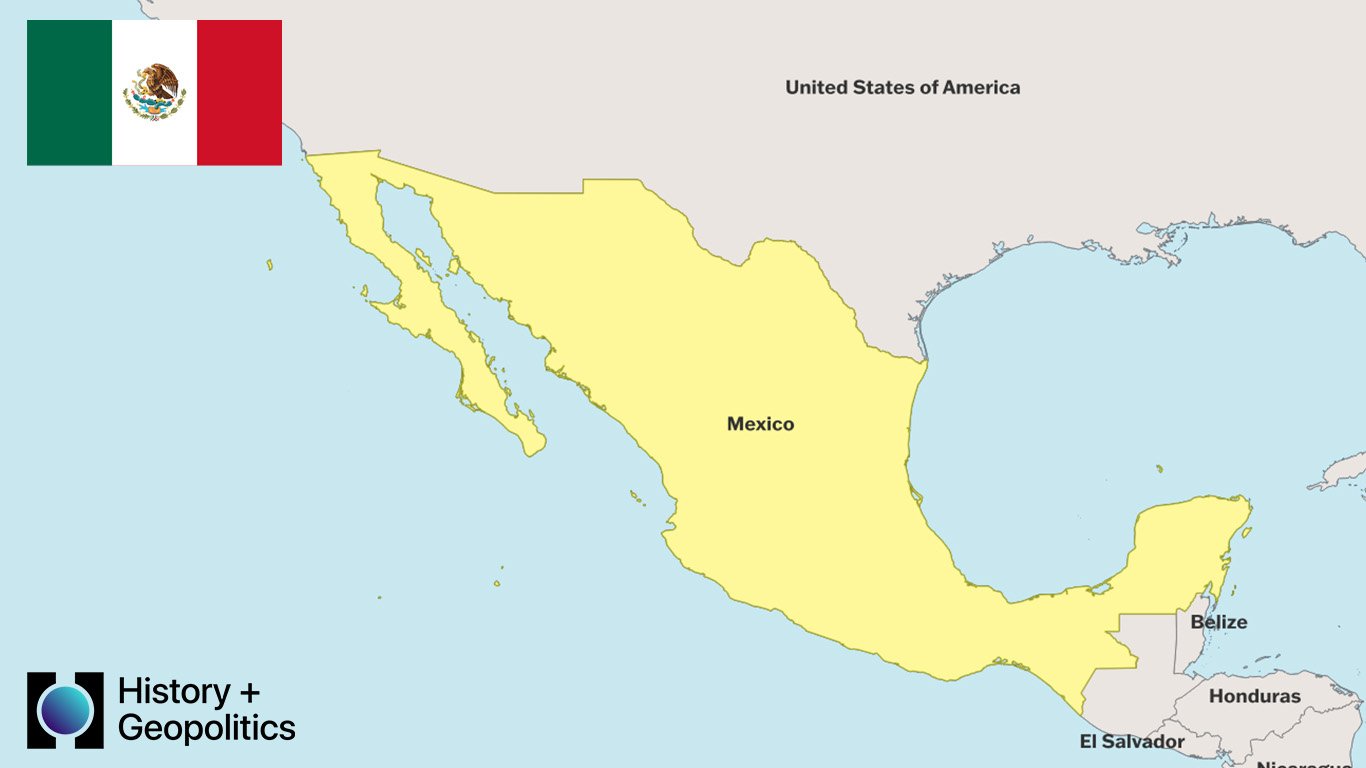
Mexico is located in North America, bordered by the United States to the north, Guatemala and Belize to the southeast, the Pacific Ocean to the west and south, and the Gulf of Mexico and the Caribbean Sea to the east.
Mexico Facts
- OFFICIAL NAME: United Mexican States
- CAPITAL: Mexico City
- POPULATION: 132,997,658 (2026)
- AREA: 1,964,375 square kilometers
- OFFICIAL LANGUAGE: Spanish
- CURRENCY: Mexican Peso (MXN)
Mexico Flag
The flag of Mexico has three equal vertical stripes — green on the left, white in the middle, and red on the right — with the national coat of arms centered on the white stripe. The green represents hope and the independence movement, the white represents purity and the Catholic faith, and the red represents the blood of the national heroes who died for independence. The coat of arms depicts an eagle perched on a cactus devouring a serpent, a symbol rooted in the ancient Aztec legend that guided the founding of Tenochtitlan, the capital of the Aztec Empire and the site of present-day Mexico City.
Mexico Geography
- Located in North America, the third largest country in Latin America.
- Borders: United States to the north, Guatemala and Belize to the southeast.
- The Pacific Ocean lies to the west and south, the Gulf of Mexico and Caribbean Sea to the east.
- The terrain is highly diverse, featuring the Sierra Madre Occidental and Sierra Madre Oriental mountain ranges flanking a high central plateau.
- The Yucatán Peninsula in the southeast is a flat limestone platform covered in tropical forest.
- Pico de Orizaba, also known as Citlaltépetl, is the highest peak at 5,636 meters and the third highest in North America.
- Mexico sits on the Pacific Ring of Fire and has numerous active volcanoes, including Popocatépetl near Mexico City.
- The country has a highly varied climate, from desert in the northwest to tropical rainforest in the south and east.
- The Baja California Peninsula extends approximately 1,250 kilometers southward from the US border between the Pacific Ocean and the Gulf of California.
- Mexico City, the capital, sits in a highland basin at approximately 2,240 meters elevation and is one of the largest metropolitan areas in the world.
Watch video on YouTube – Mexico Geography
Mexico Government
- Mexico is a federal presidential republic.
- The President serves as both head of state and head of government.
- Mexico is divided into 31 states and one federal entity, Mexico City.
- Claudia Sheinbaum has served as President since October 2024, becoming Mexico’s first female president.
- Mexico has a bicameral Congress consisting of the Senate and the Chamber of Deputies.
- Mexico is a founding member of the United Nations and a member of the G20.
History of Mexico
- Mexico has been inhabited for over 20,000 years, with ancient civilizations including the Olmec, Maya, Zapotec, and Teotihuacan cultures flourishing long before European contact.
- The Aztec Empire, centered at Tenochtitlan on an island in Lake Texcoco, was one of the most powerful civilizations in the Americas at the time of Spanish arrival.
- Spanish conquistador Hernán Cortés arrived in 1519 and, with the help of indigenous allies opposed to Aztec rule, conquered the Aztec Empire by 1521.
- New Spain, as the colony was known, became one of the most important and wealthy territories in the Spanish Empire.
- Mexico declared independence from Spain on September 16, 1810, led by Father Miguel Hidalgo, whose Grito de Independencia is reenacted every year on Independence Day.
- Full independence was achieved in 1821 after an eleven-year war.
- Mexico lost approximately half its territory to the United States following the Mexican-American War of 1846 to 1848, including present-day California, Texas, and much of the American Southwest.
- The Mexican Revolution from 1910 to 1920 was one of the most significant social and political upheavals in the Americas, resulting in a new constitution in 1917.
- The Institutional Revolutionary Party (PRI) dominated Mexican politics for 71 years until losing the presidency in 2000.
- Mexico has been significantly impacted by drug cartel violence since the mid-2000s, with organized crime posing major challenges to governance and public security.
watch on YouTube – Why Mexico has two Californias
People and Culture of Mexico
- Mexico is one of the most ethnically diverse countries in the Americas, with mestizo Mexicans of mixed indigenous and European heritage making up approximately 62% of the population.
- Indigenous peoples make up approximately 21% of the population, with dozens of distinct groups including the Nahua, Maya, Zapotec, and Mixtec.
- Spanish is the official language, and Mexico has the largest Spanish-speaking population of any country in the world.
- Roman Catholicism is practiced by approximately 72% of the population and is deeply embedded in Mexican culture, art, and traditions.
- Tacos, tortillas filled with various meats, cheeses, and vegetables, are Mexico’s most internationally recognized food and a daily staple across the country.
- Mole, a complex sauce made from dozens of ingredients including chiles, chocolate, and spices, is considered one of Mexico’s most celebrated culinary achievements.
- Mexican cuisine was recognized by UNESCO as an intangible cultural heritage of humanity, reflecting its extraordinary depth, diversity, and cultural significance.
Economy of Mexico
- Mexico has the second largest economy in Latin America and one of the largest in the world, ranking among the G20 nations.
- Manufacturing is the most important export sector, with Mexico one of the world’s largest producers of automobiles, electronics, and aerospace components.
- The proximity to and free trade relationship with the United States, formalized through NAFTA and its successor USMCA, has made Mexico one of the United States’ most important trading partners.
- Oil production from state company PEMEX has historically been significant, though production has declined from its peak.
- Tourism is a major industry, with Mexico consistently among the most visited countries in the world, attracting visitors to beach resorts, ancient ruins, and colonial cities.
- Remittances from Mexicans working in the United States are one of the largest sources of national income, exceeding oil revenues in recent years.
Mexico Resources
- Mexico has significant oil and natural gas reserves, primarily in the Gulf of Mexico, though production has been declining.
- The country has large deposits of silver, making it the world’s largest silver producer.
- Mexico also produces significant quantities of gold, copper, zinc, and fluorite.
- Fertile agricultural land supports production of corn, avocados, tomatoes, and citrus fruits, with Mexico the world’s largest avocado producer.
- The country has significant renewable energy potential, particularly solar and wind, and has been investing in clean energy development.
Mexico Wildlife
- Mexico is one of the world’s megadiverse countries, home to an extraordinary range of species across its varied ecosystems.
- The jaguar, Mexico’s largest wild cat, inhabits the tropical forests of the south and is a powerful symbol in ancient Mexican cultures.
- The monarch butterfly undertakes one of nature’s most remarkable migrations, traveling thousands of kilometers from the United States and Canada to overwinter in the oyamel fir forests of central Mexico.
- The axolotl, a unique aquatic salamander with the ability to regenerate lost limbs, is native to the lakes of Mexico City and is critically endangered in the wild.
- The vaquita, a small porpoise found only in the northern Gulf of California, is the world’s most critically endangered marine mammal with fewer than ten individuals remaining.
- Mexico’s coral reefs in the Caribbean and Pacific support extraordinary marine biodiversity.
- Mexico has established numerous protected areas and biosphere reserves, though deforestation, agricultural expansion, and illegal wildlife trade remain significant conservation challenges.