Bosnia and Herzegovina Country Profile
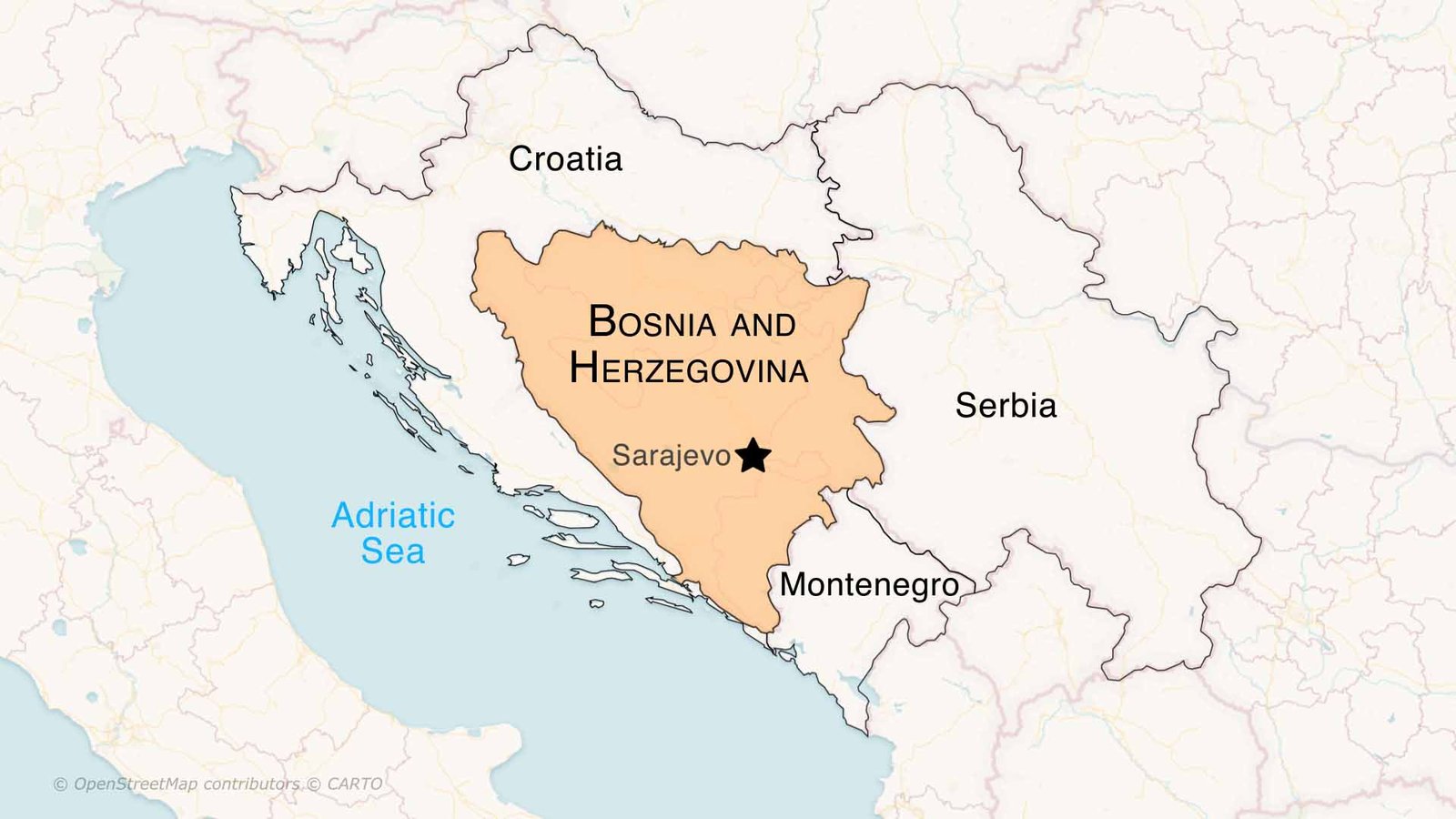
Bosnia and Herzegovina is located in Southeastern Europe, in the western part of the Balkan Peninsula. It is bordered by Croatia to the north, west, and southwest, Serbia to the east, and Montenegro to the southeast. It has a small stretch of coastline along the Adriatic Sea in the south.
Bosnia and Herzegovina Facts
- OFFICIAL NAME: Bosnia and Herzegovina
- CAPITAL: Sarajevo
- POPULATION: 3,114,242 (2026)
- AREA: 51,197 square kilometers
- OFFICIAL LANGUAGES: Bosnian, Croatian, Serbian
- CURRENCY: Bosnia and Herzegovina Convertible Mark (BAM)
Bosnia and Herzegovina Flag
The flag of Bosnia and Herzegovina features a blue background with a yellow right triangle positioned along the top edge, and a diagonal row of white stars running from the upper right to the lower left alongside the triangle’s diagonal edge. The blue and yellow colors are associated with the European Union, reflecting the country’s aspirations for European integration. The stars, partially cut off at both ends of the diagonal line, are derived from the EU flag’s circle of stars and represent continuity and the ongoing journey of the nation. The triangle itself symbolizes the three main constituent peoples of Bosnia and Herzegovina — Bosniaks, Croats, and Serbs.
Bosnia and Herzegovina Geography
- Located in Southeastern Europe, on the western part of the Balkan Peninsula.
- Borders: Croatia to the north, west, and southwest, Serbia to the east, Montenegro to the southeast.
- Bosnia and Herzegovina has a very short coastline of approximately 20 kilometers along the Adriatic Sea near the town of Neum.
- The terrain is largely mountainous, with the Dinaric Alps covering much of the country.
- The highest peak, Maglić, rises to 2,386 meters on the border with Montenegro.
- The northern region, known as Posavina, consists of flat and fertile lowlands along the Sava River.
- The country has a varied climate — continental in the north and Mediterranean influences along the brief southern coastline.
- Major rivers include the Sava, Drina, and Neretva, which flows through a dramatic limestone canyon before reaching the Adriatic.
- The Neretva River valley is known for its emerald green waters and medieval stone bridges.
Bosnia and Herzegovina Government
- Bosnia and Herzegovina has a unique and complex governmental structure established by the Dayton Peace Agreement of 1995.
- The country is divided into two main political entities — the Federation of Bosnia and Herzegovina and Republika Srpska — along with the Brčko District.
- A rotating three-member Presidency represents the three constituent peoples — Bosniaks, Croats, and Serbs.
- The Council of Ministers serves as the national government, with a rotating Chair of the Council of Ministers.
- Bosnia and Herzegovina is a candidate country for membership in the European Union.
History of Bosnia and Herzegovina
- The region has been inhabited since the Neolithic period, with evidence of ancient Illyrian and later Roman settlement.
- Bosnia emerged as a distinct political entity in the medieval period, ruled by local bans and kings.
- The Ottoman Empire conquered Bosnia in 1463 and ruled the region for over 400 years, during which much of the population converted to Islam.
- Following Ottoman decline, Austria-Hungary occupied Bosnia and Herzegovina in 1878 and formally annexed it in 1908.
- The assassination of Archduke Franz Ferdinand of Austria in Sarajevo in 1914 triggered a chain of events that led to the outbreak of World War I.
- After World War I, Bosnia and Herzegovina became part of the Kingdom of Yugoslavia.
- Following World War II, it became one of the six republics of communist Yugoslavia under Marshal Tito.
- Following the dissolution of Yugoslavia, Bosnia and Herzegovina declared independence in 1992.
- A devastating war from 1992 to 1995 resulted in massive loss of life and displacement, including the Srebrenica massacre.
- The Dayton Peace Agreement of 1995 ended the war and established the country’s current political structure.
People and Culture of Bosnia and Herzegovina
- The three main ethnic groups are Bosniaks, Serbs, and Croats, each with distinct cultural and religious traditions.
- Bosniaks are predominantly Muslim, Serbs are predominantly Eastern Orthodox, and Croats are predominantly Roman Catholic.
- Bosnian, Croatian, and Serbian are all recognized as official languages, though they are mutually intelligible.
- Ćevapi, small grilled minced meat sausages served with flatbread, is considered the national dish of Bosnia and Herzegovina.
- Sarajevo, the capital, is known for its unique blend of Ottoman, Austro-Hungarian, and Yugoslav architectural heritage.
- Coffee culture, particularly Bosnian coffee served in a traditional džezva pot, is central to daily social life.
- The medieval Stećci tombstones, found across the country, are recognized as UNESCO World Heritage Sites.
Economy of Bosnia and Herzegovina
- Bosnia and Herzegovina has a developing economy, with industry, services, and agriculture as the main sectors.
- Manufacturing, including metals, textiles, and wood products, plays an important role in the economy.
- Agriculture includes the production of fruits, vegetables, and livestock, particularly in rural areas.
- Tourism has grown in recent years, with visitors drawn to Sarajevo’s history, the old city of Mostar, and mountain landscapes.
- The country faces challenges including high unemployment, particularly among young people, and significant emigration.
- Bosnia and Herzegovina receives support from international financial institutions as it works toward EU integration.
Bosnia and Herzegovina Resources
- Bosnia and Herzegovina has significant deposits of coal, iron ore, bauxite, and manganese.
- The country has notable hydropower potential due to its many rivers and mountainous terrain.
- Forests cover a substantial portion of the country and support a timber and wood processing industry.
- Agricultural land in the northern lowlands supports crop and livestock production.
- The country’s natural landscapes and historical sites serve as important resources for the growing tourism sector.
Bosnia and Herzegovina Wildlife
- Bosnia and Herzegovina’s mountains and forests support a rich diversity of wildlife.
- Brown bears, wolves, and lynx inhabit the remote forested and mountainous regions of the country.
- The Balkan lynx, one of the rarest cats in Europe, is found in small numbers in the country’s dense forests.
- The Neretva River and its tributaries are home to the Huchen, a large and rare river fish found only in select European rivers.
- Griffon vultures and golden eagles soar over the limestone cliffs and canyon landscapes.
- The country has several nature parks and protected areas dedicated to preserving its alpine and forest ecosystems.
- Conservation efforts focus on protecting large carnivores such as the brown bear and lynx amid increasing human activity.