Botswana Country Profile
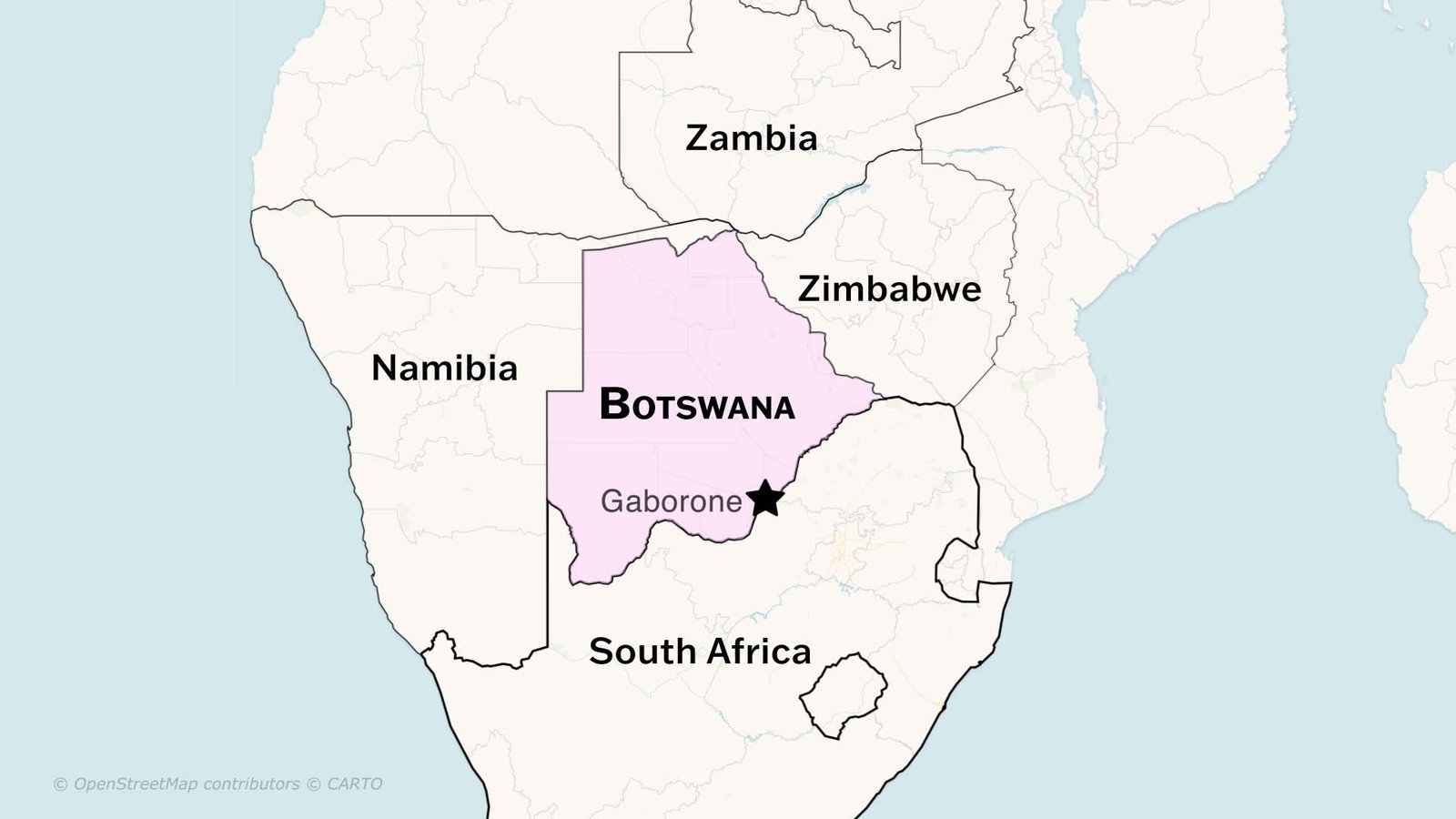
Botswana is located in Southern Africa, a landlocked country bordered by Zambia to the north, Zimbabwe to the northeast, South Africa to the south and southeast, and Namibia to the west and north.
Botswana Facts
- OFFICIAL NAME: Republic of Botswana
- CAPITAL: Gaborone
- POPULATION: 2,603,388 (2026)
- AREA: 581,730 square kilometers
- OFFICIAL LANGUAGES: English, Setswana
- CURRENCY: Botswana Pula (BWP)
Botswana Flag
The flag of Botswana has a light blue background with a horizontal black stripe bordered on both sides by thin white stripes running across the center. The blue represents water, particularly rain, which is an essential and precious resource in the largely arid country — the national motto “Pula” means “rain” in Setswana, reflecting its cultural significance. The black and white stripes represent the racial harmony between the country’s different communities and also symbolize the zebra, Botswana’s national animal.
Botswana Geography
- Located in Southern Africa, completely landlocked with no access to the sea.
- Borders: Zambia to the north, Zimbabwe to the northeast, South Africa to the south and southeast, Namibia to the west and north.
- Botswana is one of the largest landlocked countries in Africa by land area.
- The Kalahari Desert covers approximately 70% of the country, though it is not a true desert and supports significant plant and animal life.
- The Okavango Delta, located in the northwest, is one of the world’s largest inland river deltas and a UNESCO World Heritage Site.
- The Makgadikgadi Pans, vast salt flats in the northeast, are among the largest in the world.
- Botswana has a semi-arid climate, with hot summers, mild winters, and limited annual rainfall.
- The country is one of the most sparsely populated nations in the world, with vast areas of uninhabited land.
- Most of the population is concentrated in the eastern part of the country, where rainfall is slightly higher.
Botswana Government
- Botswana is a presidential republic and a multi-party democracy.
- The President serves as both head of state and head of government.
- Botswana has a unicameral parliament called the National Assembly.
- Since gaining independence, Botswana has maintained one of the most stable democratic governments in Africa.
- The Botswana Democratic Party has dominated politics since independence, though opposition parties have grown in recent elections.
History of Botswana
- The region has been inhabited for thousands of years, with the San people among the earliest known inhabitants of the area.
- Bantu-speaking Tswana people migrated into the region from the north several centuries ago.
- In the 19th century, the territory faced increasing pressure from neighboring settler communities in South Africa.
- Local chiefs sought British protection, and the territory became the British Bechuanaland Protectorate in 1885.
- Unlike many neighboring territories, the protectorate was not incorporated into South Africa, preserving it as a separate entity.
- Botswana gained independence from the United Kingdom on September 30, 1966.
- At independence, Botswana was one of the poorest countries in the world with very limited infrastructure.
- The discovery of diamonds in 1967 transformed the country’s economic fortunes dramatically.
- Botswana has since become one of Africa’s most prosperous and stable nations, widely regarded as a model of democratic governance and economic development on the continent.
People and Culture of Botswana
- The Tswana people, also known as Batswana, make up the majority of the population.
- The San, also known as Bushmen, are among the oldest indigenous peoples of southern Africa and have lived in the Kalahari region for tens of thousands of years.
- English and Setswana are the official languages, with Setswana spoken by the vast majority of the population.
- Christianity is the predominant religion, practiced alongside traditional beliefs.
- Seswaa, a slow-cooked shredded beef or goat dish, is considered the national food of Botswana.
- Dikgosi, or traditional chiefs, continue to play an important role in local governance and cultural life.
- Music, dance, and storytelling are central parts of Batswana cultural traditions.
Economy of Botswana
- Botswana has one of the most successful economies in sub-Saharan Africa, driven primarily by diamond mining.
- The country is one of the world’s largest producers of diamonds by value, with major mines operated in partnership with De Beers.
- Diamond revenues have been used to fund significant investment in education, healthcare, and infrastructure.
- Tourism is a growing sector, with visitors attracted to the Okavango Delta, Chobe National Park, and the Kalahari Desert.
- The government has been working to diversify the economy beyond diamonds through investment in finance, tourism, and technology.
- Botswana maintains one of the highest GDP per capita figures in sub-Saharan Africa.
Botswana Resources
- Botswana holds some of the world’s richest diamond deposits, making it one of the most valuable mineral economies in Africa.
- Copper, nickel, and coal are also found in significant quantities and contribute to mining exports.
- The Okavango River and Delta provide vital water resources in an otherwise arid region.
- Wildlife and natural landscapes are among Botswana’s most valuable resources, underpinning a high-value tourism industry.
- The Kalahari region, despite its arid nature, supports grazing land used for cattle farming.
Botswana Wildlife
- Botswana is home to some of the largest and most diverse wildlife populations in Africa.
- The country has one of the largest elephant populations in the world, concentrated particularly in Chobe National Park.
- The Okavango Delta supports an extraordinary range of wildlife, including lions, leopards, wild dogs, and hippos.
- The African wild dog, one of the continent’s most endangered predators, has one of its healthiest populations in Botswana.
- The Makgadikgadi Pans attract massive seasonal migrations of zebras and wildebeest.
- Botswana has committed to a high-value, low-volume approach to wildlife tourism, helping to preserve its ecosystems.
- The country has established extensive national parks and wildlife reserves covering a significant portion of its land area.