Brazil Country Profile
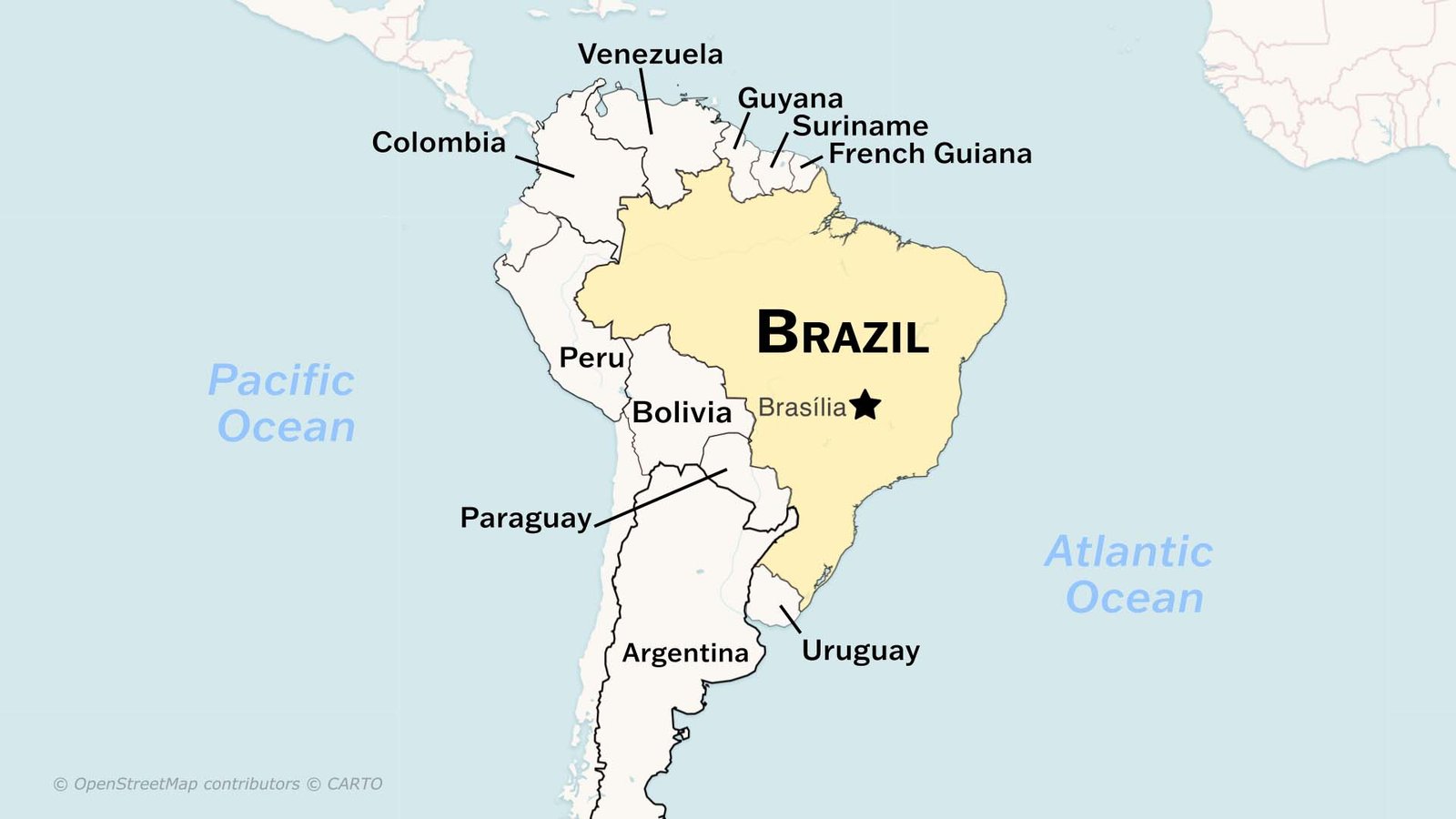
Brazil is located in South America, the largest country on the continent. It borders every South American country except Chile and Ecuador, sharing its borders with Venezuela, Guyana, Suriname, and French Guiana to the north, Colombia to the northwest, Peru and Bolivia to the west, Paraguay and Argentina to the southwest, and Uruguay to the south. To the east lies the Atlantic Ocean.
Brazil Facts
- OFFICIAL NAME: Federative Republic of Brazil
- CAPITAL: Brasília
- POPULATION: 213,562,666 (2026)
- AREA: 8,515,767 square kilometers
- OFFICIAL LANGUAGE: Portuguese
- CURRENCY: Brazilian Real (BRL)
Brazil Flag
The flag of Brazil has a green background representing the forests and natural wealth of the country, with a large yellow diamond shape in the center symbolizing Brazil’s gold and mineral resources. Inside the diamond sits a dark blue celestial globe depicting a starry sky, representing the night sky over Rio de Janeiro on November 15, 1889, the day Brazil became a republic. A white band crosses the globe diagonally with the national motto “Ordem e Progresso,” meaning “Order and Progress.” The 27 stars on the globe represent Brazil’s 26 states and the Federal District.
Brazil Geography
- Located in South America, the largest country on the continent and the fifth largest in the world.
- Borders every South American country except Chile and Ecuador.
- The Atlantic Ocean forms the entire eastern coastline, stretching approximately 7,500 kilometers.
- The Amazon River, the largest river by water flow in the world, runs through the northern part of the country.
- The Amazon Rainforest, the world’s largest tropical rainforest, covers much of northern and western Brazil.
- The Cerrado, a vast tropical savanna, covers much of central Brazil and is one of the world’s most biodiverse savannas.
- The Pantanal, located in western Brazil, is the world’s largest tropical wetland.
- The terrain ranges from dense tropical rainforest in the north to fertile agricultural plains in the south.
- Brazil has a varied climate, including tropical, semi-arid, and subtropical conditions across its vast territory.
- The country is home to approximately 12% of the world’s fresh water supply.
Brazil Government
- Brazil is a federal presidential republic.
- The President serves as both head of state and head of government.
- Brazil is made up of 26 states and one Federal District, where the capital Brasília is located.
- The National Congress is bicameral, consisting of the Federal Senate and the Chamber of Deputies.
- Brazil returned to democratic governance in 1985 after over two decades of military rule.
History of Brazil
- Indigenous peoples have inhabited Brazil for at least 10,000 years before European contact.
- Portuguese explorer Pedro Álvares Cabral arrived in Brazil in 1500, claiming the land for Portugal.
- Brazil became a major center of the transatlantic slave trade under Portuguese colonial rule, with millions of Africans brought to work on sugar and later coffee plantations.
- Brazil declared independence from Portugal on September 7, 1822, becoming an empire under Dom Pedro I.
- Brazil abolished slavery in 1888, the last country in the Americas to do so.
- Brazil became a republic in 1889 following a military coup that ended the imperial period.
- The 20th century saw periods of significant economic development alongside political instability and military rule.
- A military dictatorship governed Brazil from 1964 to 1985.
- Brazil adopted a new democratic constitution in 1988 and has since maintained democratic governance, becoming one of the largest democracies in the world.
People and Culture of Brazil
- Brazil has one of the most diverse populations in the world, with people of Indigenous, African, European, and Asian descent.
- Portuguese is the official language and Brazil is the largest Portuguese-speaking country in the world.
- Roman Catholicism is the largest religion, though Evangelical Christianity has grown significantly in recent decades.
- Feijoada, a hearty stew of black beans and pork, is considered the national dish of Brazil.
- Carnival, celebrated in the days before Lent, is the world’s largest festival and a central expression of Brazilian culture.
- Football is the most popular sport and Brazil has won the FIFA World Cup a record five times.
- Samba and bossa nova music originated in Brazil and have had a significant influence on global music culture.
Economy of Brazil
- Brazil has the largest economy in Latin America and one of the largest in the world.
- Agriculture is a major pillar, with Brazil being the world’s largest exporter of soybeans, coffee, sugar, and beef.
- The industrial sector includes manufacturing of aircraft, automobiles, and steel.
- Brazil has significant oil reserves, particularly offshore in the pre-salt layer discovered in the late 2000s.
- Tourism attracts millions of visitors annually, drawn to the Amazon, Iguazu Falls, and Rio de Janeiro.
- Brazil faces significant challenges related to income inequality, deforestation, and economic instability.
Brazil Resources
- Brazil possesses some of the world’s largest reserves of iron ore, gold, and bauxite.
- The country has significant offshore oil and gas reserves, particularly in the pre-salt fields off the southeastern coast.
- The Amazon River system provides enormous hydropower potential, with several large dams generating significant electricity.
- Vast agricultural land supports Brazil’s position as one of the world’s leading food exporters.
- The Amazon Rainforest represents an extraordinary biological resource, containing a significant share of the world’s plant and animal species.
Brazil Wildlife
- Brazil is the most biodiverse country on Earth, home to more species of plants, freshwater fish, and mammals than any other nation.
- The Amazon Rainforest supports jaguars, anacondas, river dolphins, and thousands of bird and insect species.
- The Pantanal wetlands are home to the world’s largest concentration of jaguars and support giant otters, capybaras, and caimans.
- The hyacinth macaw, the world’s largest parrot, is native to Brazil and found primarily in the Pantanal and Cerrado regions.
- The golden lion tamarin, a critically endangered small monkey, is native to the Atlantic Forest region of Brazil.
- Deforestation, particularly in the Amazon, poses the greatest threat to Brazil’s extraordinary biodiversity.
- Brazil has established numerous national parks and reserves, though conservation remains a significant ongoing challenge.