Burkina Faso Country Profile
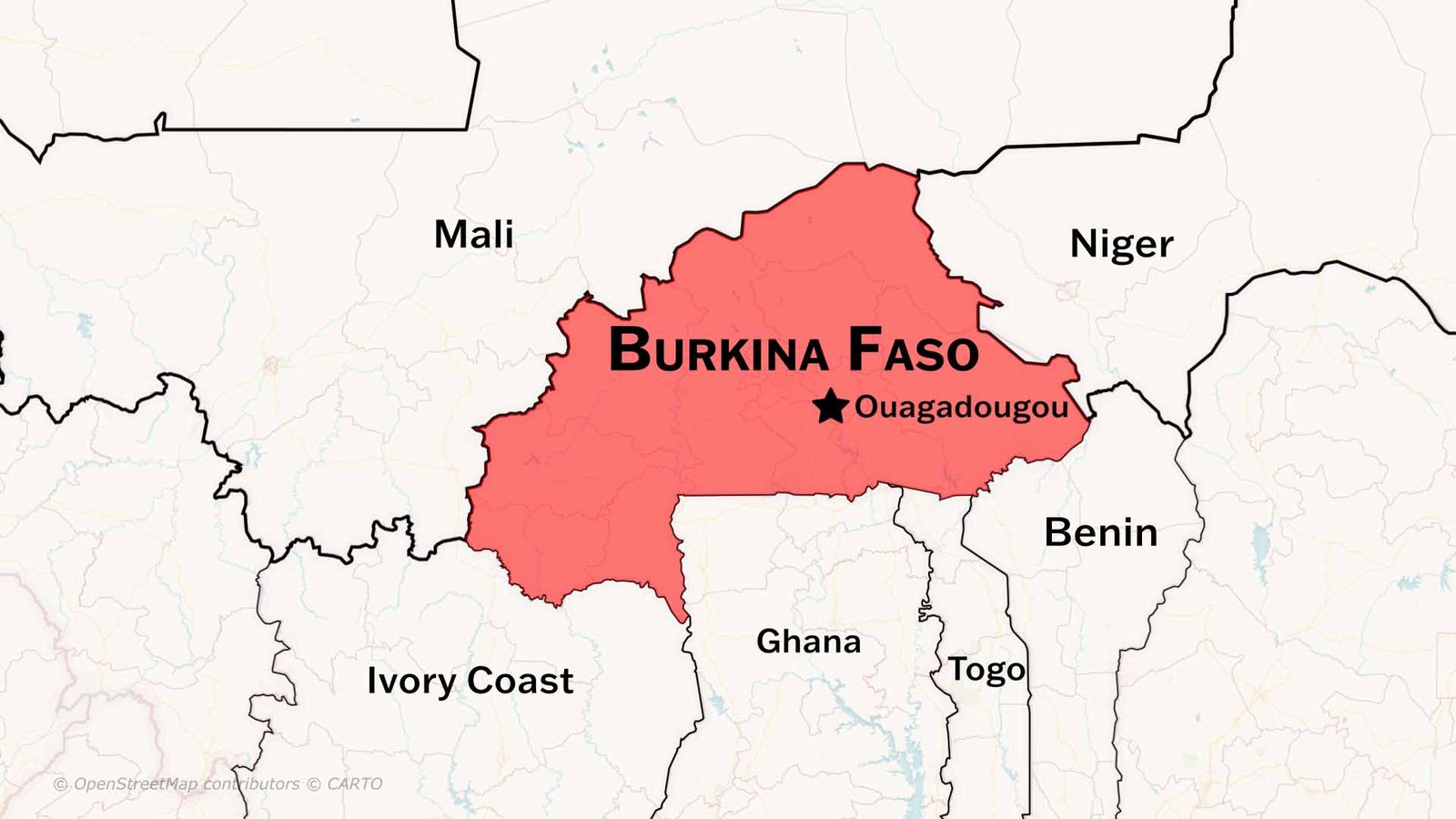
Burkina Faso is located in West Africa, a landlocked country bordered by Mali to the north and west, Niger to the east, Benin to the southeast, Togo and Ghana to the south, and Côte d’Ivoire to the southwest.
Burkina Faso Facts
- OFFICIAL NAME: Burkina Faso
- CAPITAL: Ouagadougou
- POPULATION: 24,601,700 (2026)
- AREA: 274,222 square kilometers
- OFFICIAL LANGUAGE: French
- CURRENCY: West African CFA Franc (XOF)
Burkina Faso Flag
The flag of Burkina Faso has two equal horizontal stripes — red on top and green on the bottom — with a yellow five-pointed star in the center. The red represents the revolution and the blood of those who fought for independence, while the green symbolizes the country’s agricultural wealth and natural resources. The yellow star represents the guiding light of the revolution and the country’s mineral wealth. The flag was adopted in 1984 when the country was renamed from Upper Volta to Burkina Faso, reflecting the revolutionary ideals of the government at the time.
Burkina Faso Geography
- Located in West Africa, completely landlocked with no access to the sea.
- Borders: Mali to the north and west, Niger to the east, Benin to the southeast, Togo and Ghana to the south, Côte d’Ivoire to the southwest.
- The terrain is mostly flat to gently rolling savanna and plains.
- The country lies in the Sahel region, a transition zone between the Sahara Desert to the north and wetter tropical regions to the south.
- The three main rivers — the Black Volta, White Volta, and Red Volta — flow southward into Ghana and give the country its former name, Upper Volta.
- The northern regions are increasingly arid and prone to desertification.
- Burkina Faso experiences a tropical climate with a distinct rainy season from June to October and a long dry season.
- The harmattan, a dry and dusty wind blowing from the Sahara, affects the country significantly during the dry season.
- The country is highly vulnerable to drought, which frequently affects agricultural production.
Burkina Faso Government
- Burkina Faso is currently governed by a military transitional government following a coup in 2022.
- The country experienced two military coups in 2022, first in January and again in September.
- Captain Ibrahim Traoré assumed power in September 2022 and serves as head of state.
- The military government has suspended the constitution and dissolved the National Assembly.
- Burkina Faso has a long history of political instability, including multiple coups since independence in 1960.
History of Burkina Faso
- The region was historically home to the Mossi kingdoms, which were powerful political entities dating back to the 11th century.
- The Mossi kingdoms successfully resisted the Mali and Songhai Empires and maintained their independence for centuries.
- France colonized the territory in the late 19th century, naming it Upper Volta.
- Upper Volta gained independence from France on August 5, 1960.
- The country experienced several military coups in its early decades as an independent nation.
- In 1983, revolutionary leader Thomas Sankara came to power and renamed the country Burkina Faso, meaning “Land of Incorruptible People” in Moore and Dioula languages.
- Sankara implemented radical social and economic reforms before being assassinated in a coup in 1987.
- The country returned to civilian democratic governance in the 1990s but has continued to experience political instability.
- A jihadist insurgency linked to groups in the wider Sahel region has destabilized much of the country since the mid-2010s, leading to significant displacement and humanitarian crisis.
People and Culture of Burkina Faso
- The Mossi are the largest ethnic group, making up over half of the population, alongside the Fulani, Lobi, Bobo, and Mande peoples.
- French is the official language, though Moore, Dioula, and dozens of other local languages are widely spoken.
- Islam is the largest religion, followed by Christianity and traditional indigenous beliefs, which often coexist and overlap.
- To, a thick porridge made from millet or sorghum, is a staple food served with sauces made from vegetables, meat, or peanuts.
- Burkina Faso is internationally known for its rich traditions in mask-making, weaving, and music.
- The country hosts the Pan-African Film and Television Festival of Ouagadougou (FESPACO), the largest film festival in Africa.
- Griots, traditional oral historians and musicians, play an important role in preserving cultural heritage and history.
Economy of Burkina Faso
- Burkina Faso is one of the poorest countries in the world, with its economy largely dependent on agriculture and gold mining.
- Cotton is the primary agricultural export, and the country is one of Africa’s largest cotton producers.
- Gold mining has grown significantly and is now the country’s largest source of export revenue.
- The majority of the population is engaged in subsistence farming, growing millet, sorghum, and maize.
- Remittances from Burkinabé workers abroad contribute meaningfully to household incomes.
- The ongoing security crisis in the Sahel has severely disrupted economic activity and access to markets in many regions.
Burkina Faso Resources
- Gold is the country’s most important mineral resource, with Burkina Faso being one of West Africa’s top gold producers.
- Manganese deposits in the north represent a significant but underdeveloped mineral resource.
- The country also has deposits of zinc, limestone, and phosphates.
- The Volta River system provides water resources for agriculture and some hydropower generation.
- Cotton-producing agricultural land in the southern and central regions is one of the country’s key economic assets.
Burkina Faso Wildlife
- Burkina Faso’s savanna and Sahel landscapes support a variety of wildlife, concentrated largely in protected areas.
- The W National Park, shared with Niger and Benin and recognized as a UNESCO World Heritage Site, protects elephants, lions, leopards, and hippos.
- The Arli National Park and Arly-Singou ecosystem in the southeast are among the most important wildlife areas in the country.
- African elephants, West African lions, and various antelope species inhabit the country’s national parks.
- Crocodiles are found in rivers and pools and hold cultural significance in some communities, where they are considered sacred.
- Increasing desertification and the ongoing security crisis pose significant threats to wildlife habitats and conservation efforts across the country.