Cabo Verde Country Profile
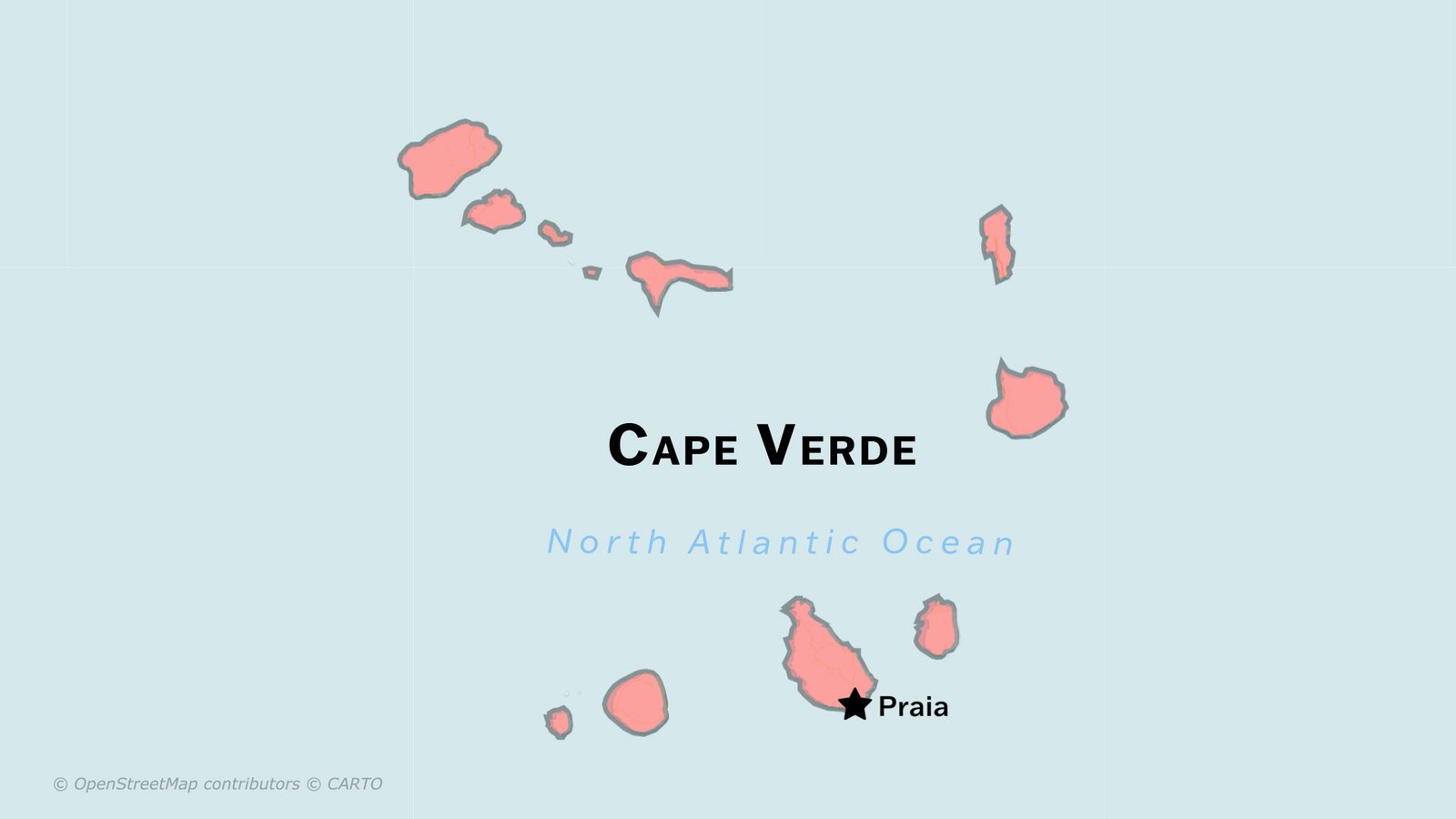
Cabo Verde is located in the Atlantic Ocean off the northwest coast of Africa. It is an island nation made up of ten volcanic islands situated approximately 570 kilometers west of the African mainland near Senegal and Mauritania, with no land borders.
Cabo Verde Facts
- OFFICIAL NAME: Republic of Cabo Verde
- CAPITAL: Praia
- POPULATION: 529,630 (2026)
- AREA: 4,033 square kilometers
- OFFICIAL LANGUAGE: Portuguese
- CURRENCY: Cape Verdean Escudo (CVE)
Cabo Verde Flag
The flag of Cabo Verde has a blue background with a horizontal white and red striped band positioned in the lower half. On the left side, a circle of ten yellow five-pointed stars is placed across the striped band, with the stars arranged in a ring representing the ten main islands of the archipelago. The blue represents the Atlantic Ocean surrounding the islands and the sky above. The white symbolizes peace and the red stripe represents the effort and resolve of the people. The ten stars stand for each of the inhabited islands that make up the nation.
Cabo Verde Geography
- Located in the Atlantic Ocean, approximately 570 kilometers west of the West African coast.
- An archipelago of ten volcanic islands and several smaller islets, with no land borders.
- The islands are divided into two main groups — the Barlavento or Windward Islands to the north and the Sotavento or Leeward Islands to the south.
- Santiago is the largest island and home to the capital, Praia.
- The terrain is mostly volcanic and mountainous, with the highest peak, Pico do Fogo, rising to 2,829 meters on the island of Fogo.
- Fogo is an active volcano and has erupted several times in recent history.
- The climate is warm and dry, influenced by trade winds and the Saharan harmattan.
- Cabo Verde receives very little rainfall, making fresh water a scarce and precious resource.
- The islands experience periodic droughts, which have historically caused famines.
- Sal and Boa Vista are the flattest and driest islands, known for their sandy beaches and salt flats.
Cabo Verde Government
- Cabo Verde is a parliamentary republic.
- The President serves as head of state with largely ceremonial duties.
- The Prime Minister serves as head of government, holding executive authority.
- Cabo Verde has a unicameral parliament known as the National Assembly.
- Since independence in 1975, Cabo Verde has developed into one of the most stable and democratic countries in Africa.
- Cabo Verde is frequently cited as a model of good governance and political stability on the continent.
History of Cabo Verde
- The islands were uninhabited when Portuguese explorers arrived in 1456, discovering them as part of their Atlantic exploration.
- Portugal established the first permanent European settlement in sub-Saharan Africa on the island of Santiago in 1462.
- Cabo Verde became a major hub of the transatlantic slave trade due to its strategic location between Africa, Europe, and the Americas.
- The islands suffered repeated famines throughout the colonial period due to droughts and neglect.
- Cabo Verde gained independence from Portugal on July 5, 1975.
- The country was initially governed as a one-party state but transitioned peacefully to multi-party democracy in 1991.
- Since democratization, Cabo Verde has maintained consistent political stability and economic development.
People and Culture of Cabo Verde
- The population is predominantly of mixed African and Portuguese descent, known as Creole or Mestiço, reflecting the islands’ history as a meeting point of cultures.
- Portuguese is the official language, while Cabo Verdean Creole, known as Kriolu, is widely spoken in daily life.
- Roman Catholicism is the predominant religion, reflecting centuries of Portuguese influence.
- Cachupa, a slow-cooked stew of hominy, beans, vegetables, and meat or fish, is the national dish of Cabo Verde.
- Morna, a melancholic and soulful music genre, is the most celebrated cultural export of Cabo Verde, made internationally famous by singer Cesária Évora, and recognized by UNESCO as intangible cultural heritage.
- Cabo Verde has a large and influential diaspora, with more Cabo Verdeans living abroad than on the islands themselves, particularly in the United States, Portugal, and Senegal.
Economy of Cabo Verde
- Cabo Verde has a service-based economy, with tourism and remittances from the diaspora being the most important sources of income.
- Tourism has grown significantly, particularly on the islands of Sal and Boa Vista, attracting visitors with beaches and water sports.
- Remittances from Cabo Verdeans living abroad play a crucial role in supporting household incomes and the broader economy.
- The country has limited agricultural potential due to its arid climate and volcanic terrain.
- Fishing is an important industry, with the surrounding waters rich in tuna and other marine species.
- Cabo Verde has invested in renewable energy, particularly wind and solar power, to reduce dependence on imported fuel.
Cabo Verde Resources
- Cabo Verde has limited natural resources due to its small size and arid climate.
- The surrounding Atlantic waters provide significant fishing resources, including tuna, lobster, and various reef fish.
- Salt has historically been an important resource, particularly from the island of Sal, whose name means salt in Portuguese.
- Wind and solar energy potential is significant given the islands’ trade wind exposure and sunny climate.
- The volcanic landscapes and beaches serve as important resources for the growing tourism industry.
Cabo Verde Wildlife
- Cabo Verde’s isolation in the Atlantic has led to the development of several unique endemic species found nowhere else on Earth.
- The Cabo Verde giant gecko and several endemic bird species are among the most notable native fauna.
- The loggerhead sea turtle nests in large numbers on the beaches of Cabo Verde, which hosts one of the largest nesting populations in the world.
- The waters around the islands are rich in marine life, including dolphins, humpback whales, and various shark species.
- The Raso lark, found only on the tiny island of Raso, is one of the rarest birds in the world.
- Conservation efforts focus on protecting sea turtle nesting sites and preserving endemic species from habitat loss and invasive predators.