Central African Republic Country Profile
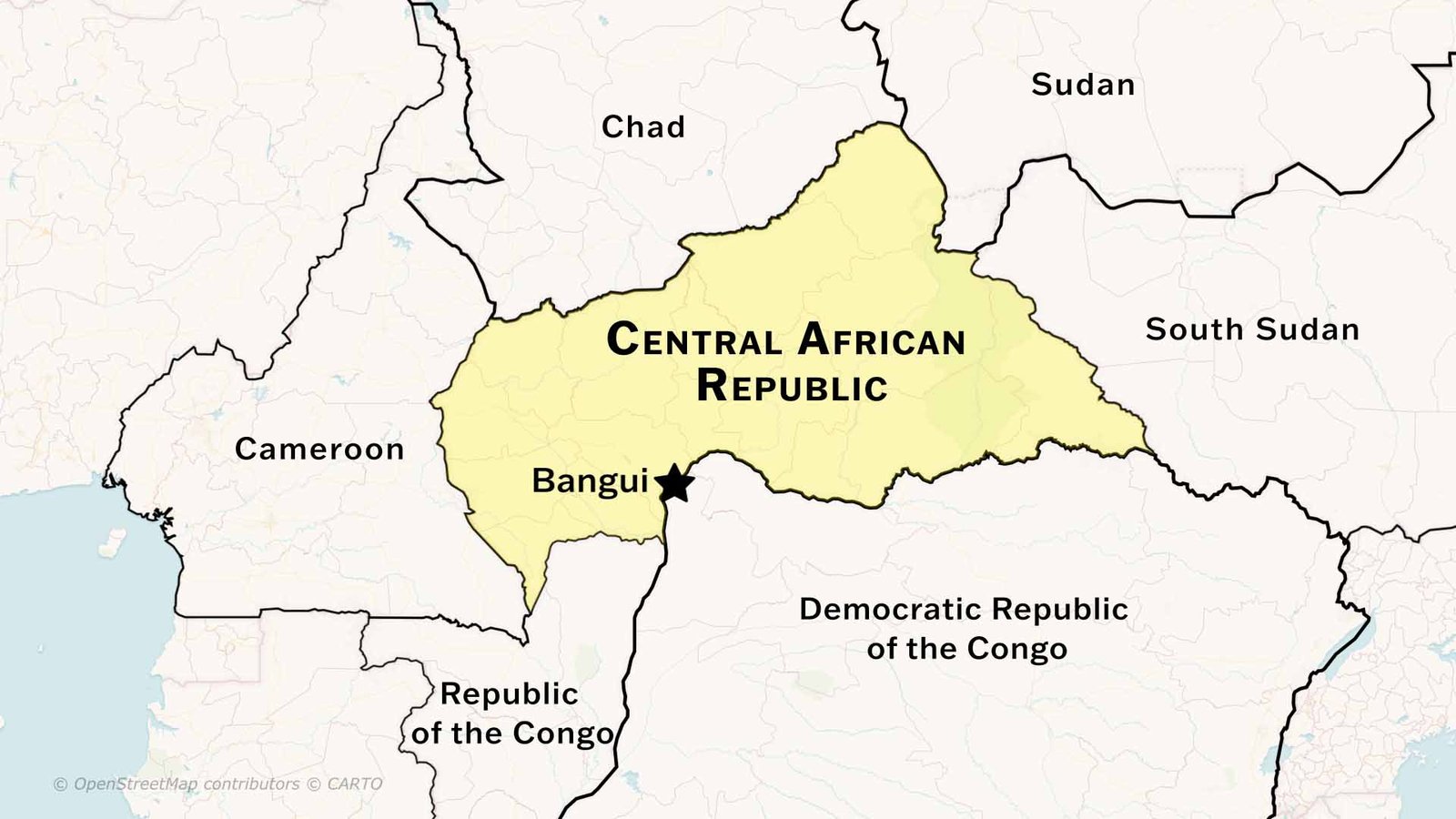
The Central African Republic is located in the heart of Africa, a landlocked country bordered by Chad to the north, Sudan and South Sudan to the east, the Democratic Republic of the Congo and the Republic of the Congo to the south, and Cameroon to the west.
Central African Republic Facts
- OFFICIAL NAME: Central African Republic
- CAPITAL: Bangui
- POPULATION: 5,698,984 (2026)
- AREA: 622,984 square kilometers
- OFFICIAL LANGUAGES: French, Sango
- CURRENCY: Central African CFA Franc (XAF)
Central African Republic Flag
The flag of the Central African Republic has four equal horizontal stripes — blue on top, then white, then green, then yellow — with a vertical red stripe running through the center across all four bands. A single yellow five-pointed star sits in the upper left corner of the blue stripe. The blue represents the sky and freedom, the white symbolizes peace and dignity, the green represents the forests and hope, and the yellow represents tolerance and the country’s savanna landscapes. The red vertical stripe represents the blood shed by the people in their struggle for independence and unity, and is also said to represent the blood that unites all four horizontal stripes and all peoples of the nation.
Central African Republic Geography
- Located in the heart of the African continent, completely landlocked with no access to the sea.
- Borders: Chad to the north, Sudan and South Sudan to the east, Democratic Republic of the Congo and Republic of the Congo to the south, Cameroon to the west.
- The terrain consists largely of a flat to rolling plateau, averaging around 600 meters in elevation.
- The southwest contains dense tropical rainforest, while the north transitions to savanna and semi-arid Sahel conditions.
- The Ubangi River forms the southern border with the Democratic Republic of the Congo.
- The Sangha River in the southwest flows through one of the most biodiverse rainforest regions in Africa.
- The country has a tropical climate, with a wet season and a dry season varying by region.
- The northern region is more arid and prone to drought conditions.
- Much of the country remains sparsely populated, with vast areas of forest and savanna largely uninhabited.
Central African Republic Government
- The Central African Republic is a presidential republic.
- The President serves as both head of state and head of government.
- Faustin-Archange Touadéra has served as President since 2016 and was re-elected in 2020.
- The country has a unicameral National Assembly.
- The Central African Republic has experienced significant political instability, coups, and armed conflict since gaining independence.
- Russian Wagner Group mercenaries have played a significant role in supporting the government’s security operations in recent years.
History of the Central African Republic
- The region has been inhabited for thousands of years by various Bantu and other peoples.
- The area became part of French Equatorial Africa under colonial rule in the late 19th century.
- France named the territory Oubangui-Chari after its two major rivers.
- The Central African Republic gained independence from France on August 13, 1960.
- Jean-Bédel Bokassa seized power in a coup in 1966 and declared himself Emperor in 1977, renaming the country the Central African Empire.
- French forces helped oust Bokassa in 1979, restoring the republic.
- The country experienced further coups and political instability throughout the 1980s and 1990s.
- A devastating civil conflict beginning in 2013 caused massive displacement and a severe humanitarian crisis that continues to affect the country.
People and Culture of the Central African Republic
- The Baya and Banda are the two largest ethnic groups, together making up over half of the population.
- Other significant groups include the Mandjia, Sara, Mboum, and the Aka, a Pygmy people who inhabit the southwestern forests.
- French is the official language used in government and education, while Sango serves as the national lingua franca spoken across the country.
- Christianity is the predominant religion, with Islam also practiced, particularly in the north.
- Gozo, a dish made from cassava leaves cooked with palm oil and spices, is a staple of Central African cuisine.
- Traditional music, storytelling, and mask-making are important parts of cultural expression across the country’s many ethnic communities.
- The Aka people of the southwestern forests are known internationally for their polyphonic vocal music, recognized by UNESCO as intangible cultural heritage.
Economy of the Central African Republic
- The Central African Republic is one of the poorest and least developed countries in the world.
- The economy is largely subsistence-based, with agriculture employing the majority of the population.
- Diamond mining is the most significant formal export sector, though much of the trade occurs informally.
- Gold and timber are also important export commodities.
- Decades of political instability and armed conflict have severely damaged economic development and infrastructure.
- The country relies heavily on international humanitarian aid and foreign assistance to meet basic needs.
Central African Republic Resources
- The country has significant diamond deposits, making it one of Africa’s notable diamond producers.
- Gold deposits are found in various parts of the country and are mined on both artisanal and small commercial scales.
- Uranium deposits have been identified, representing a potentially significant but undeveloped resource.
- Vast tropical rainforests in the south provide timber resources, though illegal logging has been a concern.
- The Ubangi and Sangha rivers provide water and fishery resources for local communities.
Central African Republic Wildlife
- The Central African Republic’s forests and savannas support remarkable biodiversity, particularly in the southwest.
- The Dzanga-Sangha Special Reserve in the southwest is one of the most important forest elephant habitats in Africa.
- Western lowland gorillas and chimpanzees inhabit the dense rainforests of the south.
- The Dzanga Bai, a forest clearing in the southwest, attracts large numbers of forest elephants and is one of the best places in Africa to observe them.
- The northern savannas support lions, leopards, buffalo, and various antelope species in Manovo-Gounda St Floris National Park, a UNESCO World Heritage Site.
- The ongoing conflict and instability have severely impacted wildlife conservation and led to significant poaching pressures across the country.