Chad Country Profile
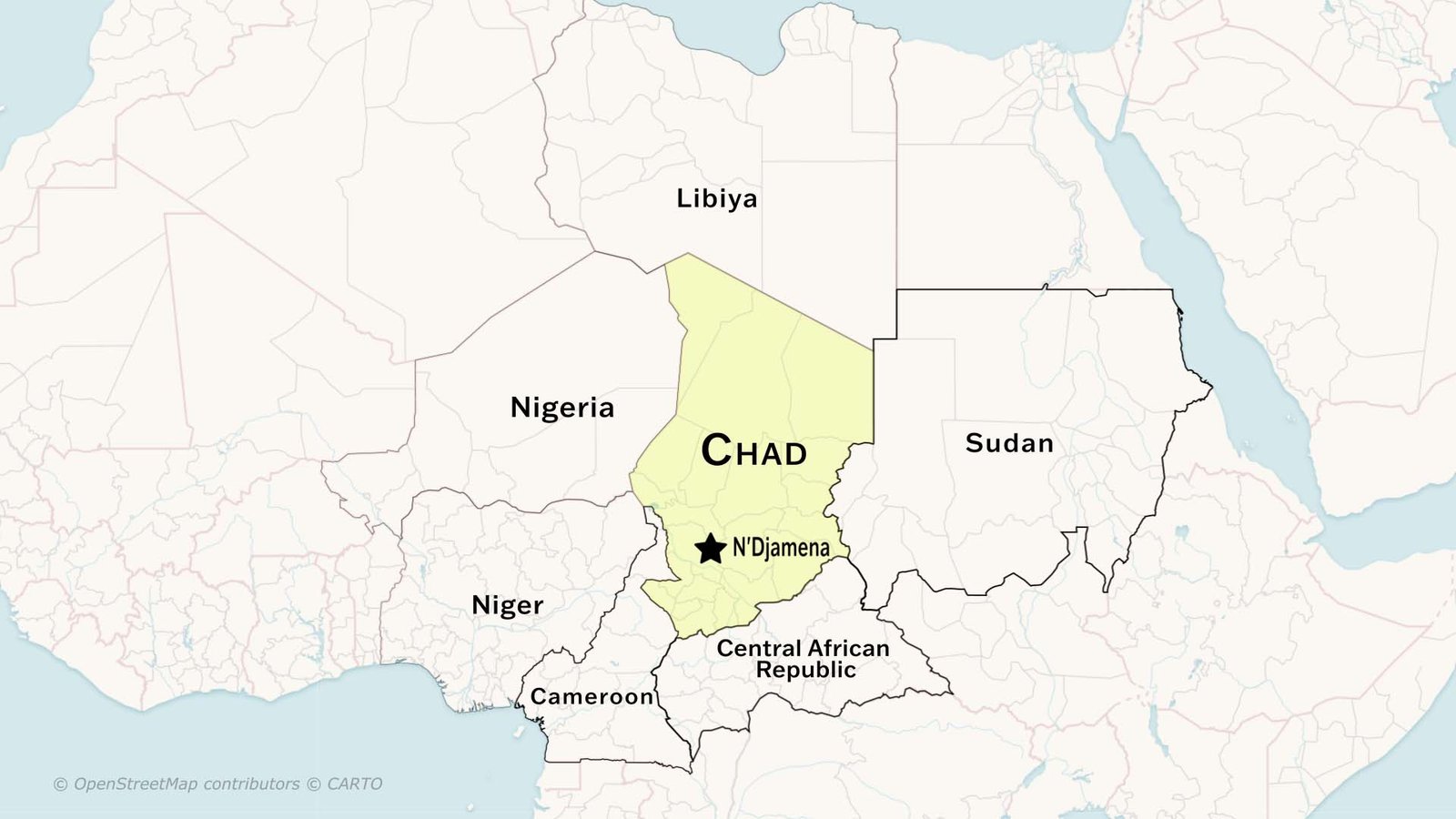
Chad is located in north-central Africa, a landlocked country bordered by Libya to the north, Sudan to the east, the Central African Republic to the south, Cameroon and Nigeria to the southwest, and Niger to the west.
Chad Facts
- OFFICIAL NAME: Republic of Chad
- CAPITAL: N’Djamena
- POPULATION: 21,560,380 (2026)
- AREA: 1,284,000 square kilometers
- OFFICIAL LANGUAGES: French, Arabic
- CURRENCY: Central African CFA Franc (XAF)
Chad Flag
The flag of Chad has three equal vertical stripes — blue on the left, yellow in the middle, and red on the right. The blue represents the sky, hope, and the waters of Lake Chad. The yellow symbolizes the sun and the Sahara Desert that covers much of the country. The red represents the blood shed in the struggle for independence and national unity. Interestingly, Chad’s flag is nearly identical to Romania’s flag, with only a very slight difference in the shade of blue. The flag was adopted in 1959, a year before independence from France.
Chad Geography
- Located in north-central Africa, completely landlocked with no access to the sea.
- Borders: Libya to the north, Sudan to the east, Central African Republic to the south, Cameroon and Nigeria to the southwest, Niger to the west.
- Chad is the fifth largest country in Africa by land area.
- The terrain is extremely diverse, ranging from the Sahara Desert in the north to tropical forests in the south.
- The Tibesti Mountains in the north contain the highest peak in the Sahara, Emi Koussi, rising to 3,415 meters.
- The central region consists of the Sahel, a semi-arid transition zone between the desert and the savanna.
- The southern region is the most fertile, receiving the most rainfall and supporting most of the agricultural population.
- Lake Chad, located in the west, is one of Africa’s largest lakes but has shrunk dramatically in recent decades due to climate change and human use.
- The Chari and Logone rivers flow through the south, forming part of the border with Cameroon.
Chad Government
- Chad is a presidential republic.
- The President serves as both head of state and head of government with extensive executive authority.
- Mahamat Idriss Déby has served as transitional President since 2021, following the death of his father, longtime President Idriss Déby, who was killed in a military skirmish.
- Chad has a bicameral parliament consisting of the National Assembly and the Senate.
- Chad has experienced significant political instability, coups, and armed conflict since independence.
- The country held a constitutional referendum in 2023 and held presidential elections in 2024, with Mahamat Idriss Déby winning.
History of Chad
- The Lake Chad basin has been inhabited since at least 7000 B.C. and was home to several significant ancient civilizations.
- The Kanem Empire, centered near Lake Chad, was one of the most powerful states in sub-Saharan Africa from the 9th century onward.
- The Kanem-Bornu Empire that followed remained a major regional power for nearly a thousand years.
- Arab traders and Islamic scholars brought Islam to the region beginning in the 11th century.
- France colonized the territory in the late 19th century, incorporating it into French Equatorial Africa.
- Chad gained independence from France on August 11, 1960.
- The country has experienced almost continuous civil conflict and political instability since independence, including a prolonged civil war and repeated coups.
- The discovery of oil in the early 2000s brought new economic potential but also new political tensions.
- Chad hosts one of the largest refugee populations in Africa, receiving displaced people from Sudan, the Central African Republic, and Nigeria.
People and Culture of Chad
- Chad has over 200 distinct ethnic and linguistic groups, making it one of the most ethnically diverse countries in Africa.
- The Sara of the south are the largest ethnic group, while Arabs form the second largest group in the central Sahel region.
- The Toubou are a nomadic people of the northern desert and Tibesti Mountains, known for their hardiness in extreme conditions.
- French and Arabic are the official languages, though over 120 local languages are spoken across the country.
- Islam is the predominant religion in the north and center, while Christianity and traditional beliefs are more common in the south.
- Daraba, a dish made from okra leaves cooked with various meats and served with a starchy base, is a staple food in many parts of Chad.
- Camel racing and traditional wrestling are popular cultural activities in the northern and central regions.
Economy of Chad
- Chad is one of the poorest countries in the world, with an economy dependent on oil exports and subsistence agriculture.
- Oil production began in 2003 and quickly became the country’s largest source of government revenue and foreign exchange.
- Agriculture employs the majority of the population, with subsistence farming of sorghum, millet, and peanuts in the south.
- Livestock herding is widely practiced across the Sahel and northern regions.
- Cotton is the most important cash crop in the south and a significant agricultural export.
- Chad faces severe development challenges including landlocked geography, recurring droughts, and ongoing conflict.
Chad Resources
- Chad has significant oil reserves, primarily located in the Doba Basin in the south.
- A pipeline linking Chad’s oil fields to the Cameroonian port of Kribi allows landlocked Chad to export its oil.
- Uranium deposits have been identified in the north, representing a potentially significant future resource.
- Lake Chad and the southern rivers provide freshwater fishery resources vital for local populations.
- The fertile soils of the south support cotton cultivation and subsistence agriculture.
- Natron, a mineral salt found near Lake Chad, has been harvested and traded for centuries.
Chad Wildlife
- Chad’s diverse landscapes, from the Sahara to the southern savannas, support a remarkable range of wildlife.
- Zakouma National Park in the southeast is one of Central Africa’s most important wildlife reserves, protecting elephants, lions, giraffes, and hippopotamuses.
- The park has seen a remarkable recovery of its elephant population following years of devastating poaching.
- Addax antelope and Dama gazelle, both critically endangered, inhabit the remote northern desert regions.
- Lake Chad and its surrounding wetlands support large populations of waterbirds and migratory species.
- The Saharan cheetah is found in extremely small numbers in the remote northern desert areas.
- Conservation efforts in Zakouma National Park have become an internationally recognized success story for African wildlife management.