Cyprus Country Profile
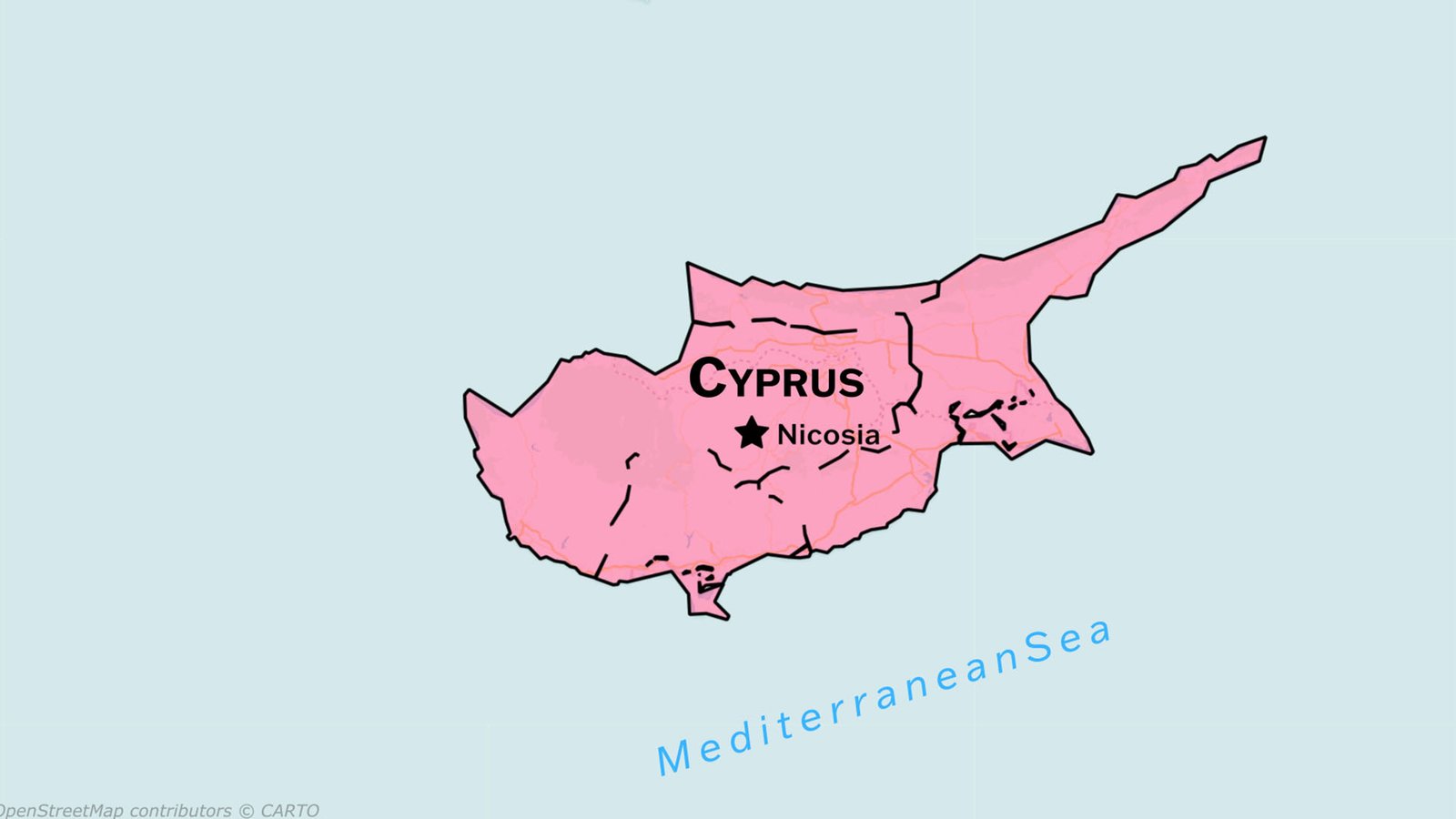
Cyprus is located in the eastern Mediterranean Sea, the third largest island in the Mediterranean. It lies south of Turkey, west of Syria and Lebanon, northwest of Israel, north of Egypt, and east of Greece. Cyprus has no land borders, surrounded entirely by the Mediterranean Sea.
Cyprus Facts
- OFFICIAL NAME: Republic of Cyprus
- CAPITAL: Nicosia
- POPULATION: 1,382,334 (2026)
- AREA: 9,251 square kilometers
- OFFICIAL LANGUAGES: Greek, Turkish
- CURRENCY: Euro (EUR)
Cyprus Flag
The flag of Cyprus has a white background with a copper-colored silhouette of the island of Cyprus in the center, below which are two crossed olive branches in green. The copper color of the island map reflects Cyprus’s name, which is believed to derive from the Greek word for copper, as the island was a major source of copper in ancient times. The olive branches symbolize peace between the Greek Cypriot and Turkish Cypriot communities. The white background also represents peace. The flag is one of the few national flags in the world to depict the map of the country it represents.
Cyprus Geography
- Located in the eastern Mediterranean Sea, the third largest island in the Mediterranean after Sicily and Sardinia.
- Lies south of Turkey, west of Syria and Lebanon, and north of Egypt.
- Cyprus has no land borders, surrounded entirely by the Mediterranean Sea.
- The terrain consists of two main mountain ranges — the Troodos Mountains in the center and west, and the Kyrenia Mountains along the northern coast.
- Mount Olympus in the Troodos range is the highest peak, rising to 1,952 meters.
- Between the two mountain ranges lies the fertile Mesaoria Plain, the agricultural heartland of the island.
- Cyprus has a Mediterranean climate with hot, dry summers and mild, wet winters.
- The island is prone to periodic droughts due to its semi-arid climate.
- Cyprus has no permanent rivers, with most watercourses flowing only during the rainy season.
- The island is divided between the internationally recognized Republic of Cyprus in the south and the Turkish-administered north.
Cyprus Government
- The Republic of Cyprus is a presidential republic.
- The President serves as both head of state and head of government.
- Cyprus has a unicameral House of Representatives as its legislature.
- Cyprus joined the European Union in 2004 and adopted the Euro in 2008.
- The northern part of the island has been administered by Turkey since 1974 as the Turkish Republic of Northern Cyprus, recognized only by Turkey.
- Nikos Christodoulides has served as President since 2023.
History of Cyprus
- Cyprus has one of the longest histories of human habitation in the Mediterranean, with settlements dating back over 10,000 years.
- The island was an important center of Bronze Age civilization and a major copper-producing hub in the ancient world.
- Cyprus came under the influence of various ancient powers, including the Assyrians, Egyptians, Persians, and Greeks.
- Alexander the Great incorporated Cyprus into his empire in 333 B.C.
- The island later became part of the Roman Empire and was an early center of Christianity, visited by the Apostle Paul.
- Cyprus was ruled by the Byzantine Empire, then the Crusaders, Venice, and the Ottoman Empire over subsequent centuries.
- Britain took control of Cyprus in 1878 and formally annexed it in 1914.
- Cyprus gained independence from Britain on August 16, 1960.
- Intercommunal violence between Greek Cypriots and Turkish Cypriots escalated in the years following independence.
- Turkey invaded and occupied the northern third of the island in 1974 following a coup backed by Greece, creating a division that persists to this day.
People and Culture of Cyprus
- Greek Cypriots make up the majority of the population in the south, while Turkish Cypriots predominantly inhabit the north.
- Greek and Turkish are both official languages, reflecting the island’s bicommunal heritage.
- Greek Orthodox Christianity is the predominant religion in the south, while Islam is practiced in the north.
- Souvla, large pieces of meat slow-roasted on a spit over charcoal, is considered the quintessential Cypriot dish and a centerpiece of social gatherings.
- Halloumi, a semi-hard cheese made from sheep and goat milk, is Cyprus’s most internationally recognized food export.
- Cypriot culture blends Greek, Turkish, and broader Mediterranean influences, reflecting the island’s long and diverse history.
- Traditional Cypriot lace-making, known as lefkaritika, is recognized by UNESCO as intangible cultural heritage.
Economy of Cyprus
- Cyprus has a service-based economy with tourism, financial services, and shipping as the main pillars.
- Tourism is the largest single industry, attracting millions of visitors annually to the island’s beaches, resorts, and historical sites.
- Cyprus developed as an international financial and business services center, though its banking sector faced a severe crisis in 2012 and 2013.
- The shipping industry is significant, with Cyprus being one of the largest ship management centers in the world.
- Agriculture produces citrus fruits, grapes, olives, and vegetables, with halloumi cheese being a notable export.
- Cyprus has been working to develop its energy sector following the discovery of significant offshore natural gas reserves in the eastern Mediterranean.
Cyprus Resources
- Cyprus has significant offshore natural gas reserves in its exclusive economic zone in the eastern Mediterranean, still being explored and developed.
- Copper deposits, historically the island’s most important resource, are now largely exhausted.
- The island’s beaches, archaeological sites, and Mediterranean climate are among its most valuable resources for tourism.
- Agricultural land in the Mesaoria Plain supports citrus, grape, and olive production.
- Solar energy potential is significant due to the island’s high sunshine hours throughout the year.
Cyprus Wildlife
- Cyprus’s Mediterranean landscape supports a variety of wildlife, including several endemic species unique to the island.
- The Cyprus mouflon, a wild sheep species, is the national animal of Cyprus and one of the rarest wild sheep in the world, found only in the Troodos Mountains.
- The Mediterranean monk seal, one of the world’s most endangered marine mammals, is occasionally sighted in the waters around Cyprus.
- Cyprus is an important stopover point for migratory birds traveling between Europe and Africa, with hundreds of species recorded on the island.
- The loggerhead sea turtle nests on the beaches of Cyprus, particularly along the southern and eastern coastlines.
- The Akamas Peninsula in the northwest is the most important protected natural area, supporting endemic flora and nesting sea turtles.
- Conservation efforts focus on protecting the Cyprus mouflon, sea turtle nesting sites, and the island’s remaining natural habitats.