El Salvador Country Profile
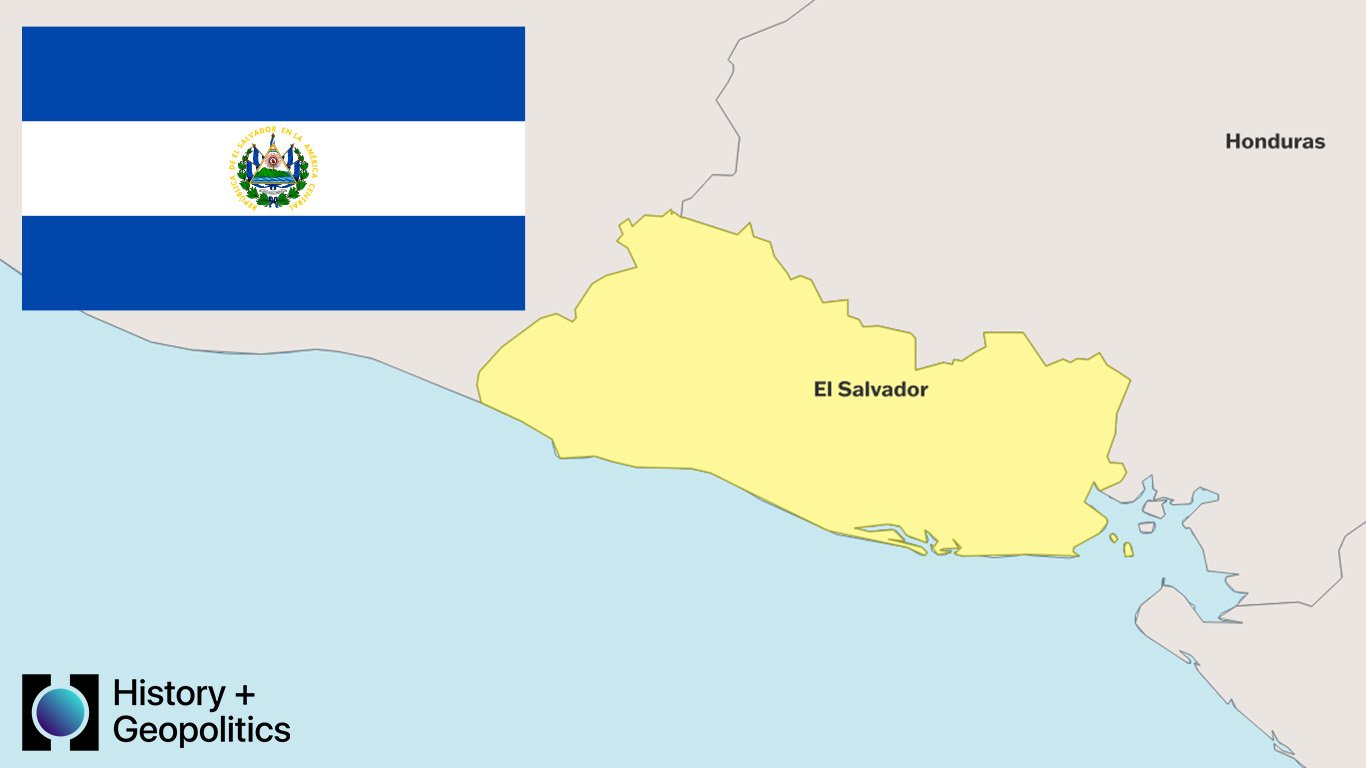
El Salvador is located in Central America, the smallest and most densely populated country on the mainland of the Americas. It is bordered by Guatemala to the northwest and Honduras to the north and east, with the Pacific Ocean forming its entire southern coastline.
El Salvador Facts
- OFFICIAL NAME: Republic of El Salvador
- CAPITAL: San Salvador
- POPULATION: 6,391,253 (2026)
- AREA: 21,041 square kilometers
- OFFICIAL LANGUAGE: Spanish
- CURRENCY: United States Dollar (USD)
El Salvador Flag
The flag of El Salvador has three equal horizontal stripes — blue on top, white in the middle, and blue on the bottom — with the national coat of arms centered on the white stripe. The blue stripes represent the Pacific Ocean and the Caribbean Sea bordering Central America, while the white represents peace. The coat of arms features a triangle containing five volcanoes rising from the sea, representing the five original nations of Central America, along with a rainbow, the Phrygian cap symbolizing liberty, and the motto “Dios, Union, Libertad,” meaning “God, Union, Liberty.” The flag’s design is shared with Honduras and Nicaragua, reflecting their common history as part of the Federal Republic of Central America.
El Salvador Geography
- Located in Central America, the smallest country on the American mainland and the only one without a Caribbean coastline.
- Borders: Guatemala to the northwest, Honduras to the north and east.
- The Pacific Ocean forms the entire southern coastline of the country.
- El Salvador is one of the most densely populated countries in the Americas.
- The terrain is mountainous, dominated by two parallel volcanic mountain ranges running east to west.
- The country has over 20 volcanoes, several of which are still active, including Santa Ana, the highest volcano, rising to 2,381 meters.
- A central plateau sits between the two mountain ranges and is the most densely populated region.
- The Lempa River is the longest and most important river in the country, flowing into the Pacific Ocean.
- El Salvador has a tropical climate with a distinct dry season from November to April and a rainy season from May to October.
- The country is located along the Pacific Ring of Fire and is prone to earthquakes and volcanic activity.
El Salvador Government
- El Salvador is a presidential republic.
- The President serves as both head of state and head of government.
- El Salvador has a unicameral Legislative Assembly.
- Nayib Bukele has served as President since 2019 and was re-elected in 2024, becoming one of the most prominent and controversial political figures in Latin America.
- El Salvador made international headlines in 2021 by becoming the first country in the world to adopt Bitcoin as legal tender alongside the US dollar.
- The Bukele government has pursued aggressive anti-gang policies, dramatically reducing crime rates while drawing international criticism over human rights concerns.
History of El Salvador
- The region was originally inhabited by the Pipil people, descendants of the Nahua, who called their territory Cuscatlán.
- Spanish conquistador Pedro de Alvarado arrived in 1524 and faced fierce resistance from the Pipil before establishing colonial control.
- El Salvador became part of the Captaincy General of Guatemala under Spanish colonial rule.
- El Salvador declared independence from Spain on September 15, 1821, along with the rest of Central America.
- Following brief incorporation into the Mexican Empire and then the Federal Republic of Central America, El Salvador became a fully independent republic in 1838.
- The country experienced repeated political instability and military rule throughout the 19th and 20th centuries.
- A devastating civil war between the US-backed government and leftist guerrilla forces known as the FMLN lasted from 1979 to 1992, resulting in over 75,000 deaths.
- Peace accords signed in 1992 ended the civil war and led to democratic reforms.
- Gang violence, particularly from the MS-13 and Barrio 18 gangs, became a defining challenge of the post-war period, making El Salvador one of the most violent countries in the world.
- President Bukele’s state of emergency crackdown beginning in 2022 dramatically reduced homicide rates, transforming the country’s security landscape.
People and Culture of El Salvador
- The population is predominantly mestizo, of mixed Spanish and indigenous descent, making up approximately 86% of the population.
- Small indigenous communities, including the Pipil and Lenca peoples, maintain cultural traditions in rural areas.
- Spanish is the official and universally spoken language, with some Nahuatl words preserved in everyday Salvadoran vocabulary.
- Roman Catholicism is the largest religion, though Evangelical Protestant churches have grown significantly in recent decades.
- Pupusas, thick handmade corn tortillas stuffed with cheese, beans, or pork, are the national dish of El Salvador and a beloved staple eaten daily across the country.
- El Salvador has a large diaspora, particularly in the United States, and remittances from Salvadorans abroad represent one of the largest sources of national income.
- Football is the most popular sport, deeply embedded in Salvadoran culture and community life.
Economy of El Salvador
- El Salvador has a developing economy with services, manufacturing, and agriculture as the main sectors.
- Remittances from the large Salvadoran diaspora in the United States are the single largest source of foreign income, accounting for over 20% of GDP.
- The country adopted the US dollar as its official currency in 2001, replacing the Salvadoran colón.
- In 2021, El Salvador became the first country to adopt Bitcoin as legal tender, though its practical impact on the economy has been limited.
- Manufacturing in free trade zones, particularly textiles and apparel, is an important export sector.
- Agriculture, including coffee, sugarcane, and corn, remains an important part of the rural economy.
- Tourism has been growing as security improvements have made the country more attractive to visitors.
El Salvador Resources
- El Salvador has limited mineral resources but has significant geothermal energy potential from its numerous volcanoes.
- Geothermal energy provides a significant share of the country’s electricity, making it one of the leading users of geothermal power in Central America.
- Agricultural land supports coffee, sugarcane, corn, and bean cultivation.
- The Pacific coastline provides fishing resources and supports a developing surf tourism industry.
- El Salvador’s rivers, particularly the Lempa, provide hydroelectric power generation capacity.
El Salvador Wildlife
- El Salvador’s varied terrain, including volcanic slopes, tropical forests, and Pacific coastline, supports a range of wildlife despite the country’s small size and high population density.
- The torogoz, also known as the turquoise-browed motmot, is the national bird of El Salvador and is known for its distinctive colorful plumage.
- Sea turtles, including leatherback and olive ridley species, nest on El Salvador’s Pacific beaches.
- Howler monkeys and white-tailed deer inhabit the remaining forest areas in volcanic national parks.
- El Salvador has one of the lowest forest cover percentages in Central America due to centuries of agricultural expansion and deforestation.
- Conservation efforts focus on protecting the remaining cloud forests on volcanic slopes and the sea turtle nesting sites along the Pacific coast.