Gambia Country Profile
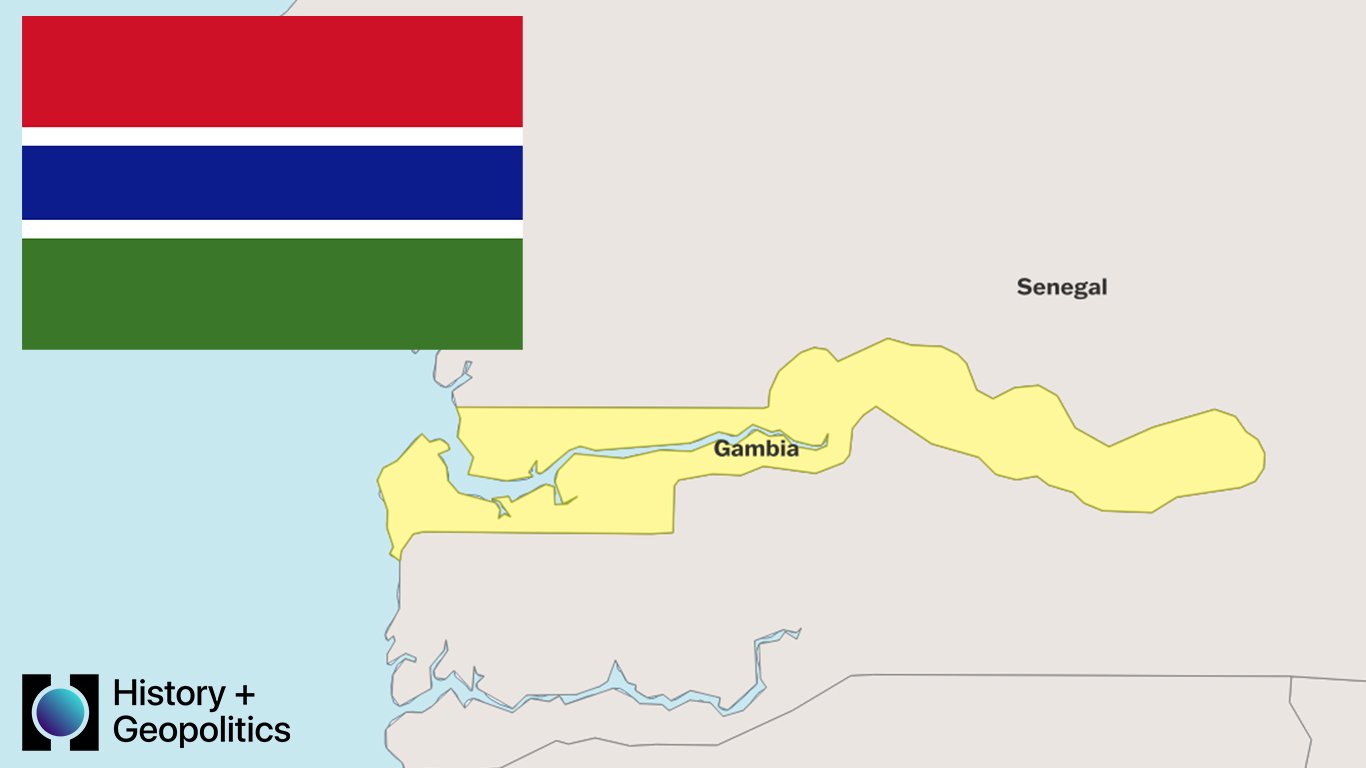
Gambia is located in West Africa, the smallest country on the African mainland. It is almost entirely surrounded by Senegal, with a narrow Atlantic Ocean coastline to the west. The country follows the course of the Gambia River, creating a long and thin strip of land stretching inland from the coast.
Gambia Facts
- OFFICIAL NAME: Republic of The Gambia
- CAPITAL: Banjul
- POPULATION: 2,884,079 (2026)
- AREA: 11,295 square kilometers
- OFFICIAL LANGUAGE: English
- CURRENCY: Gambian Dalasi (GMD)
Gambia Flag
The flag of Gambia has three horizontal stripes — red on top, blue in the middle, and green on the bottom — with narrow white stripes bordering the blue stripe on both sides. The red represents the sun and the savanna, as well as the courage of the Gambian people. The blue represents the Gambia River, which is the country’s most defining geographic feature. The green represents the land, forests, and agricultural wealth of the nation. The white stripes represent unity and peace among the people of Gambia. The flag was adopted upon independence from Britain in 1965.
Gambia Geography
- Located in West Africa, the smallest country on the African mainland.
- Almost entirely surrounded by Senegal on three sides, with a short Atlantic Ocean coastline to the west.
- The country follows the course of the Gambia River, forming a long and narrow strip of land approximately 50 kilometers wide and 350 kilometers long.
- The Gambia River runs through the entire length of the country from east to west, emptying into the Atlantic Ocean.
- The terrain is mostly flat, consisting of floodplains along the river and low-lying sandy soils on either side.
- Gambia has a tropical climate with a distinct dry season from November to May and a rainy season from June to October.
- The country is one of the most densely populated in Africa despite its small land area.
- Mangrove swamps line much of the riverbanks, particularly in the western parts near the coast.
Gambia Government
- Gambia is a presidential republic.
- The President serves as both head of state and head of government.
- Adama Barrow has served as President since 2017, having won a historic election that ended the 22-year rule of dictator Yahya Jammeh.
- Gambia has a unicameral National Assembly.
- Jammeh’s refusal to accept his electoral defeat in 2016 was resolved by ECOWAS military intervention, after which he went into exile.
- Gambia has been working to rebuild democratic institutions and address human rights abuses committed during Jammeh’s rule.
History of Gambia
- The Gambia River valley has been inhabited for thousands of years by various West African peoples.
- The region was part of the powerful Mali and later Songhai empires during the medieval period.
- Portuguese explorers arrived along the Gambia River in the mid-15th century, initiating European contact and trade.
- Britain established trading posts along the river in the 17th century, eventually making Gambia a British colony known as the British Gambia Protectorate.
- Gambia gained independence from the United Kingdom on February 18, 1965, becoming one of the smallest and least developed countries in Africa.
- Dawda Jawara governed Gambia as its first post-independence leader until he was overthrown in a military coup in 1994.
- Yahya Jammeh seized power in the 1994 coup and ruled the country with an iron fist for 22 years, presiding over widespread human rights abuses.
- Jammeh was unexpectedly defeated in the 2016 presidential election by Adama Barrow, and was forced into exile in 2017 after refusing to concede.
- Since 2017, Gambia has been undergoing a democratic transition and a Truth, Reconciliation and Reparations Commission has documented abuses under Jammeh’s rule.
People and Culture of Gambia
- The Mandinka are the largest ethnic group, making up approximately 33% of the population, followed by the Fula, Wolof, Jola, and Serahule peoples.
- English is the official language, while Mandinka, Wolof, and Fula are widely spoken in everyday life.
- Islam is the predominant religion, practiced by approximately 96% of the population, making Gambia one of the most predominantly Muslim countries in West Africa.
- Benachin, also known as Jollof rice, a one-pot dish of rice cooked with tomatoes, vegetables, and fish or meat, is the national dish of Gambia.
- Domoda, a groundnut stew served with rice, is another beloved traditional dish widely eaten across the country.
- Music and storytelling through the griot tradition, known locally as jali, is a deeply rooted cultural practice preserving history and heritage through song and oral narrative.
- Gambia’s Atlantic beaches and river ecosystem have made it a popular tourism destination, particularly for European visitors seeking winter sun.
Economy of Gambia
- Gambia has one of the smallest and least developed economies in Africa, heavily dependent on tourism, agriculture, and remittances.
- Tourism is the most significant formal economic sector, with the Atlantic coastline and eco-tourism along the Gambia River attracting visitors primarily from Europe.
- Agriculture employs the majority of the rural population, with groundnuts historically being the most important cash crop and export commodity.
- Remittances from the large Gambian diaspora, particularly in Europe and the United States, are a critical source of household income.
- The country has limited mineral resources and relies heavily on imports and foreign aid.
- Gambia faces significant development challenges including poverty, youth unemployment, and limited infrastructure.
Gambia Resources
- The Gambia River is the country’s most significant natural resource, providing fresh water, fisheries, and a transport route through the interior.
- Groundnuts remain an important agricultural resource and a traditional export crop.
- Fertile riverside land supports smallholder agriculture producing rice, millet, sorghum, and vegetables.
- The Atlantic coastline and coastal fishing grounds provide marine resources including bonga fish, which is an important part of local diets.
- Gambia’s sandy beaches, mangroves, and river ecosystems represent the country’s most valuable tourism resources.
Gambia Wildlife
- Gambia’s river, wetlands, and remaining forest patches support a surprisingly rich variety of wildlife for such a small country.
- The Gambia River and its tributaries are home to hippopotamuses and Nile crocodiles, the latter of which are considered sacred in certain communities.
- The Abuko Nature Reserve, one of the smallest nature reserves in Africa, protects a remarkable diversity of bird and mammal species close to the capital.
- Gambia is renowned among birdwatchers, with over 560 recorded bird species making it one of the best birding destinations in West Africa relative to its size.
- Green monkeys and red colobus monkeys inhabit the remaining forested areas and riverine woodlands.
- Manatees inhabit the lower reaches of the Gambia River, though they are threatened by fishing nets and river traffic.
- Conservation efforts focus on protecting the river ecosystem, sacred crocodile pools, and the country’s remarkable bird diversity.