Georgia Country Profile
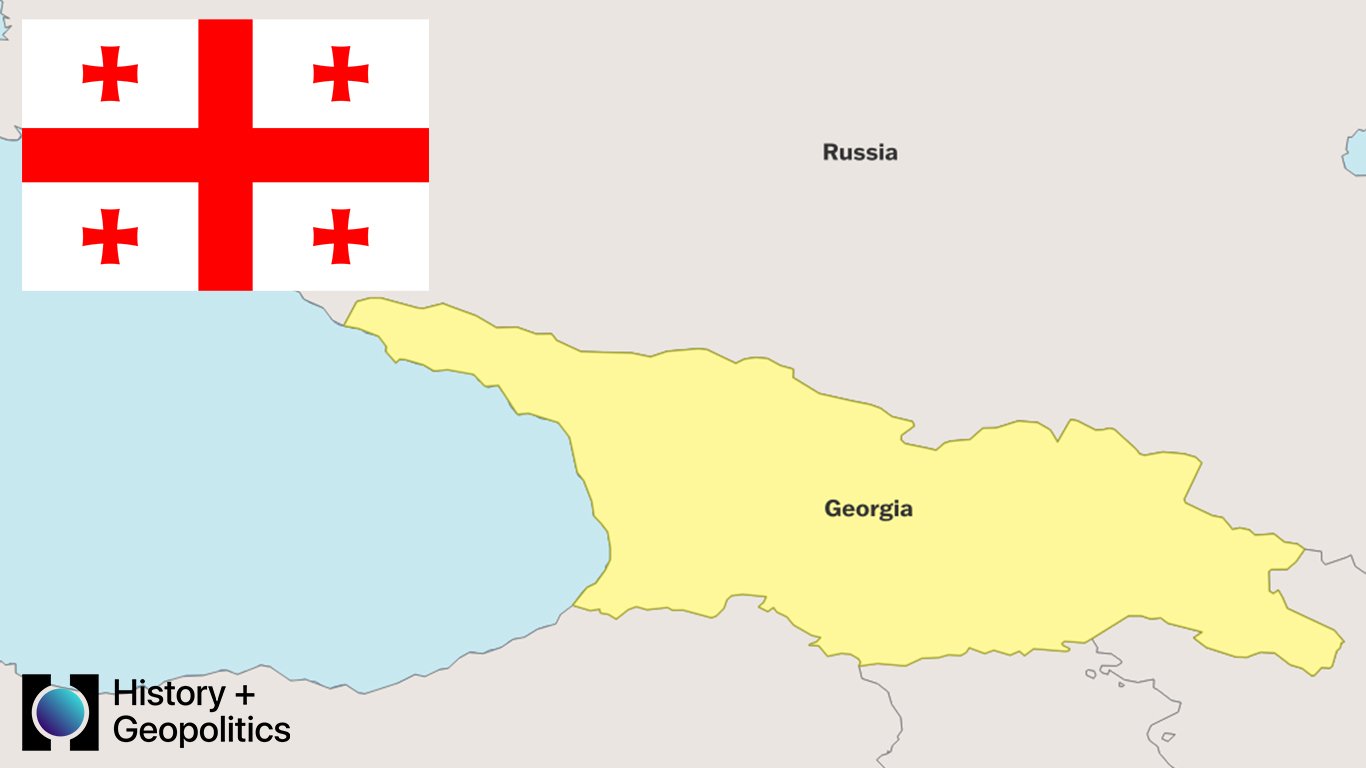
Georgia is located in the South Caucasus region at the crossroads of Eastern Europe and Western Asia. It is bordered by Russia to the north, Azerbaijan to the east, Armenia to the south, and Turkey to the southwest, with the Black Sea forming its entire western coastline.
Georgia Facts
- OFFICIAL NAME: Georgia
- CAPITAL: Tbilisi
- POPULATION: 3,804,642 (2026)
- AREA: 69,700 square kilometers
- OFFICIAL LANGUAGE: Georgian
- CURRENCY: Georgian Lari (GEL)
Georgia Flag
The flag of Georgia, known as the Five Cross Flag, has a white background with a large red cross dividing it into four equal quadrants, each containing a smaller red cross. The design is known as the Georgian Cross or Bolnisi Cross, one of the oldest Christian symbols in the world. The five crosses are said to represent Jesus Christ and the four Evangelists, or alternatively the five holy wounds of Christ. The white represents purity and innocence, while the red represents the courage and sacrifice of those who defended Georgia. The flag has ancient roots dating back to medieval Georgia and was restored as the national flag in 2004.
Georgia Geography
- Located in the South Caucasus, at the crossroads of Eastern Europe and Western Asia.
- Borders: Russia to the north, Azerbaijan to the east, Armenia to the south, Turkey to the southwest.
- The Black Sea forms the entire western coastline, stretching approximately 310 kilometers.
- The Greater Caucasus Mountains run along the northern border with Russia, forming a dramatic natural boundary.
- Mount Shkhara, on the border with Russia, is the highest peak in Georgia, rising to 5,193 meters.
- The Lesser Caucasus range runs through the south of the country.
- The Kolkheti lowlands along the Black Sea coast are fertile and subtropical.
- The Mtkvari, also known as the Kura River, is the most important river, flowing through Tbilisi toward Azerbaijan.
- Georgia has a varied climate, from subtropical along the Black Sea coast to alpine in the high Caucasus and semi-arid in the eastern regions.
- The country also includes the disputed territories of South Ossetia and Abkhazia, which declared independence with Russian support following the 2008 war.
Georgia Government
- Georgia is a semi-presidential republic.
- The President serves as head of state with largely ceremonial duties.
- The Prime Minister serves as head of government, holding executive authority.
- Georgia has a unicameral Parliament.
- The Georgian Dream party has governed since 2012 and has maintained political dominance through successive elections.
- Georgia is a candidate country for European Union membership, though its path to accession has been complicated by concerns over democratic backsliding.
- The disputed regions of Abkhazia and South Ossetia remain outside government control, administered as Russian-backed de facto states.
History of Georgia
- Georgia has one of the oldest and richest histories in the Caucasus region, with human habitation dating back hundreds of thousands of years.
- The ancient kingdoms of Colchis and Kartli, mentioned in Greek mythology as the destination of Jason and the Argonauts, were established in what is now Georgia.
- Georgia adopted Christianity as its state religion in 337 A.D., making it one of the earliest Christian nations in the world.
- The Georgian alphabet, one of the most distinctive and ancient writing systems in the world, was developed in the 5th century A.D.
- The medieval Kingdom of Georgia reached its golden age under Queen Tamar in the 12th and early 13th centuries, becoming one of the most powerful states in the region.
- Georgia was repeatedly invaded by Mongols, Persians, and Ottomans over the following centuries, fragmenting the kingdom.
- Georgia voluntarily joined the Russian Empire in 1801 seeking protection from its neighbors.
- Georgia declared independence in 1918 following the Russian Revolution but was forcibly incorporated into the Soviet Union in 1921.
- Georgia declared independence from the Soviet Union on April 9, 1991.
- Civil conflicts and the wars over Abkhazia and South Ossetia marked the early post-independence period.
- The Rose Revolution of 2003, a peaceful popular uprising, brought Mikheil Saakashvili to power and launched a major reform program.
- A brief war with Russia in August 2008 over South Ossetia resulted in Russian recognition of the breakaway regions and a lasting shift in Georgia’s geopolitical position.
People and Culture of Georgia
- Georgians make up approximately 86% of the population, with Azerbaijani, Armenian, and Russian minorities also present.
- Georgian is the official language, written in the unique Mkhedruli script, one of the most distinctive alphabets in the world.
- Georgian Orthodox Christianity is practiced by approximately 83% of the population and is central to national identity and culture.
- Khachapuri, a cheese-filled bread, is Georgia’s most iconic dish and one of the most beloved foods in the Caucasus region.
- Khinkali, large soup dumplings filled with spiced meat, are another celebrated Georgian culinary tradition.
- Georgia is widely regarded as one of the oldest wine-producing regions in the world, with a winemaking tradition dating back approximately 8,000 years using the traditional qvevri clay jar method, recognized by UNESCO.
- Georgian polyphonic singing, a unique form of multi-part choral music, is recognized by UNESCO as an intangible cultural heritage of humanity.
Economy of Georgia
- Georgia has a developing market economy with tourism, agriculture, and financial services as key sectors.
- Tourism has grown significantly, with visitors drawn to Georgia’s mountain landscapes, ancient monasteries, wine regions, and the vibrant capital Tbilisi.
- Georgia is an important transit country for oil and gas pipelines connecting Azerbaijan to Turkey and European markets.
- Agriculture produces wine, citrus fruits, hazelnuts, and tea, with wine being the most internationally recognized export.
- The country has attracted foreign investment due to its low taxes, ease of doing business, and strategic location.
- Georgia faces challenges including high emigration, regional inequality, and the economic impact of the frozen conflicts in Abkhazia and South Ossetia.
Georgia Resources
- Georgia has significant hydropower potential from its numerous mountain rivers, with hydroelectricity a major energy source and export.
- The country has deposits of manganese, copper, and gold.
- Fertile agricultural land in the Kolkheti lowlands and river valleys supports tea, citrus, and wine production.
- Georgia’s forests, mountain landscapes, and Black Sea coastline are important resources for the growing tourism industry.
- The country’s strategic position as a transit corridor for Caspian energy exports is one of its most economically significant geographic assets.
Georgia Wildlife
- Georgia’s diverse landscapes, from Black Sea subtropical forests to high Caucasus alpine zones, support exceptional biodiversity.
- The Caucasian leopard, one of the rarest and most endangered big cats in the world, inhabits remote mountain forests in Georgia.
- Brown bears, wolves, and lynx are found in the forested mountain regions.
- The Caucasian tur, a wild goat species endemic to the Caucasus, inhabits the high rocky slopes of the Greater Caucasus.
- The Kolkheti wetlands along the Black Sea coast are an important habitat for migratory birds and several endemic species.
- Georgia has established several protected areas, including the Borjomi-Kharagauli National Park, one of the largest national parks in Europe, to conserve its mountain and forest ecosystems.
- Conservation efforts focus on protecting the Caucasian leopard, brown bear, and the unique endemic species of the Caucasus biodiversity hotspot.