Germany Country Profile
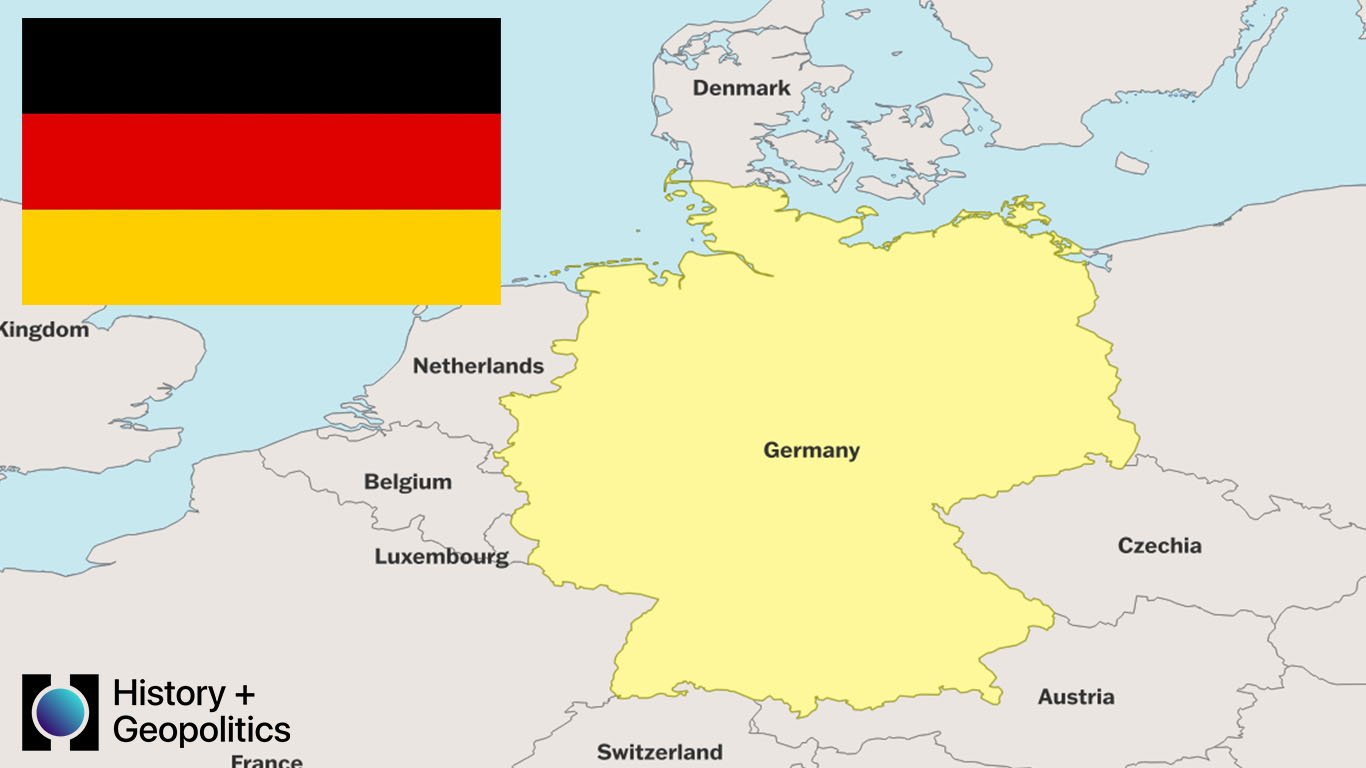
Germany is located in Central Europe, bordered by Denmark to the north, Poland and the Czech Republic to the east, Austria and Switzerland to the south, and France, Luxembourg, Belgium, and the Netherlands to the west. To the north lie the North Sea and the Baltic Sea.
Germany Facts
- OFFICIAL NAME: Federal Republic of Germany
- CAPITAL: Berlin
- POPULATION: 83,644,258 (2026)
- AREA: 357,114 square kilometers
- OFFICIAL LANGUAGE: German
- CURRENCY: Euro (EUR)
Germany Flag
The flag of Germany has three equal horizontal stripes — black on top, red in the middle, and gold on the bottom. The colors trace their origins to the uniforms of the Lützow Free Corps, volunteer fighters who opposed Napoleon in the early 19th century and wore black coats with red facings and gold buttons. The black, red, and gold combination became associated with German liberal and nationalist movements in the 19th century. The flag was officially adopted by the Federal Republic of Germany in 1949 and retained after reunification in 1990, symbolizing democracy, freedom, and unity.
Germany Geography
- Located in Central Europe, one of the largest and most centrally positioned countries on the continent.
- Borders: Denmark to the north, Poland and the Czech Republic to the east, Austria and Switzerland to the south, France, Luxembourg, Belgium, and the Netherlands to the west.
- The North Sea lies to the northwest and the Baltic Sea to the northeast.
- The terrain is highly varied, from the flat North German Plain in the north to the Central Uplands and the Bavarian Alps in the south.
- The Rhine, Elbe, and Danube are among Germany’s most significant rivers, vital for trade and transportation throughout history.
- The Zugspitze, on the border with Austria, is the highest peak in Germany, rising to 2,962 meters.
- Germany has a temperate seasonal climate, with mild to warm summers and cold winters.
- The Black Forest in the southwest and the Bavarian Alps in the south are among the country’s most iconic natural landscapes.
- Germany is the most populous country in the European Union.
Germany Government
- Germany is a federal parliamentary republic.
- The President serves as a largely ceremonial head of state.
- The Chancellor serves as head of government and holds executive authority.
- Germany has a bicameral parliament consisting of the Bundestag and the Bundesrat.
- Germany is made up of 16 federal states, each with its own government and significant autonomy.
- Friedrich Merz has served as Chancellor since 2025 following federal elections.
- Germany is a founding member of the European Union and NATO, and one of the most influential countries in both organizations.
History of Germany
- The region has been inhabited since prehistoric times, with Germanic tribes occupying much of Central Europe before the Roman era.
- The Holy Roman Empire, centered largely on German-speaking territories, existed from 962 to 1806 and was a dominant force in European politics for centuries.
- Martin Luther launched the Protestant Reformation from Wittenberg in 1517, profoundly reshaping European religion and culture.
- Germany was unified as a nation state under Prussian leadership in 1871, with Otto von Bismarck as its first Chancellor.
- Germany’s defeat in World War I led to the abdication of the Kaiser and the establishment of the Weimar Republic in 1918.
- The Great Depression and political instability enabled Adolf Hitler and the Nazi Party to rise to power in 1933.
- Germany under the Nazis started World War II in 1939 and carried out the Holocaust, the systematic murder of six million Jewish people and millions of others.
- Germany was defeated in 1945, divided into four occupation zones, and eventually split into two states — West Germany and East Germany.
- West Germany developed into a prosperous democracy while East Germany became a communist state under Soviet influence.
- The Berlin Wall, built in 1961 to prevent East Germans from fleeing to the West, became the most powerful symbol of the Cold War division of Europe.
- The fall of the Berlin Wall on November 9, 1989, led to German reunification on October 3, 1990.
- Reunified Germany has become the economic engine of Europe and a cornerstone of the European Union.
People and Culture of Germany
- Germans make up approximately 85% of the population, with significant Turkish, Polish, Syrian, and other immigrant communities.
- German is the official language, one of the most widely spoken languages in Europe.
- Germany is one of the more secular countries in Europe, with a roughly even split between Catholics and Protestants and a large non-religious population.
- Bratwurst, grilled sausages, and Sauerkraut are among Germany’s most internationally recognized traditional foods.
- Brot, a wide variety of breads, is central to German cuisine, with Germany producing more bread varieties than almost any other country in the world.
- Oktoberfest, the annual beer festival held in Munich, is one of the most attended festivals in the world.
- Germany has produced some of the world’s greatest philosophers, composers, scientists, and writers, including Goethe, Beethoven, Kant, Einstein, and Marx.
Economy of Germany
- Germany has the largest economy in Europe and the third or fourth largest in the world.
- The country is a global leader in manufacturing, particularly in the automotive, chemical, and machinery sectors.
- Volkswagen, BMW, Mercedes-Benz, Siemens, and BASF are among Germany’s most internationally recognized companies.
- Germany is the world’s third largest exporter of goods, with a massive trade surplus built on high-quality manufactured products.
- The country is undergoing a major energy transition known as the Energiewende, shifting away from fossil fuels and nuclear power toward renewable energy.
- Germany faces demographic challenges including an aging population and one of the lowest birth rates in Europe, addressed partly through immigration.
Germany Resources
- Germany has significant coal deposits, particularly brown coal or lignite, though their use is being phased out for environmental reasons.
- The country has potash and salt deposits, supporting the chemical industry.
- Forests cover approximately one third of Germany and support a significant timber industry.
- Germany has invested heavily in renewable energy, particularly wind and solar, becoming one of the world’s leading producers of green electricity.
- The Rhine and other rivers support hydroelectric power generation and serve as vital commercial waterways.
Germany Wildlife
- Germany’s forests, rivers, wetlands, and coastal areas support a diverse range of Central European wildlife.
- Wolves have returned to Germany after an absence of nearly 150 years, with a growing population now established in several eastern states.
- Lynx have been reintroduced in several national parks and forest areas, though populations remain small.
- The white stork is a beloved symbol of German rural life and nests widely across the countryside.
- The Wadden Sea along Germany’s North Sea coast, a UNESCO World Heritage Site, is one of the most important tidal flat ecosystems in the world, supporting seals, migratory birds, and diverse marine life.
- Germany has established several national parks, including the Bavarian Forest National Park, which was the first national park in Germany and protects one of the largest areas of primeval forest in Central Europe.