Iceland Country Profile
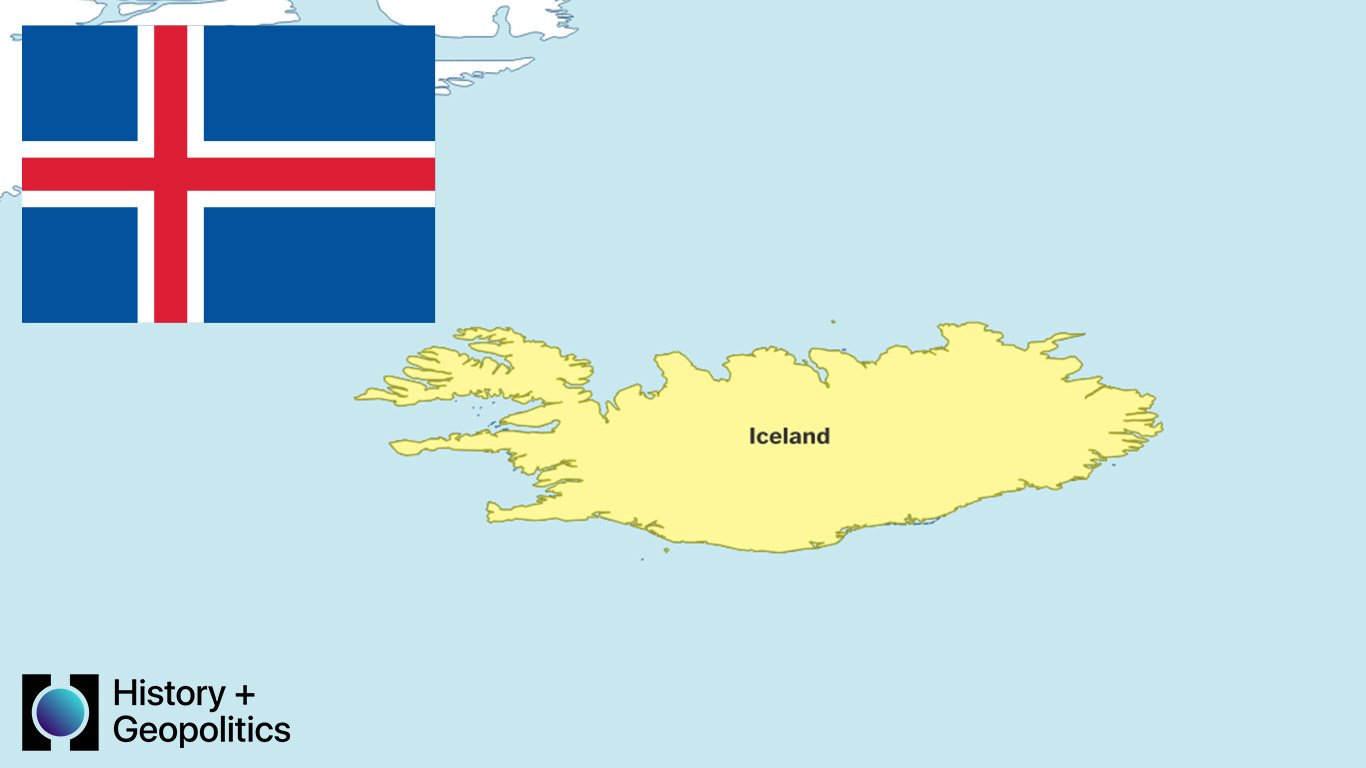
Iceland is located in the North Atlantic Ocean, a Nordic island nation sitting just south of the Arctic Circle. It has no land borders, surrounded entirely by the Atlantic Ocean to the south and east and the Greenland Sea to the north, with Greenland lying approximately 300 kilometers to the northwest and Norway around 970 kilometers to the east.
Iceland Facts
- OFFICIAL NAME: Iceland
- CAPITAL: Reykjavík
- POPULATION: 394,324 (2026)
- AREA: 103,000 square kilometers
- OFFICIAL LANGUAGE: Icelandic
- CURRENCY: Icelandic Króna (ISK)
Iceland Flag
The flag of Iceland has a deep blue background with a red Nordic cross outlined in white, extending to the edges of the flag with the vertical bar positioned slightly to the left of center. The blue represents the Atlantic Ocean surrounding the island, the white represents the snow and ice that cover much of the country, and the red represents the volcanic fire beneath Iceland’s surface. The Nordic cross design is shared with Denmark, Sweden, Norway, and Finland, reflecting Iceland’s Viking heritage and Scandinavian cultural connections. The flag was officially adopted in 1944 when Iceland became a fully independent republic.
Iceland Geography
- Located in the North Atlantic Ocean, just south of the Arctic Circle.
- No land borders, surrounded entirely by the Atlantic Ocean and the Greenland Sea.
- Iceland is the second largest island in Europe after Great Britain.
- The terrain is defined by dramatic volcanic and glacial landscapes, with lava fields, geysers, hot springs, and mountain ranges covering much of the island.
- Vatnajökull, the largest glacier in Europe by volume, covers approximately 8% of Iceland’s total land area.
- The highest peak, Hvannadalshnúkur, rises to 2,110 meters on the edge of the Vatnajökull glacier.
- Iceland sits on the Mid-Atlantic Ridge, the boundary between the North American and Eurasian tectonic plates, making it one of the most volcanically active places on Earth.
- The island has around 130 volcanoes, many of which are still active, including Eyjafjallajökull, which disrupted European air travel with its 2010 eruption.
- The Reykjanes Peninsula has experienced a series of significant volcanic eruptions since 2021.
- Iceland has a subarctic oceanic climate, moderated by the Gulf Stream, with cool summers and mild but windy winters.
Iceland Government
- Iceland is a parliamentary republic.
- The President serves as head of state with largely ceremonial duties.
- The Prime Minister serves as head of government, holding executive authority.
- Iceland has a unicameral parliament called the Althing, which is one of the oldest parliaments in the world, established in 930 A.D.
- Iceland is a member of NATO but has no standing army of its own.
- Iceland is a member of the European Economic Area but has not joined the European Union.
History of Iceland
- Iceland was uninhabited before Norse Vikings began settling the island around 874 A.D., with Ingólfr Arnarson traditionally regarded as the first permanent settler.
- Irish monks may have visited the island before the Norse settlers arrived.
- The Althing, established in 930 A.D. at Þingvellir, is considered one of the world’s first democratic parliaments.
- Iceland adopted Christianity around the year 1000 A.D. following a famous compromise at the Althing.
- The Icelandic sagas, written in the 13th and 14th centuries, are among the most significant literary works of medieval Europe.
- Iceland came under Norwegian rule in 1262 and subsequently passed to Danish control in the 14th century.
- Iceland remained under Danish rule for several centuries, experiencing devastating plagues, volcanic eruptions, and famines.
- Iceland gained limited home rule in 1904 and sovereignty in 1918 while remaining in a personal union with Denmark.
- Iceland declared full independence as a republic on June 17, 1944, while Denmark was under German occupation.
- Iceland experienced a rapid economic transformation in the late 20th century, becoming one of the wealthiest countries in the world.
- The 2008 financial crisis caused a catastrophic banking collapse in Iceland, though the country made a remarkable economic recovery.
People and Culture of Iceland
- Icelanders are predominantly of Norse and Celtic descent, reflecting the island’s Viking-era settlement.
- Iceland has become increasingly diverse, with over 20% of the population now of foreign origin, particularly from Poland and other European countries.
- Icelandic is the official language, a North Germanic language that has changed remarkably little since the Viking Age, making modern Icelanders able to read medieval sagas in their original form.
- The Evangelical Lutheran Church is the official state church, though religious participation has been declining.
- Skyr, a thick dairy product similar to yogurt, is one of Iceland’s most traditional and beloved foods and has become an internationally recognized Icelandic product.
- Lamb, raised on the open Icelandic highlands, is central to traditional Icelandic cuisine, with slow-cooked lamb soup known as kjötsúpa being a national comfort food.
- Iceland has one of the highest rates of book publishing and reading per capita in the world, and the Christmas Eve tradition of giving books as gifts, known as Jólabókaflóð or the Christmas Book Flood, is a celebrated national custom.
Economy of Iceland
- Iceland has a highly developed, small open economy with fisheries, tourism, and aluminum smelting as the main pillars.
- Fishing and fish processing have historically been the backbone of the economy, with Iceland one of the world’s most important fishing nations.
- Tourism grew dramatically in the 2010s and became the largest employer and foreign exchange earner before the COVID-19 pandemic, driven by interest in Iceland’s dramatic landscapes and the Northern Lights.
- Aluminum smelting, powered by cheap geothermal and hydroelectric energy, is a significant export industry.
- Iceland generates nearly 100% of its electricity from renewable sources, primarily hydropower and geothermal energy.
- The country has one of the highest standards of living in the world and consistently ranks among the top nations in gender equality indexes.
Iceland Resources
- Iceland’s most significant natural resources are its abundant geothermal and hydroelectric energy, which provide virtually all of the country’s electricity and heating needs.
- Fish stocks in Icelandic waters are among the most valuable marine resources, including cod, haddock, and capelin.
- The dramatic volcanic landscapes, glaciers, hot springs, and Northern Lights are among Iceland’s most valuable resources for tourism.
- Geothermal energy also supports greenhouse agriculture, allowing Iceland to grow tomatoes, cucumbers, and other vegetables despite its northern latitude.
- Iceland has deposits of diatomite, a sedimentary rock used in filtration, found in certain lake beds.
Iceland Wildlife
- Iceland’s remote location and cold subarctic environment support a relatively small but distinctive range of wildlife.
- The Arctic fox is the only native land mammal in Iceland, having arrived after the last Ice Age by walking across sea ice.
- Reindeer were introduced from Norway in the 18th century and now roam freely in the eastern highlands.
- Iceland’s coastal cliffs and offshore islands support enormous seabird colonies, including puffins, gannets, and Arctic terns.
- The puffin is one of Iceland’s most iconic animals, with Iceland hosting the largest Atlantic puffin population in the world.
- The surrounding North Atlantic waters are home to humpback whales, minke whales, orcas, and various dolphin species, making whale watching a major attraction.
- Iceland has established several nature reserves and national parks, including Þingvellir, Snæfellsjökull, and Vatnajökull, the largest national park in Europe, to protect its unique volcanic and glacial landscapes.