Iran Country Profile
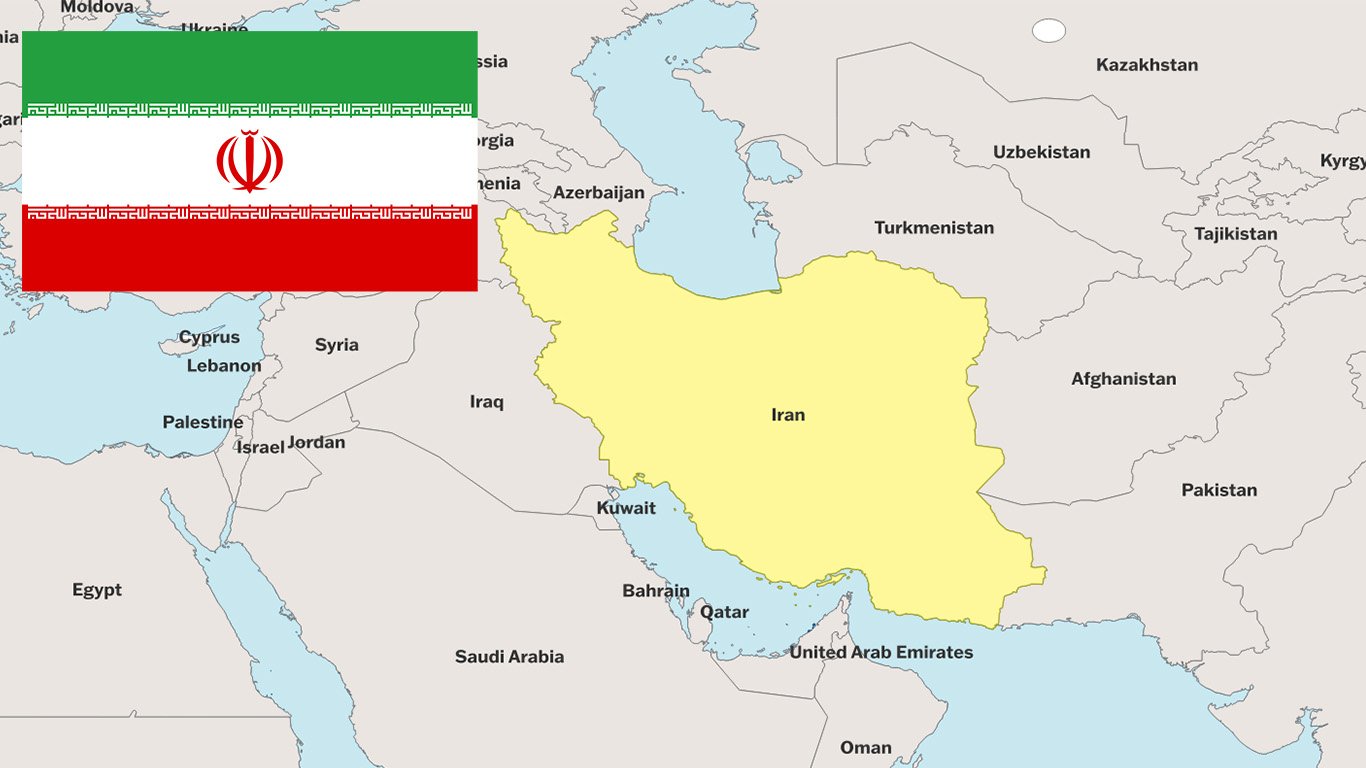
Iran is located in Western Asia, also known as the Middle East, bordered by Turkey and Iraq to the west, Armenia, Azerbaijan, and the Caspian Sea to the northwest and north, Turkmenistan to the northeast, Afghanistan and Pakistan to the east, and the Persian Gulf and Gulf of Oman to the south.
Iran Facts
- OFFICIAL NAME: Islamic Republic of Iran
- CAPITAL: Tehran
- POPULATION: 93,168,497 (2026)
- AREA: 1,648,195 square kilometers
- OFFICIAL LANGUAGE: Persian (Farsi)
- CURRENCY: Iranian Rial (IRR)
Iran Flag
The flag of Iran has three equal horizontal stripes — green on top, white in the middle, and red on the bottom — with the national emblem centered on the white stripe and inscriptions of “Allahu Akbar,” meaning “God is Great,” written 22 times along the edges of the green and red stripes. The green represents growth, prosperity, and Islam. The white represents peace and freedom. The red represents courage and the blood of those who died for the nation. The national emblem in the center is a stylized representation of the word Allah in the shape of a tulip, also symbolizing the martyrs of the revolution. The 22 repetitions of “Allahu Akbar” represent the 22nd of Bahman, the date in the Iranian calendar corresponding to February 11, 1979, the day the Islamic Revolution succeeded.
Iran Geography
- Located in Western Asia, one of the largest countries in the Middle East and the world.
- Borders: Turkey and Iraq to the west, Armenia, Azerbaijan, and Turkmenistan to the north, Afghanistan and Pakistan to the east.
- The Persian Gulf and the Strait of Hormuz, one of the world’s most strategically important waterways, lie to the south.
- The Caspian Sea, the world’s largest enclosed inland body of water, borders Iran to the north.
- The terrain is dominated by a vast central plateau ringed by mountain ranges.
- The Alborz Mountains in the north include Mount Damavand, the highest peak in Iran and the highest volcano in Asia, rising to 5,610 meters.
- The Zagros Mountains run from northwest to southeast through the western part of the country.
- The Dasht-e Kavir and Dasht-e Lut are two of the largest salt deserts in the world, covering much of the central plateau.
- The Dasht-e Lut has recorded some of the highest land surface temperatures ever measured on Earth.
- Iran has a varied climate, from subtropical along the Caspian coast to arid and semi-arid in the interior and south.
Iran Government
- Iran is an Islamic republic with a unique dual system of government combining elected institutions with religious authority.
- The Supreme Leader holds the highest authority in the state, overseeing all branches of government and the military.
- Ali Khamenei has served as Supreme Leader since 1989.
- The President serves as the head of the executive branch and is elected by popular vote.
- Masoud Pezeshkian has served as President since July 2024 following the death of President Ebrahim Raisi in a helicopter crash.
- Iran has a unicameral Islamic Consultative Assembly known as the Majlis.
- The Guardian Council, a body of Islamic jurists and legal scholars, vets all legislation and candidates for elected office.
History of Iran
- Iran is home to one of the world’s oldest civilizations, with the Elamite civilization flourishing as early as 3200 B.C.
- The Achaemenid Empire, founded by Cyrus the Great in 550 B.C., became the largest empire the world had seen up to that point, stretching from the Balkans to Central Asia.
- Cyrus the Great issued the Cyrus Cylinder, considered one of the earliest declarations of human rights in history.
- Alexander the Great conquered the Achaemenid Empire in 330 B.C., spreading Hellenistic culture across the region.
- The Sassanid Empire, from 224 to 651 A.D., was one of the most powerful empires of late antiquity, rivaling the Roman and Byzantine Empires.
- Arab armies conquered Persia in the 7th century A.D., bringing Islam to the region and transforming its culture and identity.
- Iran became a center of Islamic civilization, producing renowned poets, scientists, and philosophers including Rumi, Omar Khayyam, and Avicenna.
- The Safavid dynasty, ruling from 1501 to 1736, established Shia Islam as the state religion and created a distinct Persian-Islamic cultural identity.
- Iran came under increasing pressure from European powers, particularly Britain and Russia, in the 19th and early 20th centuries.
- The Constitutional Revolution of 1905 to 1907 established a constitutional monarchy and parliament.
- The Pahlavi dynasty, established in 1925, modernized Iran rapidly but faced growing opposition to its authoritarian rule.
- A CIA-backed coup in 1953 overthrew the democratically elected Prime Minister Mohammad Mosaddegh, who had nationalized the oil industry.
- The Islamic Revolution of 1979 overthrew Shah Mohammad Reza Pahlavi and established the Islamic Republic under Ayatollah Khomeini.
- Iran fought a devastating eight-year war with Iraq from 1980 to 1988, resulting in enormous casualties on both sides.
- Iran’s nuclear program has been a source of international tension, leading to international sanctions that have significantly impacted the economy.
People and Culture of Iran
- Persians are the largest ethnic group, making up approximately 61% of the population, with Azeris at around 16%, and Kurds, Arabs, Lurs, and Baluch also forming significant communities.
- Persian, also known as Farsi, is the official language and one of the great literary languages of the world, with a rich poetic tradition spanning over a thousand years.
- Shia Islam is practiced by approximately 90 to 95% of the population and is the official state religion.
- Ghormeh sabzi, a herb and kidney bean stew served with rice, is one of Iran’s most beloved national dishes.
- Chelo kebab, rice served with various grilled meats, is widely considered the national dish of Iran.
- Persian poetry, particularly the works of Rumi, Hafez, Ferdowsi, and Omar Khayyam, is among the most celebrated literary traditions in the world.
- Nowruz, the Persian New Year celebrated on the spring equinox, is the most important cultural and family celebration in Iran and is recognized by UNESCO.
Economy of Iran
- Iran has one of the largest economies in the Middle East, with significant oil and gas, manufacturing, and agriculture sectors.
- Iran has the world’s second largest natural gas reserves and the fourth largest proven oil reserves.
- The economy has been severely impacted by decades of international sanctions related to its nuclear program and regional policies.
- Agriculture produces wheat, rice, pistachios, saffron, and fruits, with Iran being the world’s largest producer of saffron and one of the largest producers of pistachios.
- Manufacturing includes petrochemicals, steel, automobiles, and consumer goods for the large domestic market.
- Inflation and currency depreciation have been persistent economic challenges, significantly impacting the living standards of ordinary Iranians.
Iran Resources
- Iran holds the world’s second largest natural gas reserves, found primarily in the South Pars field shared with Qatar in the Persian Gulf.
- The country has the fourth largest proven oil reserves in the world, concentrated in the southwestern Khuzestan province and offshore fields.
- Iran has significant deposits of copper, iron ore, coal, chromite, and uranium.
- The country is the world’s largest producer of saffron, the most expensive spice in the world by weight, grown primarily in Khorasan province.
- Fertile agricultural land along the Caspian coast and in river valleys supports diverse food production.
Iran Wildlife
- Iran’s extraordinary geographic diversity, from Caspian forests to Persian Gulf coasts and central deserts, supports remarkable biodiversity.
- The Persian leopard, the largest leopard subspecies in the world, inhabits the mountainous regions of Iran and is one of the country’s most iconic endangered animals.
- The Asiatic cheetah, one of the rarest animals on Earth with only a few dozen individuals remaining, survives only in Iran’s central deserts.
- The Persian fallow deer, once considered extinct, has been rediscovered and is being conserved in protected areas in western Iran.
- The Caspian Sea coast supports a unique temperate forest ecosystem, the Hyrcanian forests, recognized as a UNESCO World Heritage Site.
- Iran has established several national parks and wildlife refuges, including Golestan and Kavir National Parks, to protect its diverse fauna.
- Conservation of the Asiatic cheetah remains one of Iran’s most critical and internationally recognized wildlife priorities.