Italy Country Profile
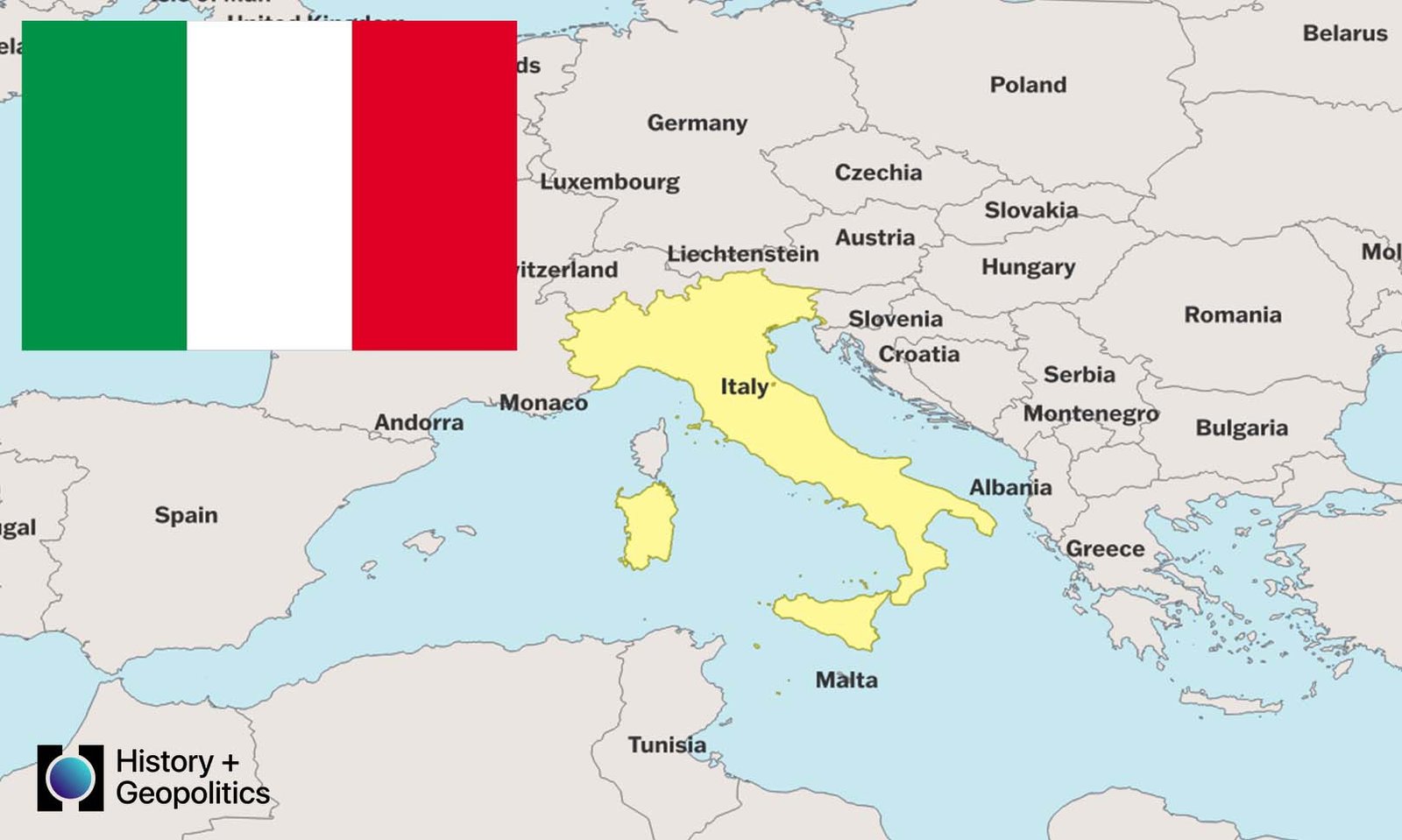
Italy is located in Southern Europe, a peninsula extending southward into the Mediterranean Sea. It is bordered by France to the northwest, Switzerland and Austria to the north, and Slovenia to the northeast. The Mediterranean Sea surrounds Italy on three sides, with the Ligurian and Tyrrhenian Seas to the west, the Ionian Sea to the south, and the Adriatic Sea to the east.
Italy Facts
- OFFICIAL NAME: Italian Republic
- CAPITAL: Rome
- POPULATION: 58,926,166 (2026)
- AREA: 301,340 square kilometers
- OFFICIAL LANGUAGE: Italian
- CURRENCY: Euro (EUR)
Italy Flag
The flag of Italy has three equal vertical stripes — green on the left, white in the middle, and red on the right. The design is based on the French Tricolore, which inspired many European flags during the Napoleonic era. The green is said to represent the hills and plains of Italy, the white represents the snow-capped Alps and the purity of ideals, and the red represents the blood shed in the wars of Italian unification. The flag was first used by Italian republican troops in 1797 and was officially adopted as the national flag upon the proclamation of the Italian Republic in 1946.
Italy Geography
- Located in Southern Europe, forming a distinctive boot-shaped peninsula extending into the Mediterranean Sea.
- Borders: France to the northwest, Switzerland and Austria to the north, Slovenia to the northeast.
- The Mediterranean Sea surrounds Italy on three sides, including the Tyrrhenian, Ligurian, Ionian, and Adriatic Seas.
- Italy also includes two large Mediterranean islands — Sicily and Sardinia — as well as several smaller island groups.
- The Alps form the entire northern border, while the Apennine Mountains run like a spine down the length of the peninsula.
- Mont Blanc, on the French-Italian border, is the highest peak in the Alps and in Western Europe, rising to 4,808 meters.
- The Po Valley in northern Italy is the country’s largest and most fertile plain, the agricultural and industrial heartland.
- Italy is home to two independent states — Vatican City and San Marino — both entirely surrounded by Italian territory.
- The country has a Mediterranean climate in the south and center and a more continental climate in the north.
- Italy is located along active seismic and volcanic zones, with Mount Etna in Sicily being one of the most active volcanoes in the world and Vesuvius near Naples remaining a closely monitored volcanic risk.
Italy Government
- Italy is a parliamentary republic.
- The President serves as head of state with largely ceremonial duties.
- The Prime Minister serves as head of government, holding executive authority.
- Italy has a bicameral parliament consisting of the Chamber of Deputies and the Senate of the Republic.
- Giorgia Meloni has served as Prime Minister since October 2022, leading a right-wing coalition government.
- Italy is a founding member of the European Union and NATO.
- Italy has a history of government instability, having had more than 60 governments since the end of World War II.
History of Italy
- Italy is home to some of the earliest human settlements in Europe, with evidence of habitation dating back hundreds of thousands of years.
- Ancient Greek colonies were established along the southern coast and in Sicily from around the 8th century B.C.
- The city of Rome, according to tradition founded in 753 B.C., grew from a small city-state to dominate first the Italian peninsula and then most of the known western world.
- At its height, the Roman Empire stretched from Britain to Mesopotamia and is considered one of the most influential political and cultural entities in human history.
- The fall of the Western Roman Empire in 476 A.D. is one of the most debated events in world history, marking the transition from the ancient to the medieval period.
- Italy was divided into numerous city-states and kingdoms throughout the medieval period, with Florence, Venice, Milan, and Genoa becoming major centers of trade and culture.
- The Italian Renaissance, roughly from the 14th to the 17th century, produced an extraordinary flowering of art, architecture, science, and philosophy that transformed European civilization.
- Italy was gradually unified as a nation-state through the Risorgimento movement, led by figures including Garibaldi and Cavour, culminating in the unification of Italy in 1861.
- Italy entered World War I in 1915 on the side of the Allies and gained some territory but felt deeply disappointed by the peace settlement.
- Benito Mussolini established a fascist dictatorship in 1922, allied Italy with Nazi Germany, and led the country into World War II on the Axis side.
- Following Italy’s defeat and Allied occupation, the Italian Republic was proclaimed in 1946 after a referendum abolished the monarchy.
- Italy became a founding member of NATO in 1949 and of the European Economic Community in 1957.
- The postwar economic miracle transformed Italy from an agricultural country into one of the world’s leading industrial nations.
People and Culture of Italy
- Italians make up approximately 95% of the population, with growing communities of immigrants from Romania, Morocco, Albania, and other countries.
- Italian is the official language, with regional dialects and minority languages such as German in South Tyrol, French in Valle d’Aosta, and Slovene also recognized.
- Roman Catholicism is the predominant religion, though Italy is increasingly secular, with declining church attendance in recent decades.
- Pizza, originating in Naples, and pasta, in its hundreds of regional varieties, are Italy’s most internationally recognized contributions to global cuisine.
- Gelato, Italian ice cream with a denser and creamier texture than traditional ice cream, is beloved worldwide.
- Italy has produced some of the most influential artists, architects, scientists, and thinkers in human history, including Leonardo da Vinci, Michelangelo, Galileo, and Dante.
- Fashion and design are central to Italian cultural identity, with Milan being one of the four global fashion capitals alongside Paris, London, and New York.
Economy of Italy
- Italy has the third largest economy in the Eurozone and one of the largest in the world.
- Manufacturing is a core strength, with Italy renowned for luxury goods, fashion, automotive production, and precision machinery.
- Major Italian brands including Ferrari, Lamborghini, Gucci, Prada, and Armani are globally recognized symbols of Italian craftsmanship and design.
- Tourism is one of the most important sectors, with Italy consistently among the most visited countries in the world, attracting visitors to Rome, Venice, Florence, the Amalfi Coast, and Sicily.
- Agriculture produces world-renowned products including olive oil, wine, cheese, and pasta.
- Italy faces significant structural challenges including high public debt, slow economic growth, an aging population, and a significant productivity gap between the industrialized north and the less developed south.
Italy Resources
- Italy has limited mineral resources but some deposits of marble, particularly the famous Carrara marble used since antiquity, as well as natural gas and petroleum.
- Fertile agricultural land in the Po Valley and along the coasts supports extensive production of wheat, grapes, olives, and tomatoes.
- Italy is one of the world’s largest producers and exporters of wine and olive oil.
- Hydroelectric power is generated from Alpine rivers in the north.
- Italy’s artistic heritage, historical sites, and natural landscapes represent some of its most economically valuable resources through tourism.
Italy Wildlife
- Italy’s diverse landscapes, from the Alps to Mediterranean coastlines and volcanic islands, support a rich variety of European wildlife.
- The brown bear survives in the Trentino region of the Alps and in the Abruzzo National Park in central Italy, with a small but growing population.
- The Apennine wolf has made a remarkable recovery and now inhabits much of the Italian peninsula, with thousands of individuals across the country.
- The Mediterranean monk seal, one of the world’s most endangered marine mammals, is occasionally sighted in the waters around Sardinia and Sicily.
- Italy’s coastlines support loggerhead sea turtles, dolphins, and fin whales in the Mediterranean waters.
- The Gran Paradiso National Park in the Aosta Valley is Italy’s oldest national park and was established to protect the Alpine ibex, which was saved from extinction here.
- Italy has established an extensive network of national parks and marine protected areas to conserve its biodiversity, though habitat loss and hunting pressure remain ongoing challenges.