Maldives Country Profile
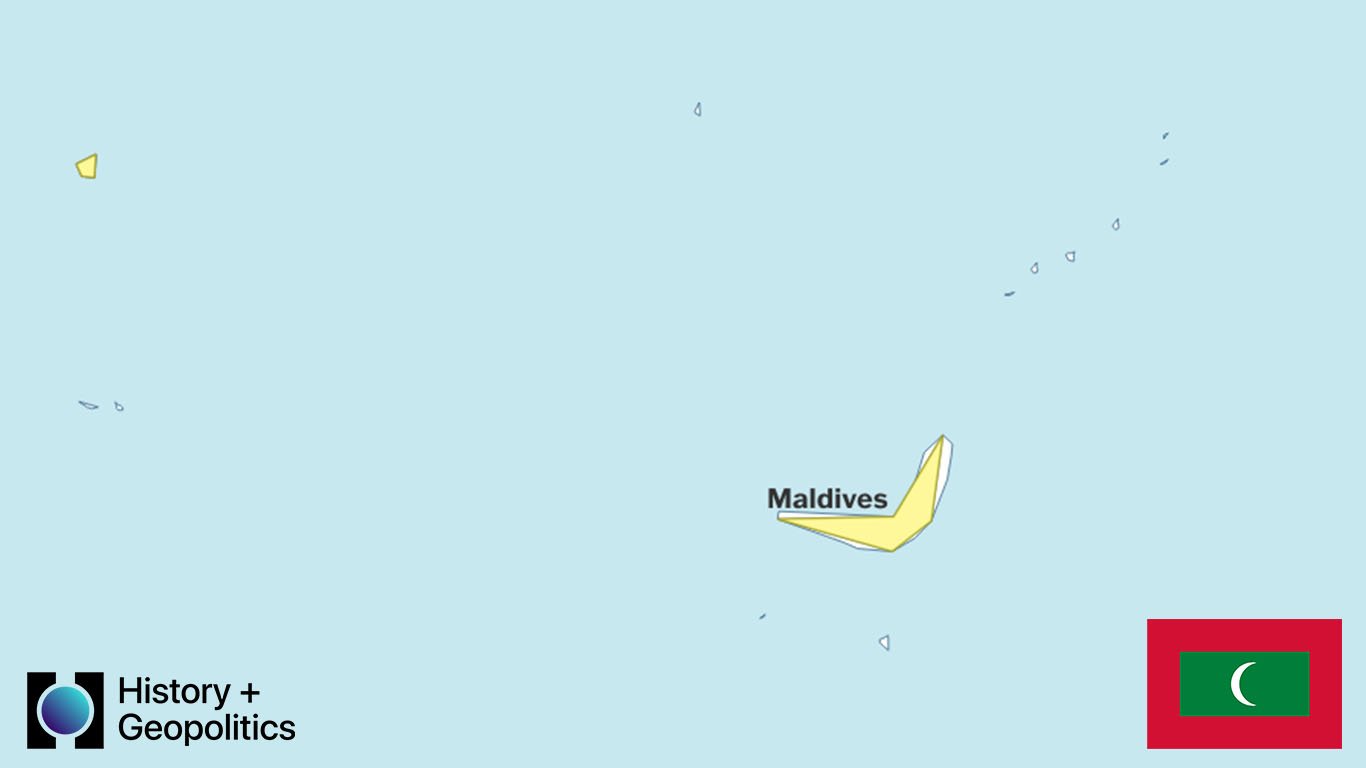
Maldives is located in the Indian Ocean, a small island nation situated southwest of Sri Lanka and India. It has no land borders, surrounded entirely by the Indian Ocean, making it one of the most geographically dispersed countries in the world.
Maldives Facts
- OFFICIAL NAME: Republic of Maldives
- CAPITAL: Malé
- POPULATION: 531,517 (2026)
- AREA: 300 square kilometers
- OFFICIAL LANGUAGE: Dhivehi
- CURRENCY: Maldivian Rufiyaa (MVR)
Maldives Flag
The flag of Maldives has a red border surrounding a green rectangle in the center, with a white crescent moon in the middle of the green section. The red represents the blood of the national heroes who defended the country. The green represents peace and prosperity as well as the coconut palms that cover the islands. The white crescent moon represents Islam, the official state religion of the Maldives. The flag design reflects the deep Islamic identity of the Maldivian people and has been used in various forms for centuries, with the current design officially adopted in 1965 upon independence.
Maldives Geography
- Located in the Indian Ocean, southwest of Sri Lanka and India.
- An archipelago of 26 natural atolls comprising over 1,200 coral islands, of which approximately 200 are inhabited.
- No land borders, surrounded entirely by the Indian Ocean.
- The Maldives is the smallest country in Asia by both land area and population.
- The islands are extremely low-lying, with an average ground level of just 1.5 meters above sea level, making it the lowest-lying country in the world.
- The highest natural point in the entire country rises to only about 2.4 meters above sea level.
- The country stretches approximately 820 kilometers from north to south but spans a width of only about 130 kilometers at its widest.
- The Maldives has a tropical climate, warm and humid throughout the year, with a wet monsoon season and a drier season.
- The country is severely threatened by rising sea levels due to climate change, with many islands at risk of becoming uninhabitable within decades.
- The capital, Malé, is one of the most densely populated cities in the world, housing approximately a third of the country’s entire population.
Watch Geography of Maldives on YouTube
Maldives Government
- The Maldives is a presidential republic.
- The President serves as both head of state and head of government.
- Mohamed Muizzu has served as President since November 2023.
- The Maldives has a unicameral People’s Majlis as its parliament.
- The Maldives gained independence from Britain on July 26, 1965.
- The country transitioned from a sultanate to a republic in 1968.
- The Maldives has experienced significant political turbulence in recent years, including tensions between pro-India and pro-China political factions.
- President Muizzu has pursued a closer relationship with China and requested the withdrawal of Indian military personnel from the islands.
History of Maldives
- The Maldives has been inhabited for at least 2,500 years, with the earliest settlers believed to have come from Sri Lanka and southern India.
- Arab traders arrived in the 12th century and the islands converted to Islam in 1153 A.D., a transition that has permanently shaped Maldivian identity.
- The Maldives was ruled as an independent sultanate for most of its history, maintaining trade relationships with Arab, Indian, and later European traders.
- Portugal briefly controlled the islands in the mid-16th century before being expelled.
- The Dutch and later the British established protectorates over the islands during the colonial period.
- The Maldives became a British protectorate in 1887 while maintaining internal self-governance under the sultanate.
- The Maldives gained full independence from Britain on July 26, 1965.
- The sultanate was abolished in 1968 and the Maldives became a republic.
- Maumoon Abdul Gayoom ruled the country as president for 30 years from 1978 to 2008.
- The Maldives adopted a multiparty democratic constitution in 2008, marking a significant political transition.
- The country has gained international attention as one of the most vulnerable nations to climate change and rising sea levels.
People and Culture of Maldives
- The Maldivian people are a homogeneous mix of South Asian, Arab, and African ancestry, reflecting centuries of maritime trade and settlement.
- Dhivehi is the official language, an Indo-Aryan language written in a unique script called Thaana.
- Sunni Islam is the official state religion and is practiced by 100% of the population, deeply embedded in all aspects of daily life, law, and culture.
- Garudhiya, a clear tuna broth served with rice, lime, chili, and onion, is the national dish of the Maldives.
- Mas huni, a breakfast dish of shredded smoked tuna mixed with grated coconut, onion, and chili, is one of the most beloved traditional foods.
- Fishing, particularly for tuna, has been the cornerstone of Maldivian culture and livelihood for centuries.
- Bodu beru, a form of traditional drumming and dance with roots in East African cultural exchange, is one of the most distinctive and energetic forms of Maldivian cultural expression.
Economy of Maldives
- The Maldives has transformed from one of the world’s poorest countries into an upper-middle-income nation, driven almost entirely by tourism.
- Tourism accounts for approximately 28% of GDP directly and much more when indirect effects are included, making it the most tourism-dependent economy in the world.
- The Maldives pioneered the concept of luxury resort islands, with each resort occupying its own private island, attracting high-spending visitors from around the world.
- Fishing, particularly skipjack tuna, remains the second most important economic sector and is central to both exports and domestic food security.
- The country faces significant economic challenges from climate vulnerability, high import costs, and dependence on a single industry.
- The government has invested in developing Malé as a regional hub and is exploring new economic opportunities in services and logistics.
Maldives Resources
- The surrounding Indian Ocean waters are the country’s most significant natural resource, providing tuna and other marine species for export and domestic consumption.
- The Maldives uses a pole-and-line fishing method for tuna, considered one of the most sustainable fishing techniques in the world.
- The coral reefs surrounding the islands are among the most biodiverse marine ecosystems on Earth and are the foundation of the tourism industry.
- The country has no significant mineral or agricultural resources due to its tiny land area and sandy, infertile soil.
- Solar energy is being developed as a renewable resource to reduce the high cost of imported fuel for electricity generation.
Maldives Wildlife
- The Maldives’ coral reef ecosystems support extraordinary marine biodiversity, making it one of the world’s premier diving and snorkeling destinations.
- The whale shark, the world’s largest fish, is commonly sighted in Maldivian waters, particularly around South Ari Atoll, where they gather year-round.
- Manta rays are found in significant numbers throughout the atolls, with several cleaning stations where they gather regularly.
- The Maldives supports a rich variety of reef sharks including blacktip, whitetip, and nurse sharks, as well as hammerhead sharks in deeper waters.
- Five species of sea turtles visit or nest in the Maldives, including the green turtle and hawksbill turtle.
- Coral bleaching events caused by rising ocean temperatures pose the most critical threat to the Maldives’ coral reefs and the marine life that depends on them.
- Conservation efforts focus on protecting coral reefs, whale sharks, and manta rays through marine protected areas and sustainable tourism practices.