Madagascar Country Profile
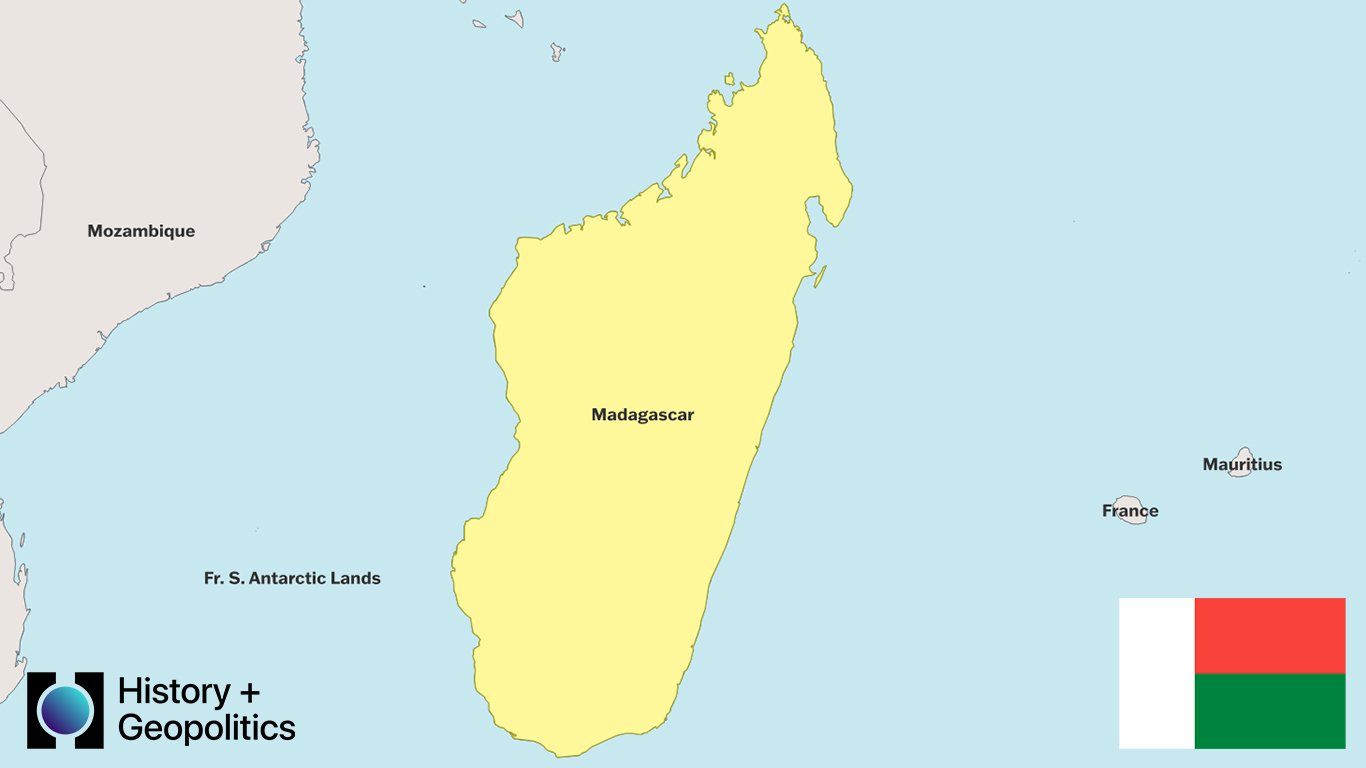
Madagascar is located in the Indian Ocean off the southeastern coast of Africa, the fourth largest island in the world. It lies approximately 400 kilometers east of Mozambique, separated from the African mainland by the Mozambique Channel, with no land borders, surrounded entirely by the Indian Ocean.
Madagascar Facts
- OFFICIAL NAME: Republic of Madagascar
- CAPITAL: Antananarivo
- POPULATION: 33,522,052 (2026)
- AREA: 587,041 square kilometers
- OFFICIAL LANGUAGES: Malagasy, French
- CURRENCY: Malagasy Ariary (MGA)
Madagascar Flag
The flag of Madagascar has a vertical white stripe on the hoist side and two equal horizontal stripes — red on top and green on the bottom — on the right side. The white represents purity and the Merina royal tradition, the red represents sovereignty and the memory of the highland rulers, and the green represents the coastal peoples and hope for the future. The colors also reflect the historical identity of the two main groups that shaped Madagascar — the highland Merina people and the coastal Malagasy peoples — as well as broader Pan-African symbolism.
Madagascar Geography
- Located in the Indian Ocean, approximately 400 kilometers off the southeastern coast of Africa across the Mozambique Channel.
- The fourth largest island in the world, after Greenland, New Guinea, and Borneo.
- No land borders, surrounded entirely by the Indian Ocean.
- The terrain is dominated by a central highland plateau running north to south, flanked by a narrow coastal plain in the east and a wider plain in the west.
- The Tsaratanana Massif in the north contains the highest peak, Maromokotro, rising to 2,876 meters.
- The eastern coast receives heavy rainfall from the Indian Ocean trade winds, supporting dense rainforests.
- The west and south are progressively drier, transitioning to dry deciduous forest and eventually desert in the far south.
- Madagascar has a tropical climate, with significant variation between the wet eastern coast and the drier west and south.
- The island is frequently affected by tropical cyclones during the rainy season.
Watch Madagascar Geography On Youtube
Madagascar Government
- Madagascar is a presidential republic.
- The President serves as head of state and holds significant executive authority.
- Andry Rajoelina has served as President since 2019 and was re-elected in a controversial election in 2023.
- Madagascar has a bicameral parliament consisting of the National Assembly and the Senate.
- The country has experienced significant political instability since independence, with multiple coups and constitutional crises.
History of Madagascar
- Madagascar was one of the last large landmasses on Earth to be settled by humans, with the first inhabitants arriving from Southeast Asia, likely from Borneo, approximately 1,500 to 2,000 years ago.
- Subsequent waves of Bantu-speaking African people arrived from the mainland, creating the unique blend of Southeast Asian and African cultures that defines Malagasy identity.
- Arab traders established contacts with the island from around the 7th century A.D., bringing Islam to some coastal communities.
- The Merina Kingdom in the central highlands became the dominant power on the island in the 18th and 19th centuries, eventually unifying much of Madagascar.
- France established colonial control over Madagascar in 1896, suppressing the Merina monarchy.
- A major uprising against French rule in 1947 was brutally suppressed, with an estimated 11,000 to 90,000 Malagasy killed.
- Madagascar gained independence from France on June 26, 1960.
- The country has experienced repeated political crises, coups, and disputed elections since independence, limiting economic development and stability.
Read more about Libya country profile
People and Culture of Madagascar
- The Malagasy people are of mixed Southeast Asian and African descent, with the island’s 18 recognized ethnic groups sharing a common Malagasy language and cultural framework.
- The Merina of the central highlands are the largest ethnic group, followed by the Betsimisaraka along the eastern coast.
- Malagasy and French are both official languages, with Malagasy spoken by the entire population and French used in government, education, and business.
- The majority of the population practices a blend of Christianity and traditional indigenous beliefs, with the veneration of ancestors, known as the cult of razana, playing a central role in Malagasy spiritual life.
- Romazava, a stew of zebu beef and green leaves, is considered the national dish of Madagascar.
- Rice is the foundation of virtually every meal in Madagascar, consumed three times a day by most Malagasy people.
- The famadihana, or turning of the bones, is a distinctive Malagasy funerary tradition in which the remains of ancestors are exhumed, rewrapped in fresh cloth, and celebrated with music and dancing before being reinterred.
Economy of Madagascar
- Madagascar is one of the poorest countries in the world, with the majority of the population living below the poverty line.
- Agriculture employs approximately 80% of the workforce, with rice, vanilla, cloves, and lychees among the most important products.
- Madagascar is the world’s largest producer of vanilla, supplying approximately 80% of the global natural vanilla market.
- Mining is a growing sector, with significant deposits of nickel, cobalt, ilmenite, chromite, and sapphires.
- Ecotourism has significant potential but remains underdeveloped due to poor infrastructure and political instability.
- The country faces serious challenges including cyclone vulnerability, deforestation, food insecurity, and weak governance.
Madagascar Resources
- Madagascar is the world’s leading producer of natural vanilla, which is among its most economically valuable agricultural exports.
- Significant mineral deposits include nickel, cobalt, and ilmenite, with several large mining projects operating in the country.
- The island is one of the world’s most important sources of sapphires and other precious stones.
- Vast fishing resources exist in the surrounding Indian Ocean waters.
- Madagascar’s extraordinary biodiversity, found nowhere else on Earth, represents an enormous potential resource for ecotourism and pharmaceutical research.
Madagascar Wildlife
- Madagascar is one of the world’s most remarkable biodiversity hotspots, with approximately 90% of its wildlife found nowhere else on Earth due to its 88 million years of isolation from the African mainland.
- Lemurs, primates found only in Madagascar, are the island’s most iconic animals, with over 100 species ranging from the tiny mouse lemur to the large indri.
- The fossa, a cat-like carnivore and Madagascar’s largest predator, is found only on the island.
- The island has over 300 species of birds, the majority of which are endemic, including the remarkable ground-roller and the colorful vangas.
- Madagascar’s chameleons are legendary, with the island hosting more than half of the world’s chameleon species, including both the world’s largest and the world’s smallest.
- Deforestation is the most critical threat to Madagascar’s extraordinary wildlife, with approximately 90% of the island’s original forest cover already lost.
- Conservation efforts by numerous international organizations focus on protecting the remaining rainforests and endemic species from logging, slash-and-burn agriculture, and illegal wildlife trade.