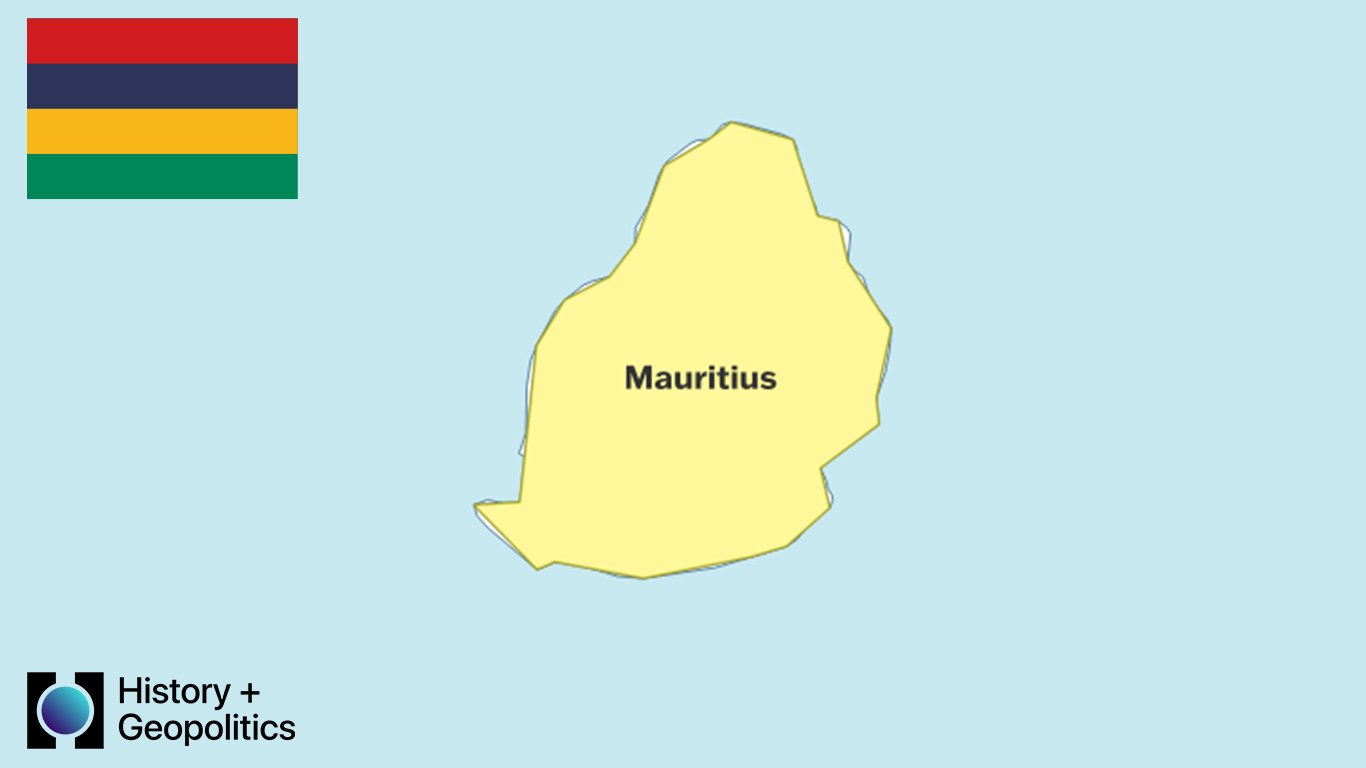
Mauritius Country Profile
Mauritius is located in the Indian Ocean, an island nation situated approximately 2,000 kilometers off the southeastern coast of Africa. It lies east of Madagascar, with no land borders, surrounded entirely by the Indian Ocean.
Mauritius Facts
- OFFICIAL NAME: Republic of Mauritius
- CAPITAL: Port Louis
- POPULATION: 1,265,059 (2026)
- AREA: 2,040 square kilometers
- OFFICIAL LANGUAGE: English
- CURRENCY: Mauritian Rupee (MUR)
Mauritius Flag
The flag of Mauritius has four equal horizontal stripes — red on top, blue second, yellow third, and green on the bottom. The red represents the struggle for independence and the blood shed during that struggle. The blue represents the Indian Ocean surrounding the island. The yellow represents the bright future of the country and the light of independence shining over the island. The green represents the lush vegetation and year-round greenery of Mauritius. The four-color flag, adopted upon independence in 1968, is one of the most colorful national flags in the world and reflects the island’s vibrant multicultural identity.
Mauritius Geography
- Located in the Indian Ocean, approximately 2,000 kilometers off the southeastern coast of Africa.
- Lies east of Madagascar with no land borders, surrounded entirely by the Indian Ocean.
- The Republic of Mauritius includes the main island of Mauritius, Rodrigues Island, and the outer islands of the Agalega Islands and St. Brandon.
- The main island is of volcanic origin, with a central plateau surrounded by coastal plains.
- The highest peak, Piton de la Petite Rivière Noire, rises to 828 meters in the southwest.
- Mauritius has a tropical climate, warm and humid throughout the year, with a hot wet season and a cooler dry season.
- The island is surrounded by coral reefs that protect much of the coastline from ocean swells.
- Mauritius is located in the cyclone belt and is periodically affected by tropical cyclones.
- The island is one of the most densely populated countries in the world, with over 600 people per square kilometer.
Read more about: The American History
Mauritius Government
- Mauritius is a parliamentary republic.
- The President serves as head of state with largely ceremonial duties.
- The Prime Minister serves as head of government, holding executive authority.
- Mauritius has a unicameral National Assembly.
- Navin Ramgoolam has served as Prime Minister since November 2024, returning to office after winning a landslide election.
- Mauritius gained independence from Britain on March 12, 1968, and became a republic in 1992.
- Mauritius is widely regarded as one of the most stable and well-governed countries in Africa, consistently ranking at the top of governance and economic freedom indices for the continent.
History of Mauritius
- Mauritius was uninhabited before the arrival of Arab sailors who may have visited as early as the 10th century.
- Portuguese explorers arrived in the early 16th century and named the island Ilha do Cirne.
- The Dutch established the first permanent settlement in 1638, naming the island after Prince Maurice of Nassau, and introduced sugar cane cultivation.
- The Dutch abandoned the island in 1710, and France took possession in 1715, renaming it Isle de France.
- Under French rule, Mauritius became a prosperous sugar colony using enslaved African and Malagasy labor.
- Britain captured Mauritius in 1810 during the Napoleonic Wars and formally received it under the Treaty of Paris in 1814.
- Britain abolished slavery in 1835, and over 450,000 indentured laborers from India were brought to work the sugar plantations between 1834 and 1920, fundamentally shaping the island’s demographic character.
- Mauritius gained independence from Britain on March 12, 1968.
- Since independence, Mauritius has transformed from a low-income sugar-dependent economy into one of Africa’s most prosperous and diversified nations.
- The dodo, a large flightless bird found only on Mauritius, became extinct in the late 17th century following Dutch settlement, becoming one of the most famous cases of human-caused extinction.
People and Culture of Mauritius
- Mauritius is one of the most ethnically and culturally diverse countries in the world for its size.
- Indo-Mauritians, descendants of Indian indentured laborers, make up approximately 68% of the population.
- Creoles, of mixed African and European descent, make up approximately 27%, while Sino-Mauritians and Franco-Mauritians form smaller communities.
- English is the official language of government and education, though Mauritian Creole is the most widely spoken language in daily life, with French, Hindi, Bhojpuri, and other languages also commonly used.
- Hinduism is the largest religion at approximately 48.5%, followed by Christianity at around 32%, Islam at around 17%, and other faiths.
- Dholl puri, a thin flatbread filled with ground split peas and served with curry and chutney, is one of the most beloved street foods in Mauritius.
- Biryani, a spiced rice dish with meat, reflects the island’s strong South Asian culinary heritage.
- Mauritius is home to a remarkable blend of Hindu, Muslim, Christian, and Chinese festivals all celebrated side by side throughout the year.
Economy of Mauritius
- Mauritius has one of the highest per capita incomes in Africa, driven by tourism, financial services, manufacturing, and information technology.
- Tourism is the most important sector, attracting visitors with the island’s beaches, luxury resorts, coral reefs, and multicultural atmosphere.
- Financial services have grown into a significant sector, with Mauritius establishing itself as a major international financial center and investment hub for Africa.
- The textile and apparel manufacturing industry has been an important employer since the 1970s.
- Sugar production, once the backbone of the economy, remains present but has declined significantly in relative importance.
- Mauritius has been working to develop its ocean economy, digital economy, and medical tourism sectors as new growth areas.
Mauritius Resources
- The surrounding Indian Ocean waters provide fishing resources, including tuna and other pelagic species.
- The coral reefs surrounding the island are among its most valuable resources, supporting both tourism and marine biodiversity.
- The island has no significant mineral resources, relying on its human capital, strategic location, and governance quality as its primary economic assets.
- Fertile volcanic soil supports sugar cane cultivation along with tea, vegetables, and tropical fruit production.
- Mauritius has significant potential for ocean thermal energy conversion and other forms of ocean-based renewable energy given its extensive maritime territory.
Mauritius Wildlife
- Mauritius is most famous for the dodo, a large flightless bird that became extinct in the late 17th century and has since become a global symbol of human-caused extinction.
- Several other endemic bird species survive on the island, including the Mauritius kestrel, pink pigeon, and echo parakeet, all of which were brought back from the brink of extinction through intensive conservation efforts.
- The Mauritius kestrel recovery is considered one of the greatest success stories in conservation history, with the population recovering from just four known individuals in 1974 to several hundred today.
- The surrounding coral reefs support rich marine biodiversity including reef sharks, sea turtles, dolphins, and hundreds of fish species.
- Rodrigues Island, part of the Republic of Mauritius, has its own endemic species including the Rodrigues fruit bat and several endemic bird species.
- The Black River Gorges National Park on the main island protects the largest remaining area of native forest and provides habitat for the island’s most endangered endemic species.
- Conservation efforts in Mauritius have become internationally recognized models for island species recovery and ecosystem restoration.