Mauritania Country Profile
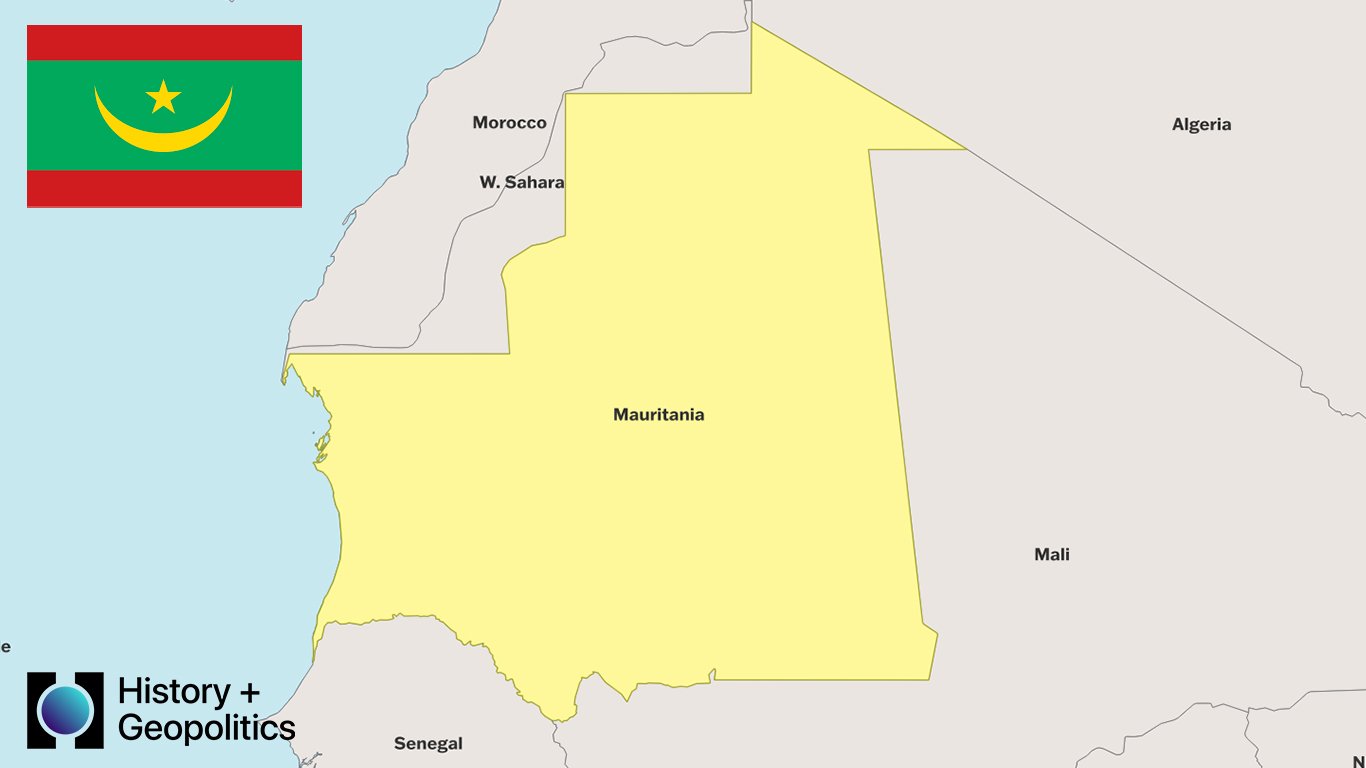
Mauritania is located in Northwest Africa, a large country bordered by Western Sahara to the north and northwest, Algeria to the northeast, Mali to the east and southeast, Senegal to the south, and the Atlantic Ocean to the west.
Mauritania Facts
- OFFICIAL NAME: Islamic Republic of Mauritania
- CAPITAL: Nouakchott
- POPULATION: 5,461,319 (2026)
- AREA: 1,030,700 square kilometers
- OFFICIAL LANGUAGE: Arabic
- CURRENCY: Mauritanian Ouguiya (MRU)
Mauritania Flag
The flag of Mauritania has a green background with a golden crescent moon and a golden five-pointed star in the center, with a red stripe along the top and bottom edges. The green represents Islam and the fertile lands of the country. The golden crescent and star are symbols of Islam, the state religion. The red stripes were added in 2017 to represent the blood shed by defenders of the nation. The flag reflects Mauritania’s deep Islamic identity and its position as a bridge between the Arab world of North Africa and the sub-Saharan African nations to the south.
Mauritania Geography
- Located in Northwest Africa, one of the largest countries on the continent.
- Borders: Western Sahara to the north and northwest, Algeria to the northeast, Mali to the east and southeast, Senegal to the south.
- The Atlantic Ocean forms the entire western coastline.
- Approximately 90% of Mauritania’s land area is covered by the Sahara Desert.
- The terrain is mostly flat desert plains with some hills and low mountains in the north and center.
- The Adrar Plateau in the center is one of the most dramatic desert landscapes, featuring ancient caravan towns and rock formations.
- The fertile Senegal River valley in the south is the most productive agricultural zone and the most densely populated region.
- Mauritania has an extremely hot and arid climate, with very little rainfall across most of the country.
- The Atlantic coastline in the west provides cooler temperatures and one of the most productive fishing zones in the world.
- Desertification is an ongoing and serious environmental challenge as the Sahara continues to expand southward.
Watch video on YouTube: Mauritania Geography
Mauritania Government
- Mauritania is a presidential republic.
- The President serves as both head of state and head of government with extensive executive authority.
- Mohamed Ould Ghazouani has served as President since 2019 and was re-elected in 2024.
- Mauritania has a bicameral parliament consisting of the National Assembly and the Senate.
- Mauritania has experienced several military coups since independence, most recently in 2008.
- The country has been relatively stable under Ghazouani compared to its turbulent political history.
History of Mauritania
- The region has been inhabited since prehistoric times, with ancient rock art found in the Sahara dating back thousands of years.
- The Ghana Empire and later the Almoravid dynasty, which originated in present-day Mauritania, were powerful medieval states that shaped the history of West Africa and North Africa.
- The Almoravids spread Islam across the region and into Spain in the 11th century, leaving a lasting cultural and religious legacy.
- Arab Beni Hassan tribes migrated into the region in the 17th century, displacing or assimilating the Berber population and establishing the Arab-Berber culture known as Moorish culture.
- France established colonial control over the territory in the late 19th and early 20th centuries, incorporating it into French West Africa.
- Mauritania gained independence from France on November 28, 1960.
- The country claimed and briefly administered the southern part of Western Sahara following Spain’s withdrawal in 1976, before renouncing its claim under pressure from the Polisario Front in 1979.
- Mauritania experienced military coups in 1978, 1984, 2005, and 2008.
- Slavery, though officially abolished multiple times, remained a significant social reality, with Mauritania being among the last countries in the world to criminalize it in 1981 and to prosecute slaveholders in 2007.
People and Culture of Mauritania
- The Haratines, also known as Black Moors, are descendants of formerly enslaved sub-Saharan Africans and make up approximately 40% of the population.
- The Beydane, or White Moors, are Arab-Berber descendants and make up approximately 30% of the population.
- Sub-Saharan African ethnic groups including the Wolof, Toucouleur, Soninke, and Fula make up the remaining 30%, concentrated mainly in the south.
- Arabic is the official language, with Hassaniya Arabic spoken by the Moorish population and various sub-Saharan African languages spoken in the south.
- Islam is the official state religion practiced by 100% of the population, making Mauritania one of the most homogeneously Muslim countries in the world.
- Thiéboudienne, a dish of rice cooked with fish and vegetables, is popular in Mauritania, shared with Senegalese culinary tradition.
- Méchoui, slow-roasted whole lamb, is a centerpiece of Mauritanian hospitality and celebrations.
- The traditional Moorish tea ceremony, serving three glasses of sweet mint tea in succession, is one of the most important social rituals in Mauritanian culture.
Economy of Mauritania
- Mauritania has a lower-middle-income economy driven by fishing, iron ore mining, and increasingly oil and gas production.
- The Atlantic coastline off Mauritania is one of the most productive fishing zones in the world, and fishing licenses granted to foreign fleets are a major source of government revenue.
- Iron ore mining in the north, particularly at the Zouerate mines, is the most important mining sector and one of the largest sources of export revenue.
- Offshore oil and gas production has grown significantly, with Mauritania becoming a notable energy producer.
- Agriculture is limited by the desert climate, confined mainly to the Senegal River valley in the south.
- Mauritania faces significant development challenges including poverty, food insecurity, and the social legacy of historical slavery.
Mauritania Resources
- The Atlantic waters off Mauritania’s coast represent one of the most valuable fishing zones in the world, attracting international fleets and generating significant license revenues.
- Iron ore deposits in the Tiris Zemmour region in the northeast are among the most significant mineral resources.
- Offshore oil and gas reserves, particularly in the Chinguetti and Greater Tortue Ahmeyim fields shared with Senegal, represent growing energy resources.
- Gold deposits have been identified in various parts of the country and are being developed.
- The ancient caravan towns of the Adrar region, including Chinguetti, Ouadane, and Tichitt, represent significant cultural heritage resources recognized by UNESCO.
Mauritania Wildlife
- Mauritania’s diverse environments, from Atlantic coastline to Sahara Desert and Sahel savanna, support a range of wildlife.
- The Banc d’Arguin National Park on the Atlantic coast, a UNESCO World Heritage Site, is one of the most important bird sanctuaries in the world, hosting millions of migratory waterbirds including flamingos, pelicans, and numerous wading bird species.
- The park’s shallow coastal waters also support significant populations of dolphins, sea turtles, and manatees.
- The Saharan regions support Dama gazelle, Dorcas gazelle, and Saharan cheetah in very small numbers.
- The Addax antelope, critically endangered, was once found across Mauritania’s Saharan regions but has been pushed to the brink of extinction.
- The monk seal colony at Cap Blanc on the Atlantic coast is one of the last remaining Mediterranean monk seal populations in the eastern Atlantic, making it one of the most important marine mammal conservation sites in Africa.
- Conservation efforts focus on protecting the Banc d’Arguin ecosystem and the critically endangered monk seal colony.