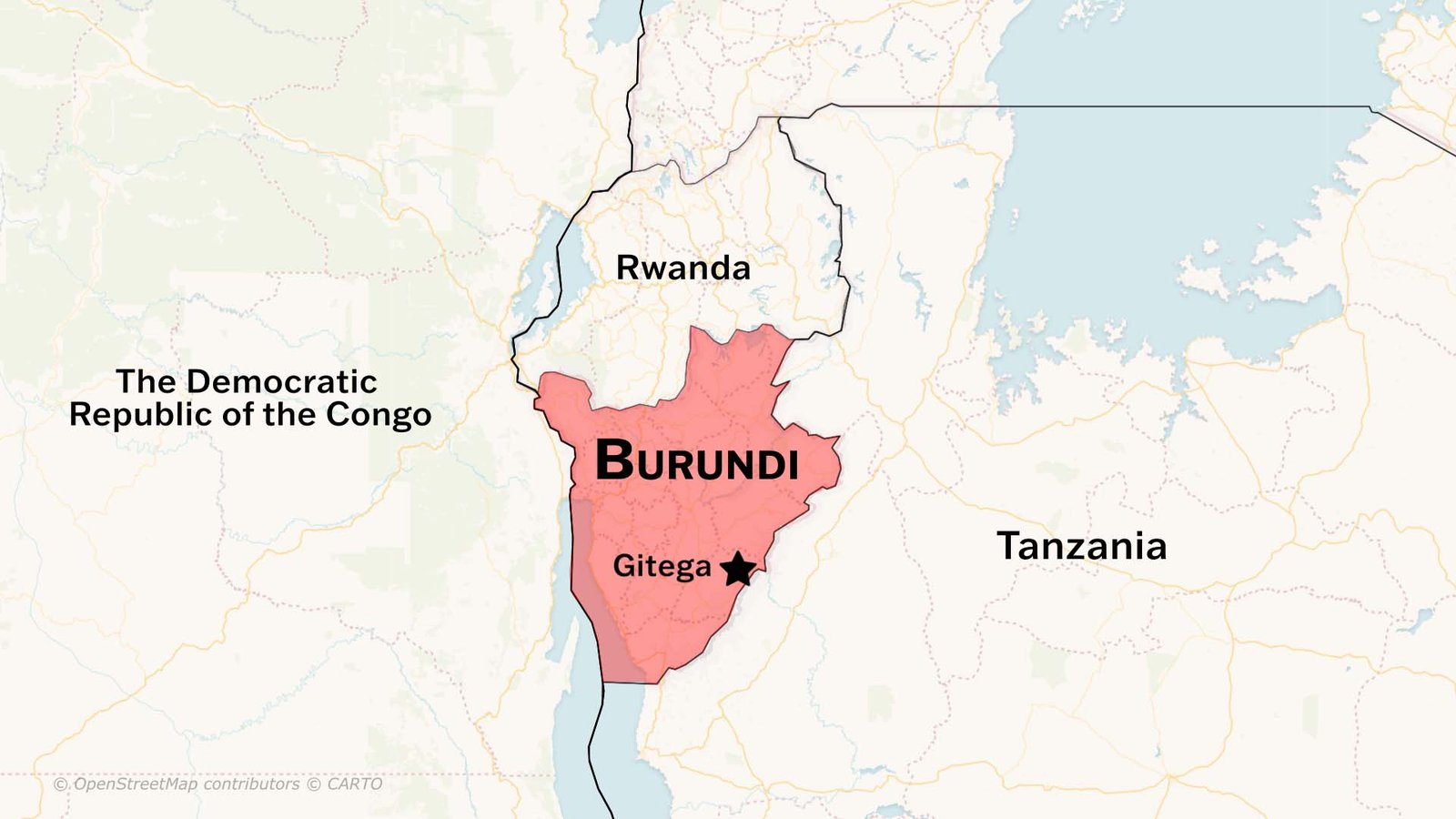
Burundi Country Profile
Burundi is located in East-Central Africa, a landlocked country bordered by Rwanda to the north, Tanzania to the east and south, and the Democratic Republic of the Congo to the west. Lake Tanganyika lies along its southwestern border.
Burundi Facts
- OFFICIAL NAME: Republic of Burundi
- CAPITAL: Gitega (official), Bujumbura (economic capital)
- POPULATION: 14,729,157 (2026)
- AREA: 27,834 square kilometers
- OFFICIAL LANGUAGES: Kirundi, French, English
- CURRENCY: Burundian Franc (BIF)
Burundi Flag
The flag of Burundi has a white diagonal cross dividing it into four sections — red in the upper and lower sections and green on the left and right sides. In the center sits a white circle containing three red six-pointed stars outlined in green. The red represents the suffering and sacrifice of those who fought for independence, the green symbolizes hope and the country’s future development, and the white represents peace. The three stars represent the three main ethnic groups of Burundi — the Hutu, Tutsi, and Twa peoples — and the national motto of unity, work, and progress.
Burundi Geography
- Located in East-Central Africa, completely landlocked with no access to the sea.
- Borders: Rwanda to the north, Tanzania to the east and south, Democratic Republic of the Congo to the west.
- Lake Tanganyika, one of the world’s deepest and largest lakes, borders the country to the southwest.
- Burundi is one of the most densely populated countries in Africa despite its small land area.
- The terrain is mostly hilly and mountainous, with some flat land along Lake Tanganyika.
- The Congo-Nile Divide runs through the country, separating river systems flowing into the Congo and Nile basins.
- Burundi has a tropical highland climate, with temperatures moderated by elevation.
- The country has two rainy seasons and two dry seasons each year.
- The Ruvubu River, flowing through the northeast, is considered one of the most remote headwaters of the Nile River.
Burundi Government
- Burundi is a presidential republic.
- The President serves as both head of state and head of government.
- Burundi has a bicameral parliament consisting of the National Assembly and the Senate.
- The country has experienced significant political tension since the controversial decision by President Pierre Nkurunziza to seek a third term in 2015, which triggered protests and violence.
- Évariste Ndayishimiye has served as President since 2020 following elections held after Nkurunziza’s death.
History of Burundi
- The Twa people are the earliest known inhabitants of the region, followed by the Hutu and Tutsi peoples who arrived over subsequent centuries.
- The Kingdom of Burundi emerged as a distinct political entity in the 16th century, with a complex social hierarchy.
- Germany colonized Burundi as part of German East Africa in the late 19th century.
- After World War I, Belgium took control of the territory under a League of Nations mandate.
- Burundi gained independence from Belgium on July 1, 1962, initially as a kingdom.
- The country became a republic in 1966 following a military coup that abolished the monarchy.
- Ethnic tensions between Hutu and Tutsi populations led to repeated episodes of mass violence and civil conflict throughout the 1970s, 1980s, and 1990s.
- A civil war lasting from 1993 to 2005 resulted in an estimated 300,000 deaths and massive displacement.
- The Arusha Peace Agreement in 2000 and subsequent negotiations helped bring an end to the civil war.
- Political tensions and human rights concerns have continued in recent years.
People and Culture of Burundi
- The Hutu make up the majority of the population, with the Tutsi forming a significant minority, and the Twarepresenting a very small indigenous community.
- Kirundi is the national language spoken by virtually all Burundians, with French and English also serving as official languages.
- Roman Catholicism is the largest religion, with Protestant Christianity and a small Muslim minority also present.
- Ugali, a thick maize or cassava porridge, is a staple food commonly eaten with beans, vegetables, or meat.
- Drumming holds profound cultural and spiritual significance in Burundian culture, with the Royal Drummers of Burundi recognized as a UNESCO cultural heritage tradition.
- Burundian society places strong emphasis on communal values, family ties, and respect for elders.
- Coffee is an important part of daily social life as well as a major agricultural export.
Economy of Burundi
- Burundi is one of the poorest countries in the world, with an economy heavily dependent on subsistence agriculture.
- Coffee and tea are the primary export crops and the main sources of foreign exchange earnings.
- Agriculture employs the vast majority of the population, with subsistence farming of beans, cassava, and maize widespread.
- Burundi faces significant challenges including food insecurity, limited infrastructure, and heavy dependence on foreign aid.
- The landlocked geography significantly increases the cost of trade and limits economic connectivity.
- Mining of nickel, gold, and other minerals presents potential future economic opportunities that remain largely underdeveloped.
Burundi Resources
- Burundi has deposits of nickel, which represent one of the country’s most significant untapped mineral resources.
- Gold, cobalt, copper, and platinum have also been identified in various parts of the country.
- Lake Tanganyika provides fishing resources that are important for both local food supply and small-scale trade.
- Fertile highland soils support coffee and tea cultivation, the country’s most valuable agricultural exports.
- The country’s rivers and elevated terrain offer some potential for hydropower development.
Burundi Wildlife
- Burundi’s highland forests, wetlands, and lake shores support a variety of wildlife despite the country’s small size and dense population.
- Chimpanzees inhabit the Kibira National Park in the northwest, one of the largest montane rainforests in East Africa.
- Hippopotamuses are found along the shores of Lake Tanganyika and in some river systems.
- Lake Tanganyika is home to an extraordinary number of endemic fish species, particularly cichlids, found nowhere else on Earth.
- Various monkey species, including red colobus and vervet monkeys, inhabit the remaining forest areas.
- Deforestation and population pressure have significantly reduced wildlife habitats across much of the country.
- Conservation efforts focus on protecting the Kibira and Ruvubu national parks as key refuges for Burundi’s remaining wildlife.