Ghana Country Profile
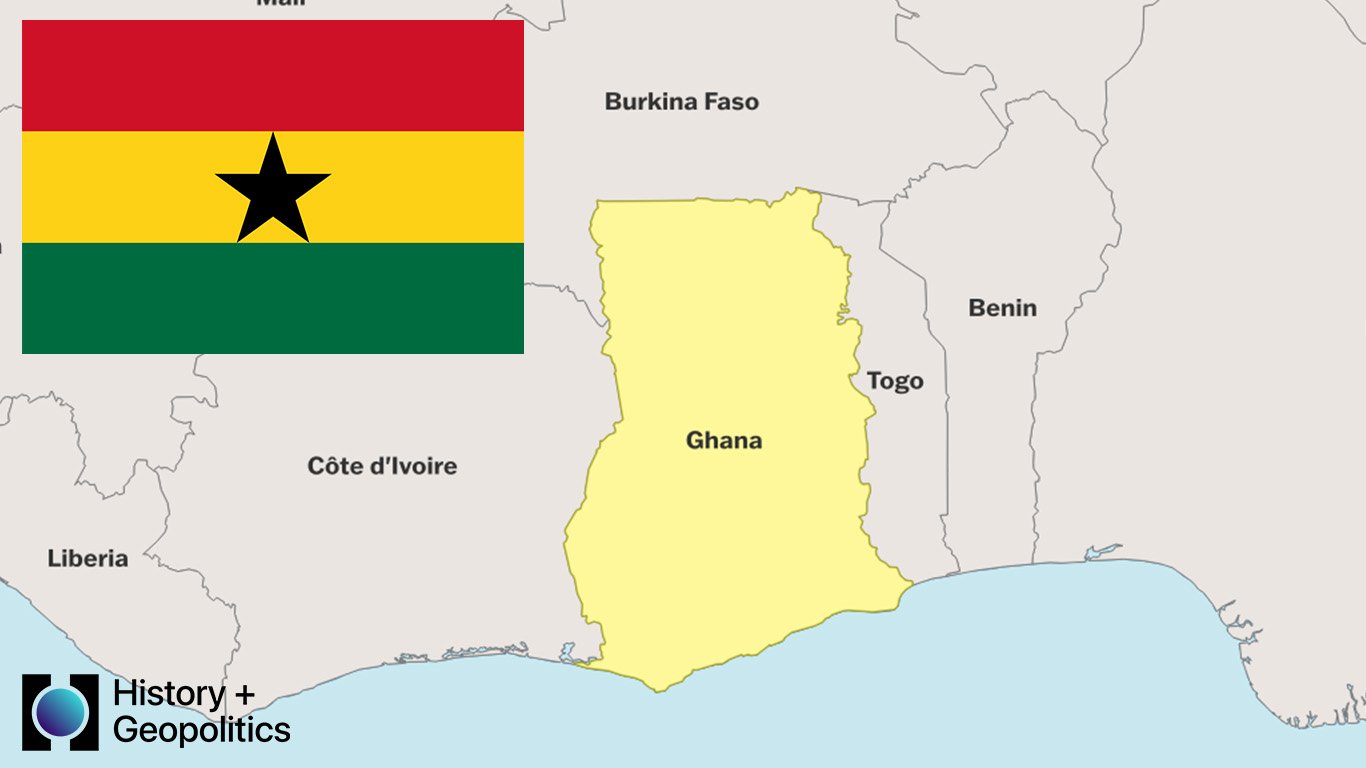
Ghana is located in West Africa, bordered by Côte d’Ivoire to the west, Burkina Faso to the north, Togo to the east, and the Gulf of Guinea and the Atlantic Ocean to the south.
Ghana Facts
- OFFICIAL NAME: Republic of Ghana
- CAPITAL: Accra
- POPULATION: 35,697,557 (2026)
- AREA: 238,533 square kilometers
- OFFICIAL LANGUAGE: English
- CURRENCY: Ghanaian Cedi (GHS)
Ghana Flag
The flag of Ghana has three equal horizontal stripes — red on top, gold in the middle, and green on the bottom — with a black five-pointed star in the center of the gold stripe. The red represents the blood shed in the struggle for independence, the gold symbolizes the country’s mineral wealth, particularly its gold resources, and the green represents the rich forests and agricultural wealth of the land. The black star, known as the Star of African Freedom, represents the African people and their emancipation from colonial rule. Ghana’s flag was the first to use the Pan-African colors of red, gold, and green, influencing the flags of many other African nations that followed.
Ghana Geography
- Located in West Africa, with a coastline along the Gulf of Guinea to the south.
- Borders: Côte d’Ivoire to the west, Burkina Faso to the north, Togo to the east.
- The terrain is mostly low plains in the south, rising to plateau in the center and north.
- The Volta River basin dominates much of the interior, with Lake Volta — one of the largest man-made lakes in the world — created by the Akosombo Dam.
- The Akwapim-Togo mountain range runs along the eastern border with Togo.
- Mount Afadjato, on the eastern border, is the highest point in Ghana, rising to 885 meters.
- Ghana has a tropical climate, with the south experiencing two rainy seasons and the north having one longer dry season influenced by the harmattan wind.
- The southern coastline features mangroves, lagoons, and beaches along the Gulf of Guinea.
- The northern savanna region transitions into the semi-arid Sahel toward Burkina Faso.
Ghana Government
- Ghana is a presidential republic and one of the most stable democracies in Africa.
- The President serves as both head of state and head of government.
- Ghana has a unicameral parliament called the Parliament of Ghana.
- John Mahama returned to the presidency in January 2025, having previously served from 2012 to 2017.
- Ghana has consistently held peaceful democratic elections since returning to multiparty democracy in 1992 and is widely regarded as a model of democratic governance in West Africa.
History of Ghana
- The region has been home to several powerful pre-colonial kingdoms, including the Ashanti Empire, one of the most powerful and sophisticated states in West Africa.
- The Ashanti Empire was known for its wealth in gold, its skilled artisanship, and its elaborate political structures centered around the Golden Stool, a sacred symbol of the nation.
- Portuguese traders arrived along the coast in 1471, establishing the first European trading post in sub-Saharan Africa at Elmina in 1482.
- The region became known as the Gold Coast due to its abundant gold resources, attracting Dutch, British, Danish, and Swedish traders.
- The Gold Coast became a major hub of the transatlantic slave trade, with numerous forts and castles built along the coastline to hold enslaved Africans before transport to the Americas.
- Britain established colonial control over the Gold Coast in the 19th century after defeating the Ashanti in a series of wars.
- Ghana gained independence from Britain on March 6, 1957, becoming the first sub-Saharan African country to gain independence from colonial rule.
- Kwame Nkrumah, Ghana’s first Prime Minister and later President, became a leading voice of Pan-Africanism and African unity.
- Ghana experienced periods of military rule and political instability before returning to stable democratic governance in 1992.
- Since 1992, Ghana has become a model of democratic stability in Africa, with peaceful transfers of power between opposition parties.
People and Culture of Ghana
- The Akan are the largest ethnic group, making up approximately 46% of the population, and include the Ashanti and Fante subgroups.
- Other significant groups include the Mole-Dagbani in the north, the Ewe in the southeast, and the Ga-Dangmealong the coast near Accra.
- English is the official language, while numerous local languages including Twi, Ewe, Dagbani, and Ga are widely spoken.
- Christianity is the dominant religion, practiced by approximately 71% of the population, with Islam the second largest, particularly in the north.
- Jollof rice, a one-pot rice dish cooked with tomatoes and spices, is one of Ghana’s most beloved and internationally recognized foods.
- Fufu, a dough made from pounded cassava and plantain served with soup, is a staple food particularly associated with Akan culture.
- Kente cloth, a colorful woven fabric with deep cultural significance, is one of Ghana’s most iconic cultural exports and is traditionally associated with Ashanti royalty.
Economy of Ghana
- Ghana has one of the largest and most diversified economies in West Africa.
- Gold is the largest export commodity, with Ghana being one of the top gold producers in Africa and the world.
- Cocoa is the second most important export, with Ghana being one of the world’s leading cocoa producers.
- Oil production from offshore fields discovered in 2007 has become a significant contributor to the economy.
- Ghana has experienced periods of strong economic growth but has also faced challenges including high inflation, currency depreciation, and a debt crisis that led to an IMF bailout program in 2023.
- Services, including finance, trade, and telecommunications, are the largest contributors to GDP.
Ghana Resources
- Ghana has substantial gold reserves, making it one of Africa’s most important gold producers.
- Cocoa-growing land in the southern forest belt is one of Ghana’s most productive agricultural resources.
- Offshore oil and gas fields, particularly the Jubilee Field, represent significant energy resources.
- Bauxite, manganese, and diamonds are also mined and exported.
- Lake Volta provides hydroelectric power through the Akosombo Dam, generating a significant share of Ghana’s electricity.
Ghana Wildlife
- Ghana’s varied ecosystems, from coastal mangroves to tropical forests and northern savanna, support a diverse range of wildlife.
- Mole National Park in the north is Ghana’s largest wildlife reserve, home to elephants, buffalos, hippos, and numerous antelope species.
- The western chimpanzee inhabits the remaining rainforest areas of western Ghana, with Bia National Park serving as an important habitat.
- The kob and roan antelope are found in the savanna regions of the north.
- Ghana’s coastline and lagoons support sea turtles, including leatherback and olive ridley species, which nest on the beaches.
- Deforestation driven by cocoa farming, illegal logging, and galamsey, or illegal small-scale gold mining, poses the most significant threats to Ghana’s wildlife and natural habitats.
- Conservation efforts focus on protecting the remaining forest reserves and national parks from encroachment and illegal resource extraction.