Guyana Country Profile
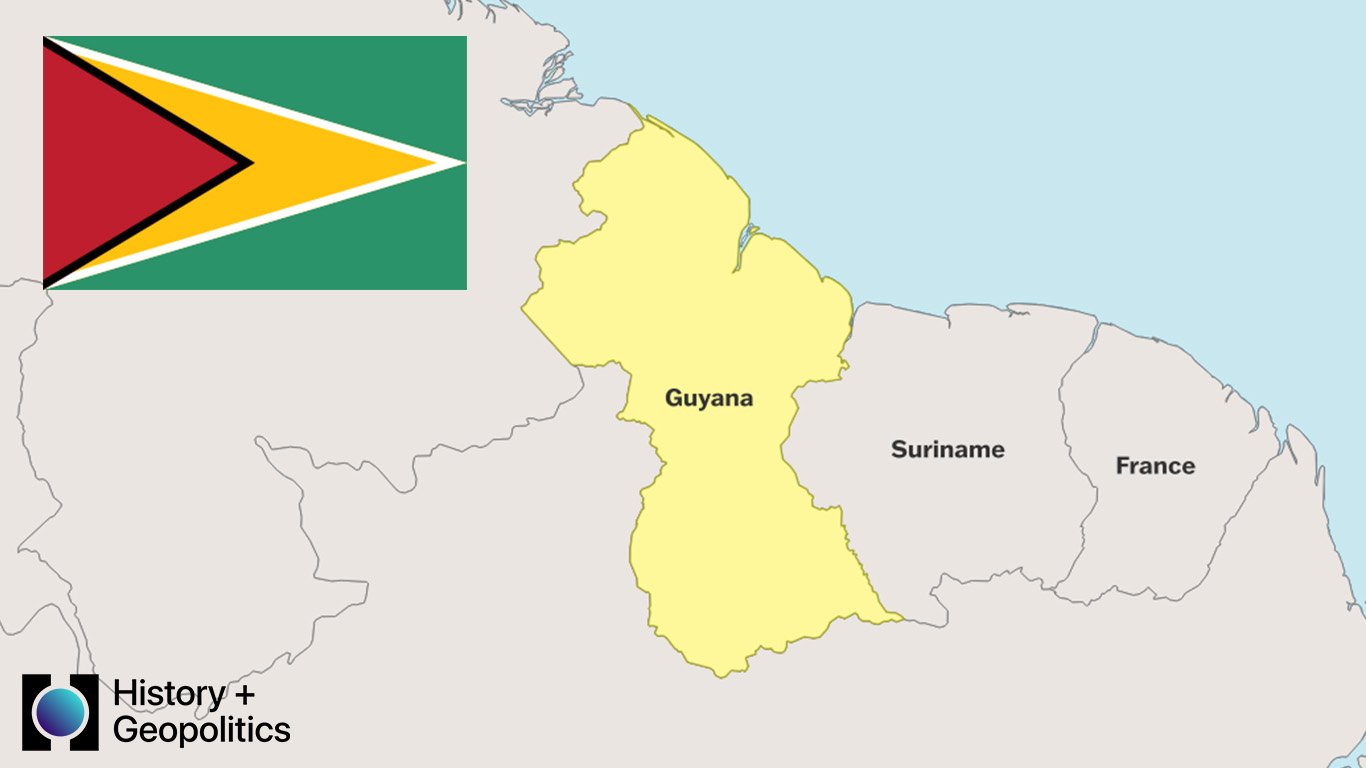
Guyana is located on the northern coast of South America, bordered by Venezuela to the west, Brazil to the south, Suriname to the east, and the Atlantic Ocean to the north. It is the only English-speaking country in South America.
Guyana Facts
- OFFICIAL NAME: Co-operative Republic of Guyana
- CAPITAL: Georgetown
- POPULATION: 840,890 (2026)
- AREA: 214,969 square kilometers
- OFFICIAL LANGUAGE: English
- CURRENCY: Guyanese Dollar (GYD)
Guyana Flag
The flag of Guyana, known as the Golden Arrowhead, has a green background with a white-bordered golden triangle extending from the hoist side and a black-bordered red triangle inside it. The green represents the forests and agricultural land that cover most of the country. The white represents the rivers and water resources. The golden triangle represents the mineral wealth of Guyana, particularly its gold deposits. The black border represents the endurance of the Guyanese people. The red triangle represents the zeal and dynamic nature of the people in nation-building. The flag was adopted upon independence from Britain in 1966 and is one of the most distinctive in the Americas.
Guyana Geography
- Located on the northern coast of South America, the only English-speaking country on the continent.
- Borders: Venezuela to the west, Brazil to the south, Suriname to the east.
- The Atlantic Ocean forms the entire northern coastline.
- The country is divided into three main geographic regions — a narrow coastal plain, an interior forested highland, and southern savannas.
- The coastal plain, though only about 16 kilometers wide, is home to the majority of the population and most of the agricultural land.
- Much of the coastal plain lies below sea level and is protected by a system of dikes and drainage canals built during Dutch colonial rule.
- The interior is dominated by dense tropical rainforest, covering approximately 70% of the country.
- Mount Roraima, on the border with Venezuela and Brazil, is the highest peak at 2,810 meters and is thought to have inspired Sir Arthur Conan Doyle’s novel The Lost World.
- The Essequibo, Demerara, and Berbice rivers are the three major rivers flowing northward to the Atlantic.
- Guyana has some of the most pristine and undisturbed tropical rainforests in South America.
Guyana Government
- Guyana is a presidential republic.
- The President serves as both head of state and head of government.
- Irfaan Ali has served as President since 2020.
- Guyana has a unicameral National Assembly.
- The country has a history of ethnic political divisions, with the Indo-Guyanese and Afro-Guyanese communities historically supporting different political parties.
- Guyana gained independence from the United Kingdom on May 26, 1966.
- The country became a republic in 1970 but remained a member of the Commonwealth.
History of Guyana
- The region has been inhabited by various indigenous peoples including the Arawak, Carib, and Warau for thousands of years before European contact.
- Spanish and Dutch explorers arrived in the late 15th and early 16th centuries, with the Dutch establishing the first permanent European settlements.
- The Dutch developed a plantation economy along the coast using enslaved African labor, constructing the elaborate canal and dike systems that still define the coastal landscape.
- Britain gained control of the territory in the early 19th century, formally establishing British Guiana as a colony.
- Following the abolition of slavery in 1834, Britain brought indentured laborers from India to work on the sugar plantations, fundamentally shaping the country’s demographic composition.
- British Guiana gained independence as Guyana on May 26, 1966.
- Forbes Burnham led the country toward a socialist cooperative republic model from the late 1960s until his death in 1985, presiding over economic decline and authoritarian governance.
- Democratic reforms in the 1990s allowed for freer elections and gradual economic liberalization.
- The discovery of massive offshore oil reserves in 2015 by ExxonMobil transformed Guyana’s economic prospects dramatically.
- Guyana has since become one of the fastest growing economies in the world as oil production has ramped up rapidly.
People and Culture of Guyana
- Guyana has a diverse population with Indo-Guyanese, descended from Indian indentured laborers, making up approximately 40% of the population.
- Afro-Guyanese, descendants of enslaved Africans, make up approximately 29% of the population.
- Indigenous Amerindian peoples make up approximately 10% and mixed and other communities form the remainder.
- English is the official language, with Guyanese Creole widely spoken in everyday life.
- Christianity, Hinduism, and Islam are all practiced in significant numbers, reflecting the country’s diverse heritage.
- Pepperpot, a slow-cooked stew of meat flavored with cassareep, a thick sauce made from cassava, is considered the national dish of Guyana.
- Cricket is the most popular sport, with Guyana contributing many players to the West Indies international cricket team.
- Guyana’s cultural identity blends African, Indian, indigenous, and European influences, creating a unique Caribbean-South American cultural fusion.
Economy of Guyana
- Guyana has transformed from one of the poorest countries in South America into one of the fastest growing economies in the world following the discovery and development of offshore oil.
- The Stabroek Block offshore oil field, discovered in 2015, has made Guyana one of the most significant new oil producers globally, with production rising rapidly each year.
- Sugar and rice production were historically the backbone of the economy and remain important agricultural sectors.
- Gold, bauxite, and timber are significant natural resource exports alongside the booming oil sector.
- The rapid influx of oil wealth has created enormous economic opportunities but also significant challenges related to infrastructure, governance, and equitable distribution of revenues.
- Guyana aims to develop its economy sustainably while managing the environmental and social impacts of rapid oil-driven growth.
Guyana Resources
- Guyana’s most significant resource is its offshore oil, with the Stabroek Block holding one of the largest oil discoveries of the past decade, estimated at over 11 billion barrels of recoverable resources.
- Gold is extensively mined in the interior, with both large-scale and artisanal operations throughout the forested interior.
- Bauxite deposits in the Berbice region have been mined for decades and remain an important export.
- The vast tropical rainforest covering the interior provides timber resources and represents an extraordinary biodiversity asset.
- Guyana’s rivers provide significant hydropower potential, largely untapped as yet.
Guyana Wildlife
- Guyana’s vast and largely undisturbed rainforests support extraordinary biodiversity, making it one of the most wildlife-rich countries in South America.
- Jaguars, giant anteaters, and giant river otters inhabit the interior forests and rivers.
- The harpy eagle, one of the largest and most powerful eagles in the world, nests in Guyana’s rainforests.
- The Iwokrama Forest, a protected area in central Guyana, is internationally recognized as one of the most pristine tropical forest ecosystems remaining on Earth.
- The Rupununi savanna in the south supports giant anteaters, giant armadillos, and the largest concentration of giant river otters in South America.
- Guyana’s rivers and coastal wetlands support manatees, giant arapaima fish, and numerous caiman and anaconda species.
- Conservation efforts focus on protecting the Iwokrama Forest and the Rupununi wetlands while managing the environmental impacts of gold mining and oil development.