Honduras Country Profile
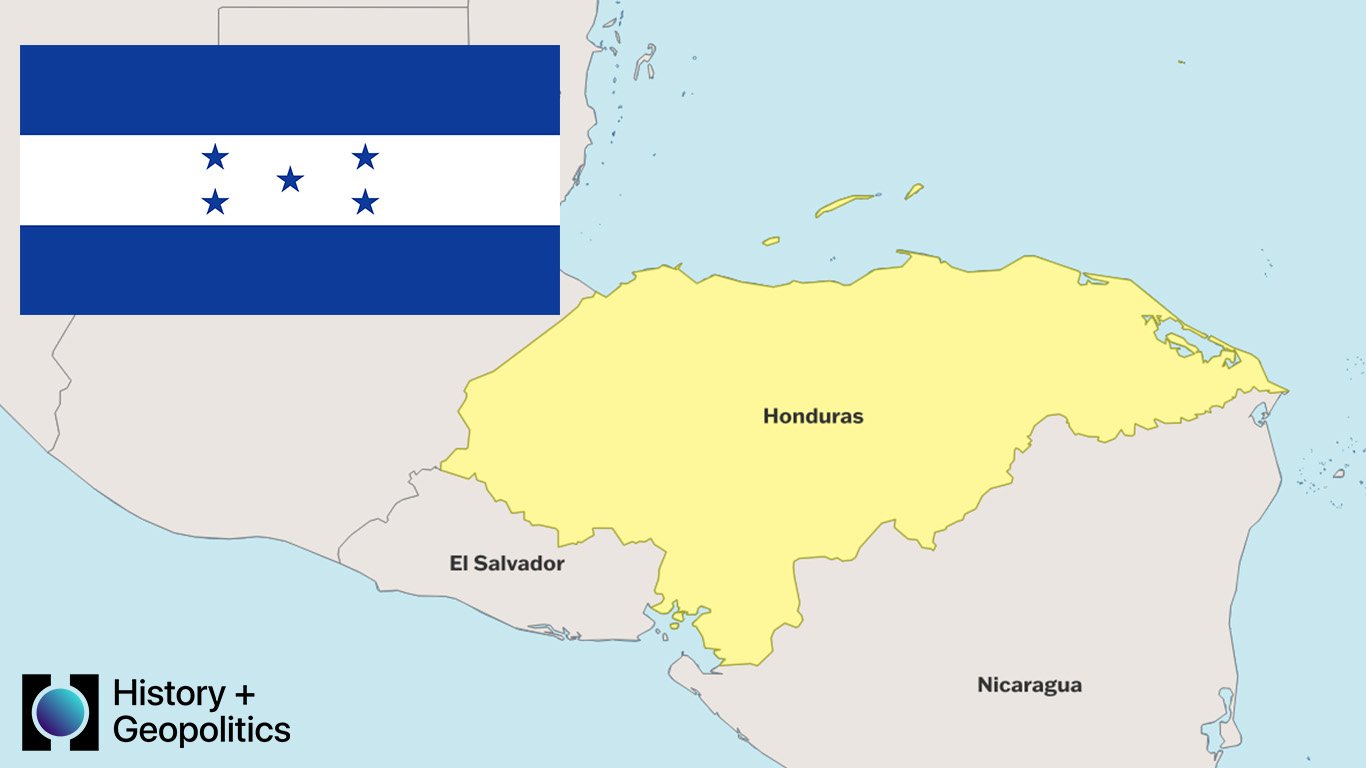
Honduras is located in Central America, bordered by Guatemala to the west, El Salvador to the southwest, Nicaragua to the east and southeast, the Caribbean Sea to the north, and the Pacific Ocean to the south via the Gulf of Fonseca.
Honduras Facts
- OFFICIAL NAME: Republic of Honduras
- CAPITAL: Tegucigalpa
- POPULATION: 11,184,760 (2026)
- AREA: 112,492 square kilometers
- OFFICIAL LANGUAGE: Spanish
- CURRENCY: Honduran Lempira (HNL)
Honduras Flag
The flag of Honduras has three equal horizontal stripes — blue on top, white in the middle, and blue on the bottom — with five blue five-pointed stars arranged in an X pattern in the center of the white stripe. The blue stripes represent the Caribbean Sea and the Pacific Ocean bordering the country, while the white represents the land between the two oceans and the peace of the Honduran people. The five stars represent the five original nations of the Federal Republic of Central America — Guatemala, El Salvador, Honduras, Nicaragua, and Costa Rica — and the hope that these nations might one day reunite. The flag shares its basic design with El Salvador and Nicaragua, reflecting their shared Central American heritage.
Honduras Geography
- Located in Central America, the second largest country in the region.
- Borders: Guatemala to the west, El Salvador to the southwest, Nicaragua to the east and southeast.
- The Caribbean Sea lies to the north and the Pacific Ocean to the south via the Gulf of Fonseca.
- Honduras has a coastline of approximately 820 kilometers along the Caribbean and 163 kilometers along the Pacific.
- The terrain is mostly mountainous in the interior, with narrow coastal plains on both the Caribbean and Pacific coasts.
- The central highlands and mountain ranges run through the heart of the country, with peaks exceeding 2,800 meters.
- Cerro Las Minas is the highest peak, rising to 2,870 meters in the western highlands.
- The Mosquito Coast, a large lowland region in the northeast, is one of the most remote and sparsely populated areas in Central America.
- Honduras has a tropical climate on the coasts and a more temperate climate in the highlands.
- The Bay Islands off the Caribbean coast are located near the Mesoamerican Barrier Reef, the second largest coral reef system in the world.
Honduras Government
- Honduras is a presidential republic.
- The President serves as both head of state and head of government.
- Xiomara Castro has served as President since January 2022, becoming the first female president in Honduras’s history.
- Honduras has a unicameral National Congress.
- The country has historically been influenced by the military and experienced significant political instability, including a controversial coup in 2009 that ousted President Manuel Zelaya.
History of Honduras
- The region was home to various indigenous peoples for thousands of years, most notably the Maya, who built the magnificent city of Copán in western Honduras.
- Copán was one of the most important Maya centers, known for its elaborate carved stelae and hieroglyphic stairway.
- Spanish explorer Hernán Cortés arrived in 1524 and established colonial control over the territory.
- Honduras became part of the Captaincy General of Guatemala under Spanish rule.
- The country declared independence from Spain on September 15, 1821, as part of the Central American independence movement.
- After brief incorporation into the Mexican Empire and the Federal Republic of Central America, Honduras became fully independent in 1838.
- The late 19th and early 20th centuries were dominated by powerful American banana companies, particularly United Fruit and Standard Fruit, giving rise to the term “banana republic.”
- Honduras experienced frequent political instability and military coups throughout the 20th century.
- During the 1980s, Honduras served as a base for US-backed Contra rebels fighting the Nicaraguan Sandinista government.
- Gang violence, particularly from MS-13 and Barrio 18, became a defining challenge of the post-Cold War period, driving significant emigration.
People and Culture of Honduras
- The population is predominantly mestizo, of mixed Spanish and indigenous descent, making up approximately 90% of the population.
- Indigenous communities including the Lenca, Garífuna, Miskito, and Maya-Chorti peoples maintain distinct cultural identities.
- The Garífuna people, of mixed African and Caribbean indigenous descent, live primarily along the Caribbean coast and are recognized by UNESCO for their unique language, music, and dance.
- Spanish is the official and universally spoken language, with indigenous languages and Garífuna also spoken in their respective communities.
- Roman Catholicism has historically been the dominant religion, though Evangelical Protestant Christianity has grown significantly.
- Baleadas, flour tortillas filled with refried beans, cheese, and cream, are the most iconic Honduran street food and a daily staple.
- Football is by far the most popular sport, with deep passion for the national team across all communities.
Economy of Honduras
- Honduras has a lower-middle-income economy with agriculture, manufacturing, and remittances as the main pillars.
- Coffee is the most important export crop, with Honduras being the largest coffee producer in Central America.
- Bananas, palm oil, shrimp, and textiles are other significant exports.
- The maquila sector, consisting of assembly factories producing textiles and apparel for export, is a major employer particularly of women in urban areas.
- Remittances from Hondurans living abroad, primarily in the United States, are one of the largest sources of national income.
- Honduras faces significant challenges including high poverty rates, income inequality, gang violence, and vulnerability to natural disasters such as hurricanes.
Honduras Resources
- Honduras has significant silver, gold, lead, and zinc mineral deposits, particularly in the western and southern regions.
- Fertile agricultural land supports coffee, banana, palm oil, and sugar production in the lowland and highland regions.
- The Caribbean coastline and Bay Islands provide fishing resources and support a growing dive tourism industry centered on the Mesoamerican Barrier Reef.
- Hydropower potential is significant, with numerous rivers flowing from the central highlands.
- Honduras has one of the highest forest cover percentages in Central America, with pine and broadleaf forests covering significant portions of the interior highlands.
Honduras Wildlife
- Honduras’s diverse ecosystems, from Caribbean coral reefs to highland pine forests and Pacific mangroves, support rich biodiversity.
- The scarlet macaw, one of the most spectacular parrots in the Americas, inhabits the lowland forests of the Mosquito Coast and the Río Plátano Biosphere Reserve.
- Jaguars, tapirs, and white-lipped peccaries roam the remote forests of the Mosquito Coast, one of the largest remaining wilderness areas in Central America.
- The Río Plátano Biosphere Reserve in the northeast is a UNESCO World Heritage Site protecting one of the most intact rainforest ecosystems in Central America.
- The Mesoamerican Barrier Reef surrounding the Bay Islands supports whale sharks, sea turtles, and extraordinary marine biodiversity.
- Honduras’s forests, wetlands, and reefs face pressure from agricultural expansion, illegal logging, and climate change, making conservation a critical ongoing challenge.