Guinea Country Profile
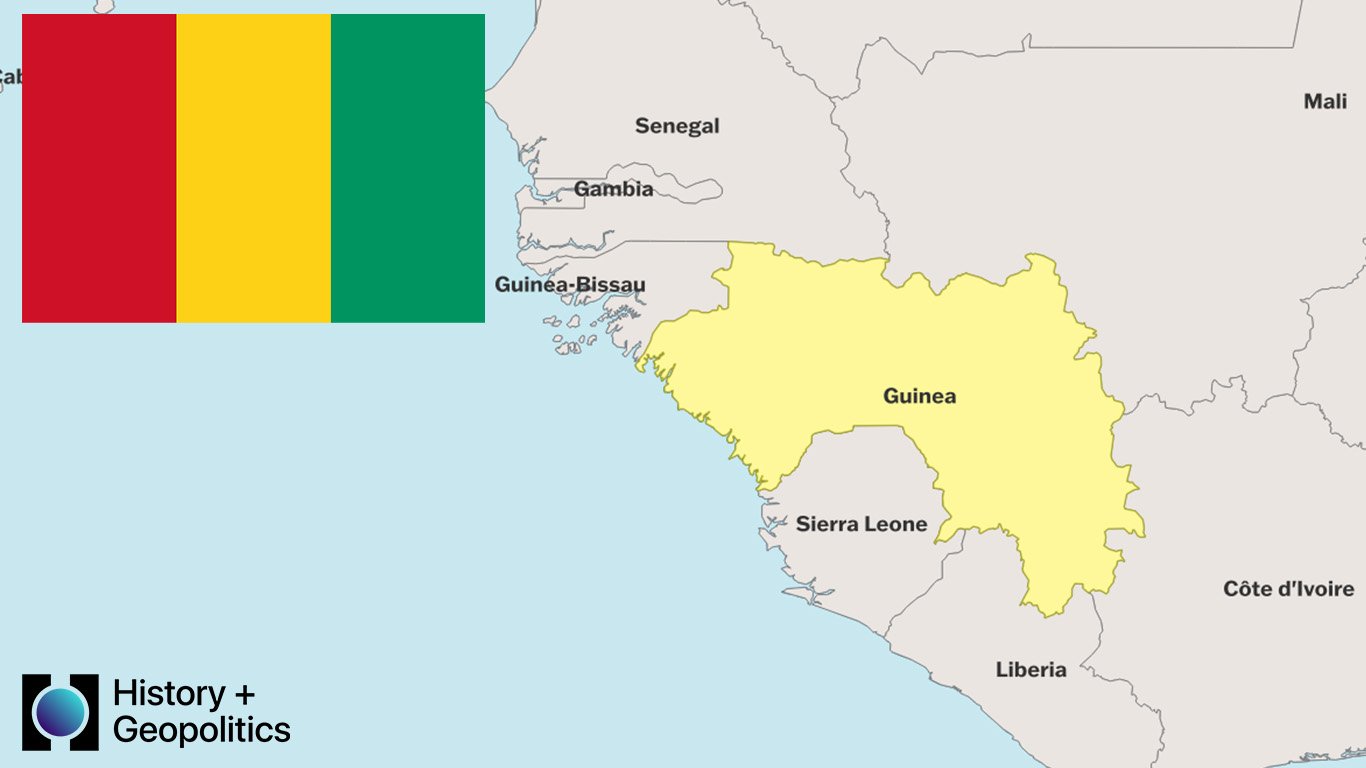
Guinea is located in West Africa, bordered by Guinea-Bissau and Senegal to the north, Mali to the northeast, Côte d’Ivoire to the east, Liberia and Sierra Leone to the south, and the Atlantic Ocean to the west.
Guinea Facts
- OFFICIAL NAME: Republic of Guinea
- CAPITAL: Conakry
- POPULATION: 15,441,993 (2026)
- AREA: 245,857 square kilometers
- OFFICIAL LANGUAGE: French
- CURRENCY: Guinean Franc (GNF)
Guinea Flag
The flag of Guinea has three equal vertical stripes — red on the left, yellow in the middle, and green on the right. The red represents the blood shed by those who fought for independence and the sacrifice of the Guinean people. The yellow symbolizes the gold and other mineral wealth of the country as well as the sun that gives life. The green represents the fertile land, forests, and agricultural wealth of Guinea. The colors are Pan-African colors, shared with several other West African nations, reflecting solidarity with the broader African independence movement. The flag was adopted when Guinea gained independence from France in 1958.
Guinea Geography
- Located in West Africa, with a coastline along the Atlantic Ocean to the west.
- Borders: Guinea-Bissau and Senegal to the north, Mali to the northeast, Côte d’Ivoire to the east, Liberia and Sierra Leone to the south.
- The country is sometimes called Guinea-Conakry to distinguish it from neighboring Guinea-Bissau and Equatorial Guinea.
- The terrain varies dramatically from a narrow coastal plain to the Fouta Djallon highlands in the center and tropical forests in the south.
- The Fouta Djallon plateau in the central region is sometimes called the “water tower of West Africa” because it is the source of several major rivers, including the Gambia, Senegal, and Niger.
- The highest point, Mount Nimba, rises to 1,752 meters on the border with Côte d’Ivoire and Liberia.
- Guinea has a tropical climate with a distinct rainy season from April to November and a dry season marked by the harmattan wind.
- The coast around Conakry receives some of the highest rainfall in West Africa.
- The southeastern forest region, known as Forest Guinea, is one of the most biodiverse areas in West Africa.
Guinea Government
- Guinea is currently governed by a military transitional government following a coup in September 2021.
- Colonel Mamadi Doumbouya led the coup that ousted President Alpha Condé and serves as transitional President.
- The coup ended Condé’s controversial third term, which had triggered widespread protests in 2020.
- Guinea has a long history of political instability and military coups since independence.
- The military government has promised a transition back to civilian democratic governance but has faced international pressure over the slow pace of political reform.
History of Guinea
- The region was part of several powerful West African empires, including the Mali and Songhai Empires, before European contact.
- The Fula people established the theocratic Imamate of Futa Jallon in the 18th century, a significant Islamic state centered in the Fouta Djallon highlands.
- France established colonial control over the territory in the late 19th century, naming it French Guinea.
- Sékou Touré led Guinea to become the first French African colony to vote for independence in 1958, rejecting the French Community in a dramatic referendum that angered France.
- France responded by withdrawing all aid and personnel, taking all infrastructure and equipment, leaving Guinea to start from scratch.
- Sékou Touré ruled Guinea from independence until his death in 1984, presiding over a repressive single-party state.
- A military coup immediately followed his death, with Lansana Conté seizing power and ruling until his own death in 2008.
- Another military coup in 2008 was followed by a gradual return to civilian rule, with Alpha Condé elected president in 2010.
- Condé’s controversial amendment allowing a third term triggered mass protests and was followed by the 2021 military coup.
People and Culture of Guinea
- The Fula, also known as Fulani or Peul, are the largest ethnic group, making up approximately 40% of the population, predominantly living in the Fouta Djallon region.
- The Mandinka are the second largest group, followed by the Susu along the coast and the Kpelle and other forest peoples in the south.
- French is the official language of government and education, while Pular, Mandinka, and Susu serve as widely spoken national languages.
- Islam is practiced by approximately 85% of the population, making Guinea one of the most predominantly Muslim countries in West Africa.
- Fouti, a rice dish cooked with various sauces of fish, groundnuts, or leafy vegetables, is a staple food across much of the country.
- Guinea has a rich tradition of music and dance, with Guinean artists and musicians, particularly those from the Mandinka griot tradition, having had significant influence across West African culture.
- The balafon, a wooden xylophone, and the kora, a 21-string West African harp, are important traditional instruments deeply rooted in Guinean cultural heritage.
Economy of Guinea
- Guinea has significant natural resource wealth but remains one of the poorest countries in the world due to political instability and poor governance.
- Bauxite is the most important mineral export, with Guinea possessing more than a quarter of the world’s known bauxite reserves, making it the world’s largest bauxite exporter.
- Gold and diamond mining are also significant contributors to export revenue.
- The Simandou iron ore deposit in southeastern Guinea is considered one of the largest untapped high-grade iron ore deposits in the world and is under development.
- Agriculture employs the majority of the population, with subsistence farming of rice, cassava, and millet widespread.
- Guinea faces persistent challenges including corruption, inadequate infrastructure, and a heavy dependence on mineral extraction with limited economic diversification.
Guinea Resources
- Guinea possesses over 25% of the world’s known bauxite reserves, making it one of the most mineral-rich countries on Earth relative to its size.
- Significant gold and diamond deposits contribute to mining exports alongside bauxite.
- The Simandou iron ore deposit represents a potentially transformative future resource once fully developed.
- The Fouta Djallon highlands are the source of several major West African rivers, making water resources a significant geographic asset.
- Fertile agricultural land and tropical forests in the south support subsistence farming and timber resources.
Guinea Wildlife
- Guinea’s diverse ecosystems, from coastal mangroves to highland forests and tropical rainforests in the south, support remarkable biodiversity.
- The western chimpanzee is found in Guinea’s forests, with the country hosting one of the largest populations in West Africa.
- The pygmy hippopotamus, one of the rarest large mammals in Africa, inhabits the rivers and forests of Forest Guinea in the southeast.
- The Mount Nimba Strict Nature Reserve on the border with Côte d’Ivoire and Liberia is a UNESCO World Heritage Site, protecting extraordinary endemic biodiversity including unique amphibian and insect species.
- Forest elephants inhabit the southern rainforests, though their populations have been significantly reduced by hunting and habitat loss.
- Guinea’s coastal waters and the Bijagós Archipelago area support sea turtles, manatees, and diverse marine life.
- Conservation efforts face significant challenges from illegal mining, deforestation, and bushmeat hunting across the country.