Guinea-Bissau Country Profile
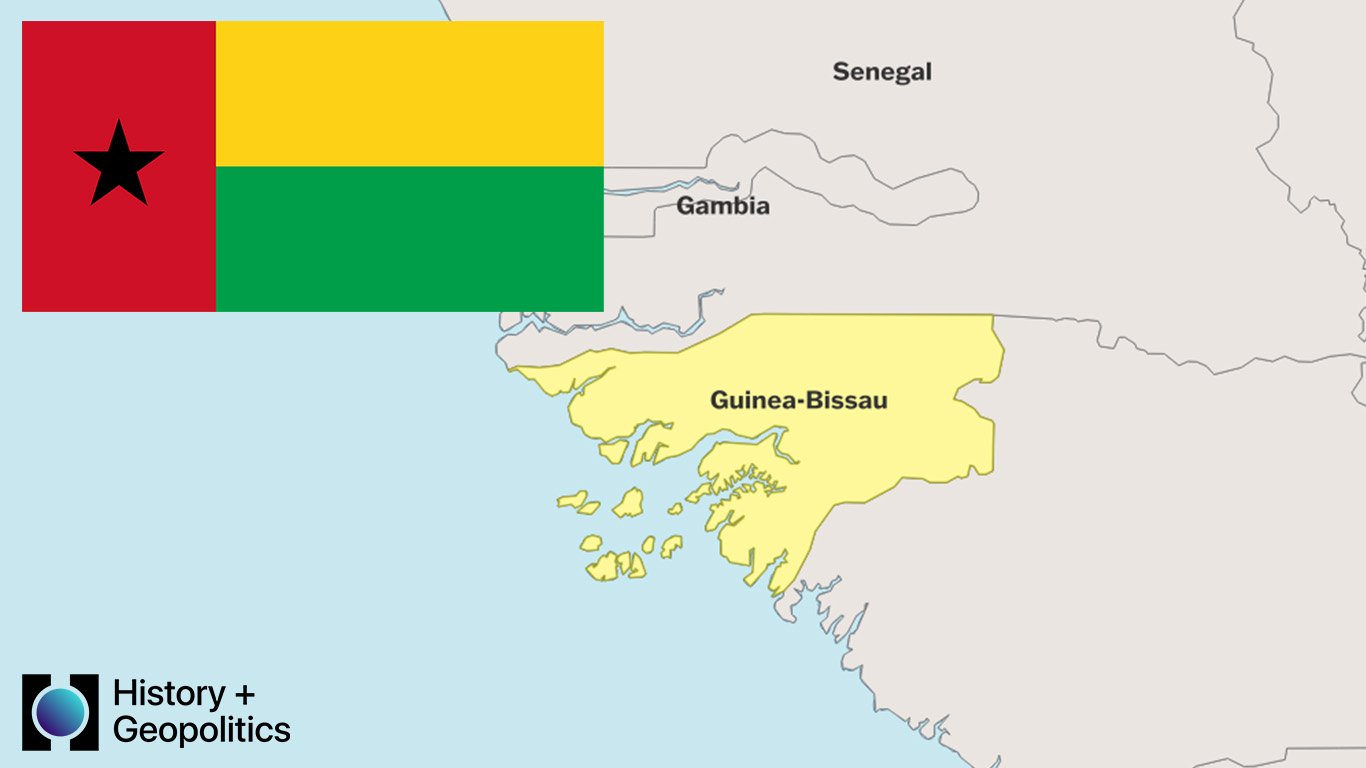
Guinea-Bissau is located in West Africa, bordered by Senegal to the north, Guinea to the south and east, and the Atlantic Ocean to the west. The country also includes the Bijagós Archipelago, a group of approximately 88 islands off its Atlantic coastline.
Guinea-Bissau Facts
- OFFICIAL NAME: Republic of Guinea-Bissau
- CAPITAL: Bissau
- POPULATION: 2,297,808 (2026)
- AREA: 36,125 square kilometers
- OFFICIAL LANGUAGE: Portuguese
- CURRENCY: West African CFA Franc (XOF)
Guinea-Bissau Flag
The flag of Guinea-Bissau has two equal horizontal stripes — yellow on top and green on the bottom — with a vertical red stripe on the hoist side containing a black five-pointed star in its center. The red represents the blood shed during the struggle for independence, the yellow symbolizes the country’s mineral and agricultural wealth, and the green represents the forests and hope for the future. The black star represents the African people and their unity, drawing on the Pan-African symbolism of the star. The flag design reflects the influence of the African Party for the Independence of Guinea and Cape Verde, which led the liberation movement.
Guinea-Bissau Geography
- Located in West Africa, with a coastline along the Atlantic Ocean to the west.
- Borders: Senegal to the north, Guinea to the south and east.
- The country includes the Bijagós Archipelago, approximately 88 islands and islets off the Atlantic coast.
- Guinea-Bissau is one of the smallest countries in mainland Africa.
- The terrain is mostly low-lying coastal plain with some inland savanna areas.
- The highest point in the country rises to only about 300 meters, making Guinea-Bissau one of the flattest countries in the world.
- Numerous rivers and estuaries flow through the coastal plain, creating an extensive network of mangroves and wetlands.
- The country has a tropical climate with a distinct rainy season from June to November and a dry season from December to May.
- The Bijagós Archipelago contains some of the most important coastal wetland ecosystems in West Africa.
Guinea-Bissau Government
- Guinea-Bissau is a semi-presidential republic.
- The President serves as head of state with significant executive authority.
- The Prime Minister serves as head of government.
- Guinea-Bissau has a unicameral National People’s Assembly.
- The country has a long history of political instability, having experienced numerous coups and governmental crises since independence.
- Umaro Sissoco Embaló has served as President since 2020 following a disputed election that was eventually resolved in his favor.
- Guinea-Bissau has been significantly affected by drug trafficking, with the country used as a transit point for South American cocaine destined for Europe.
History of Guinea-Bissau
- The region was part of the medieval Mali Empire and later home to various smaller kingdoms and chiefdoms before Portuguese contact.
- Portuguese explorers arrived along the coast in the 15th century and established trading relationships, particularly in enslaved people and gold.
- The territory became a significant center of the transatlantic slave trade under Portuguese colonial control.
- Portugal formally established the colony of Portuguese Guinea in the 19th century.
- Amílcar Cabral founded the African Party for the Independence of Guinea and Cape Verde (PAIGC) in 1956 and led a guerrilla war for independence.
- Cabral was assassinated in 1973, just before independence was achieved.
- Guinea-Bissau unilaterally declared independence on September 24, 1973, recognized internationally after the Portuguese Carnation Revolution of 1974.
- Since independence, Guinea-Bissau has experienced significant political instability, with nine coups or coup attempts making it one of the most politically volatile countries in Africa.
- Drug trafficking networks have deeply penetrated political and military institutions since the early 2000s, earning the country the label of Africa’s first narco-state.
People and Culture of Guinea-Bissau
- The Fula are the largest ethnic group, making up approximately 28% of the population, followed by the Balantaat around 22%.
- Other significant groups include the Mandinka, Papel, and Bijago peoples of the Bijagós Archipelago.
- Portuguese is the official language, though Crioulo, a Portuguese-based creole, serves as the most widely spoken lingua franca across all communities.
- Islam is practiced by approximately 45% of the population, while traditional indigenous beliefs are maintained by around 30% and Christianity by the remainder.
- Caldo de mancarra, a groundnut stew typically served with rice, is one of the most popular traditional dishes.
- The Bijago people of the Bijagós Archipelago have maintained a distinctive matriarchal cultural tradition unique in West Africa.
- Traditional music, mask ceremonies, and initiation rituals remain important parts of cultural life across Guinea-Bissau’s many ethnic communities.
Economy of Guinea-Bissau
- Guinea-Bissau is one of the poorest countries in the world, with a largely subsistence-based economy.
- Cashew nuts are by far the most important export crop, with Guinea-Bissau being one of the world’s largest cashew producers per capita.
- Fishing in the country’s rich coastal waters is important for both food security and export revenue.
- The country’s waters are leased to foreign fishing fleets, generating a source of government income.
- Drug trafficking has significantly distorted the formal economy and undermined governance and institutional development.
- Guinea-Bissau relies heavily on foreign aid and remittances from Guineans living abroad to meet basic needs.
Guinea-Bissau Resources
- The surrounding Atlantic waters are rich in fish and seafood, representing one of the country’s most valuable natural resources.
- Cashew-growing land is Guinea-Bissau’s most important agricultural resource.
- Phosphate deposits have been identified in the north, representing a potential future mineral resource.
- The Bijagós Archipelago contains rich coastal ecosystems with significant ecotourism and biodiversity potential.
- Bauxite deposits have been identified but remain largely undeveloped due to lack of infrastructure and investment.
Guinea-Bissau Wildlife
- Guinea-Bissau’s coastal wetlands, mangroves, and the Bijagós Archipelago support extraordinary marine and coastal biodiversity.
- The Bijagós Archipelago Biosphere Reserve, recognized by UNESCO, is one of the most important marine protected areas in West Africa.
- The archipelago hosts one of the largest concentrations of nesting saltwater hippos in West Africa, with hippopotamus populations inhabiting both the islands and the mainland rivers.
- Green sea turtles nest in large numbers on the beaches of the Bijagós Islands, with the area supporting one of the most significant sea turtle nesting sites in the Atlantic.
- Manatees inhabit the rivers and estuaries of the mainland coastal region.
- The waters around the Bijagós Archipelago support large populations of sharks, rays, and numerous tropical fish species.
- Conservation efforts focus on protecting the marine ecosystems of the Bijagós Archipelago and the sea turtle nesting beaches from fishing pressure and habitat destruction.