Haiti Country Profile
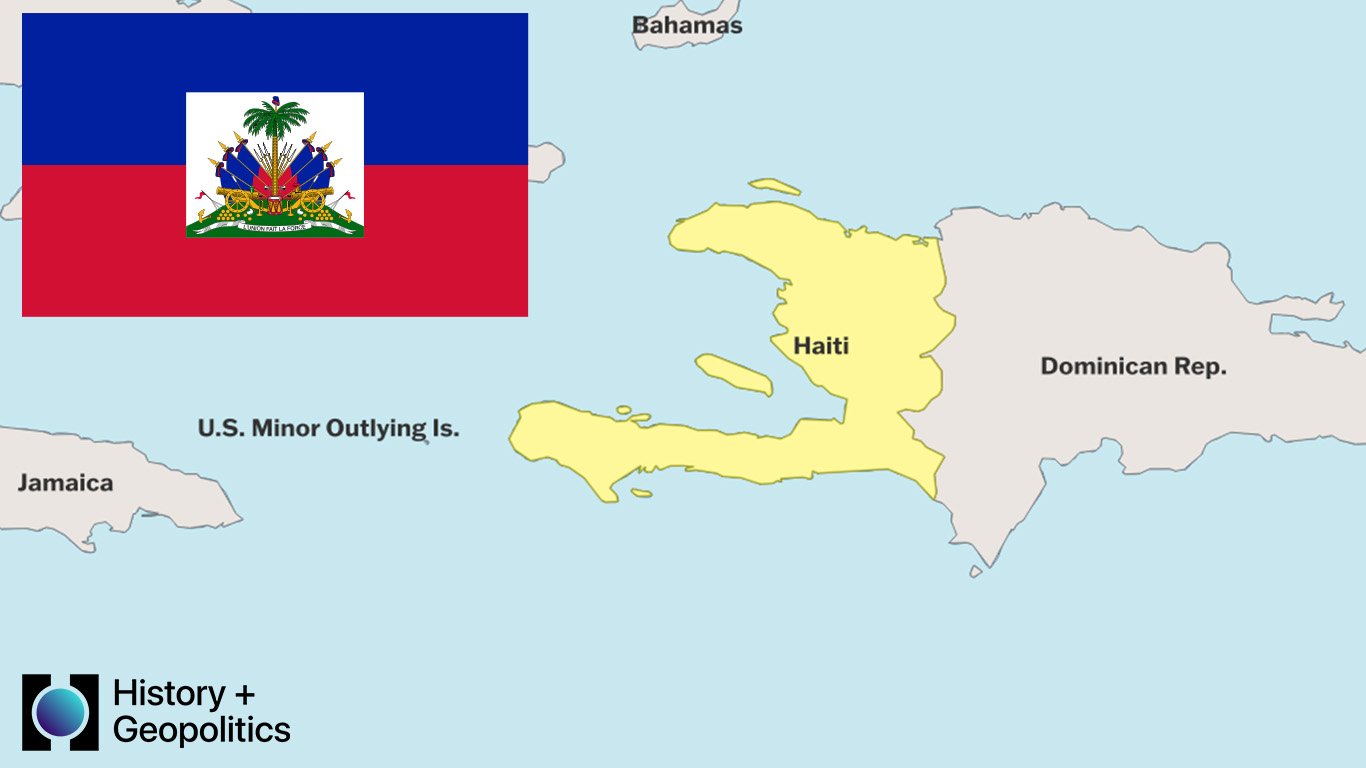
Haiti is located in the Caribbean, occupying the western third of the island of Hispaniola in the Greater Antilles. It shares the island with the Dominican Republic to the east, with the Atlantic Ocean to the north and the Caribbean Sea to the south.
Haiti Facts
- OFFICIAL NAME: Republic of Haiti
- CAPITAL: Port-au-Prince
- POPULATION: 12,037,506 (2026)
- AREA: 27,750 square kilometers
- OFFICIAL LANGUAGES: Haitian Creole, French
- CURRENCY: Haitian Gourde (HTG)
Haiti Flag
The flag of Haiti has two equal horizontal stripes — blue on top and red on the bottom — with the national coat of arms centered on a white rectangle in the middle. The blue and red colors were derived from the French tricolor, with the white removed to symbolize the expulsion of the French colonizers during the Haitian Revolution. The coat of arms features a palm tree topped by the Cap of Liberty, six flags, cannons, cannonballs, and an anchor, all representing the tools of freedom and defense. Below the coat of arms is a ribbon with the motto “L’Union Fait La Force,” meaning “Unity Makes Strength.” The flag was officially adopted in 1820.
Haiti Geography
- Located in the Caribbean, occupying the western third of the island of Hispaniola.
- Shares the island with the Dominican Republic to the east.
- The Atlantic Ocean lies to the north and the Caribbean Sea to the south.
- Haiti is one of the most densely populated countries in the Western Hemisphere.
- The terrain is mostly mountainous, with rugged peaks, narrow coastal plains, and river valleys.
- The highest point, Pic la Selle, rises to 2,680 meters in the southeast of the country.
- Haiti has a tropical climate, with a wet season and a dry season, and is located within the Atlantic hurricane belt.
- The country has been severely affected by deforestation, with less than 2% of its original forest cover remaining, contributing to severe soil erosion and flood vulnerability.
- The Gulf of Gonâve lies on the western coast, containing the island of Gonâve.
Haiti Government
- Haiti is a semi-presidential republic.
- The country has experienced a prolonged political crisis following the assassination of President Jovenel Moïse in July 2021.
- A Transitional Presidential Council was established in 2024 to oversee a transition back to democratic governance.
- Garry Conille was appointed as Prime Minister in 2024 to lead the transitional government.
- Haiti has been severely affected by gang violence, with armed gangs controlling large portions of the capital Port-au-Prince and surrounding areas.
- A Kenyan-led multinational security support mission arrived in 2024 to assist Haitian national police in restoring order.
History of Haiti
- The island was originally inhabited by the Taíno people before Columbus arrived in 1492.
- Spain colonized the western part of the island and France established Saint-Domingue in 1697, which became the most profitable colony in the Caribbean.
- Saint-Domingue’s sugar and coffee plantations were worked by hundreds of thousands of enslaved Africans under brutal conditions.
- The Haitian Revolution, beginning in 1791 and led by figures including Toussaint Louverture and Jean-Jacques Dessalines, became the only successful slave revolt in history to result in an independent nation.
- Haiti declared independence on January 1, 1804, becoming the first Black republic in the world and the first country in the Western Hemisphere to abolish slavery.
- France forced Haiti to pay a massive indemnity of 150 million francs to compensate French slaveholders for their lost “property,” a debt that crippled the country’s finances for over a century.
- The United States occupied Haiti from 1915 to 1934.
- François “Papa Doc” Duvalier and his son Jean-Claude “Baby Doc” Duvalier ruled Haiti as brutal dictators from 1957 to 1986.
- A devastating earthquake struck Haiti on January 12, 2010, killing an estimated 250,000 people and displacing over a million, causing catastrophic damage to an already fragile country.
- Haiti has continued to struggle with political instability, natural disasters, and gang violence in the years since the earthquake.
People and Culture of Haiti
- The vast majority of the population is of African descent, reflecting the legacy of the transatlantic slave trade.
- Haitian Creole, known as Kreyòl, is the native language of virtually all Haitians and one of two official languages alongside French.
- Roman Catholicism is the largest religion, though Vodou, a syncretic spiritual tradition blending West African and Catholic elements, is widely practiced alongside Christianity.
- Griyo, fried chunks of marinated pork served with pikliz, a spicy pickled vegetable condiment, is considered a national dish of Haiti.
- Riz et pois, rice cooked with kidney beans, is a staple eaten daily in most Haitian households.
- Haitian art, particularly painting and sculpture, is internationally recognized for its vibrant colors and powerful storytelling rooted in Vodou imagery and everyday life.
- Haiti is the birthplace of kompas, a popular music genre with a distinct rhythm that has spread throughout the Caribbean and Haitian diaspora worldwide.
Economy of Haiti
- Haiti is the poorest country in the Western Hemisphere and one of the least developed in the world.
- The economy has been severely undermined by decades of political instability, corruption, natural disasters, and more recently gang violence.
- Agriculture employs a large share of the population, with coffee, mangoes, and cocoa among the main export crops.
- Remittances from the large Haitian diaspora in the United States, Canada, and France are one of the most important sources of income, accounting for a significant share of GDP.
- The assembly and garment manufacturing sector, based near Port-au-Prince, has been an important source of employment.
- Haiti relies heavily on international aid and humanitarian assistance to meet basic needs, though the ongoing security crisis has severely disrupted aid delivery.
Haiti Resources
- Haiti has deposits of gold, copper, and other minerals in the northern mountains, though exploitation has been limited by political and security challenges.
- Fertile agricultural land in river valleys supports coffee, mango, and sugarcane production.
- The surrounding Caribbean Sea provides fishery resources, though the sector remains underdeveloped.
- Haiti’s potential for renewable energy, particularly solar power given its tropical location, remains largely untapped.
- The country’s cultural heritage, including its unique art, music, and history as the first Black republic, represents an important but largely unrealized tourism resource.
Haiti Wildlife
- Haiti’s severe deforestation has dramatically reduced wildlife habitats, making it one of the most environmentally degraded countries in the Caribbean.
- The Hispaniolan solenodon, a small ancient insectivore found only on Hispaniola, survives in some of Haiti’s remaining forested areas.
- The Hispaniolan hutia, a large rodent species, is found in small numbers in remaining forest pockets.
- Several endemic bird species inhabit Haiti’s montane forests, including the Hispaniolan trogon and the white-fronted quail-dove.
- The surrounding Caribbean Sea supports sea turtles, reef fish, and coral ecosystems, though overfishing and coastal degradation have impacted marine biodiversity.
- Conservation efforts face enormous challenges given the country’s poverty, deforestation crisis, and political instability, though some protected areas have been established in mountainous regions.