Malawi Country Profile
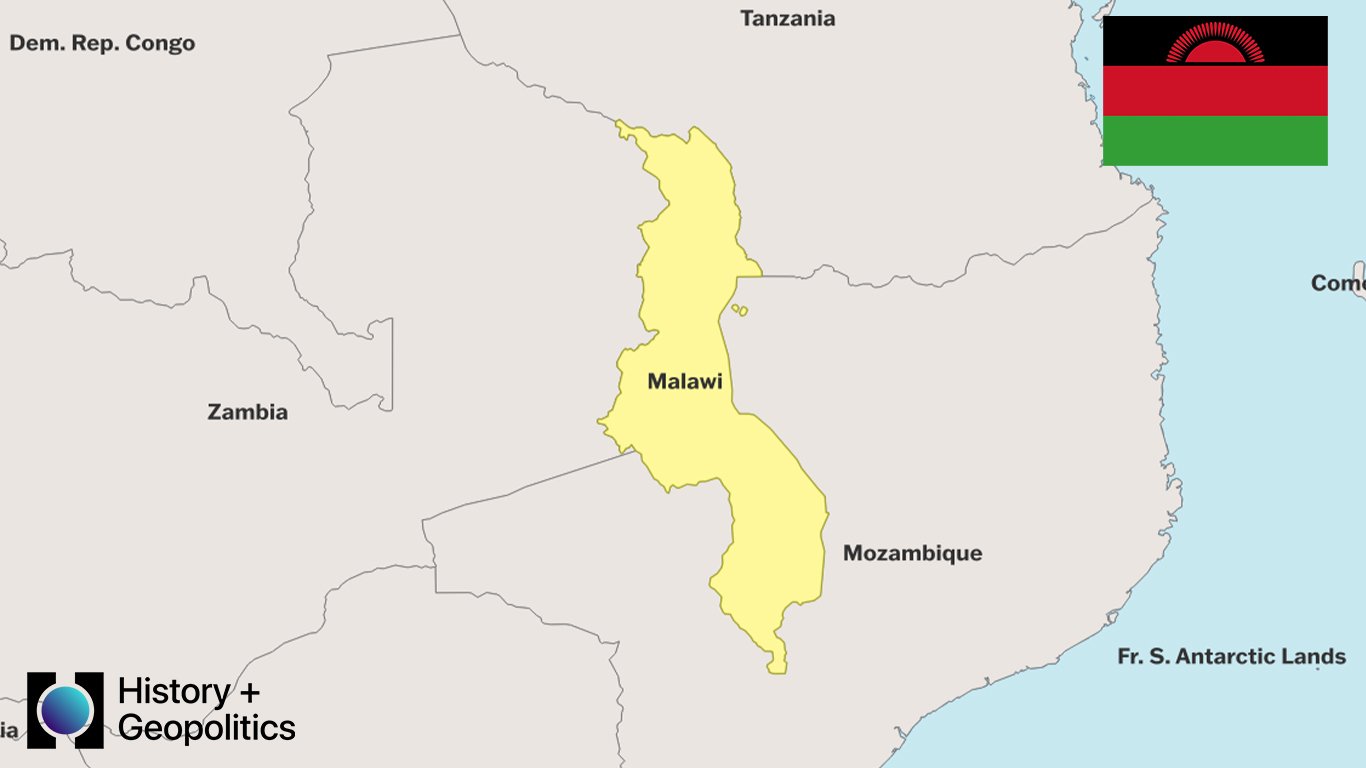
Malawi is a small, landlocked nation tucked into the heart of southeastern Africa, bordered by Zambia to the west, Tanzania to the north and northeast, and Mozambique on three sides to the east, south, and southwest. Stretching roughly 840 kilometres from north to south but rarely more than 160 kilometres wide, it is one of Africa’s most slender countries — and one of its most densely populated. Its defining geographic feature, the vast Lake Malawi, dominates the entire eastern flank of the country and shapes almost every aspect of national life.
Facts
- Capital: Lilongwe
- Population: ~22.2 million (2025)
- Area: 118,484 km²
- Currency: Malawian Kwacha (MWK)
- Official Languages: English, Chichewa
- Time Zone: UTC+2
Flag of Malawi
The flag of Malawi features three equal horizontal bands of black (top), red (middle), and green (bottom), with a rising red sun centred on the black band. Black represents the African people, red symbolises the blood shed in the struggle for independence, and green stands for the country’s natural landscape. The rising sun reflects the hope and dawn of freedom for Africa — a symbol added when Malawi gained independence in 1964.
Geography of Malawi
- Malawi sits within the East African Rift Valley, giving the country dramatic terrain including highlands, plateaus, and the long, deep trough occupied by Lake Malawi
- Lake Malawi accounts for more than one-fifth of the country’s total area and is one of Africa’s Great Lakes, reaching depths of over 700 metres
- The Shire River drains southward from the lake, flowing through the Shire Valley into Mozambique and eventually joining the Zambezi
- Mount Mulanje in the south rises to 3,002 metres, the highest peak in Central Africa
- The climate is subtropical, with a wet season from November to April; conditions around the lake are more humid and hot
Watch video Malawi geography on YouTube
Government of Malawi
- Malawi is a unitary presidential republic; the president is both head of state and head of government
- The legislature is a unicameral National Assembly with 193 members, elected every five years
- Peter Mutharika of the Democratic Progressive Party (DPP) returned to power following the 2025 general elections, defeating incumbent Lazarus Chakwera
- The current constitution dates from 1995, following the end of one-party rule in 1993
- Malawi is divided into three administrative regions — Northern, Central, and Southern — subdivided into 28 districts
Read more – Madagascar Country Profile
History of Malawi
- Human activity in Malawi dates back over a million years; early Bantu settlers arrived around the 10th century, eventually forming the Maravi Kingdom in the 16th century
- The name “Malawi” derives from the Maravi people and means “flames” in Chichewa and Chitumbuka
- Scottish missionary David Livingstone reached Lake Malawi in 1859, opening the region to British influence
- Britain established the British Central African Protectorate in 1891, renamed Nyasaland in 1907
- Malawi achieved independence on 6 July 1964 under President Hastings Kamuzu Banda, who ruled as a dictator until multiparty democracy was restored in 1994
- The country has held peaceful elections every five years since, including a landmark 2020 re-run after courts overturned a fraudulent result — the first such annulment in African history
People and Culture of Malawi
- Malawi is home to ten major ethnic groups, including the Chewa, Lomwe, Yao, Tumbuka, Ngoni, and Tonga; the Chewa are the largest group
- The population is predominantly Christian (around 80%), with a significant Muslim minority (~13%), particularly among the Yao people of the south
- Chichewa is the lingua franca and most widely spoken language
- Traditional music, dance, and storytelling are central to cultural life; the Gule Wamkulu — a ceremonial masked dance of the Chewa — is a UNESCO Intangible Cultural Heritage
- Malawi has one of Africa’s youngest populations, with a median age of just 16.4 years
- With 82% of the population in rural areas, Malawi is one of the least urbanised countries in the world
Economy of Malawi
- Malawi ranks among the world’s least developed countries, with GDP per capita well below $500
- Agriculture employs over 80% of the workforce and accounts for roughly a quarter of GDP and 80% of export earnings
- Tobacco is the dominant cash crop and top export, though its share is declining; tea, sugar, soybeans, and macadamia nuts are growing alternatives
- Inflation averaged 28.4% in 2025, driven by currency depreciation and food prices; the kwacha has undergone repeated devaluations
- The 2025 suspension of US aid — which had funded 13% of the national budget — severely disrupted public services
- Malawi 2063 is the government’s long-term vision to achieve upper-middle-income status through agricultural commercialisation, industrialisation, and urbanisation
Resources of Malawi
- Uranium deposits have been identified, and rare earth minerals are an emerging area of exploration
- Hydroelectric power is generated along the Shire River, providing most of the country’s electricity
- Fertile soils support smallholder farming across the country, though productivity remains low
- Freshwater fisheries in Lake Malawi — including the chambo tilapia — are a critical protein source and support livelihoods for lakeside communities
Wildlife of Malawi
- Malawi’s national parks and reserves protect diverse wildlife including elephants, hippos, crocodiles, leopards, and buffalo
- Liwonde National Park along the Shire River is the flagship wildlife destination, home to the country’s largest elephant population
- Lake Malawi National Park — a UNESCO World Heritage Site — protects hundreds of endemic cichlid fish species, making it one of the world’s most biodiverse freshwater habitats
- Nyika Plateau National Park in the north offers rolling montane grasslands with roan antelope, zebra, and leopard
- The African fish eagle is a common sight along the lakeshore and is deeply embedded in Malawian cultural identity