Lithuania Country Profile
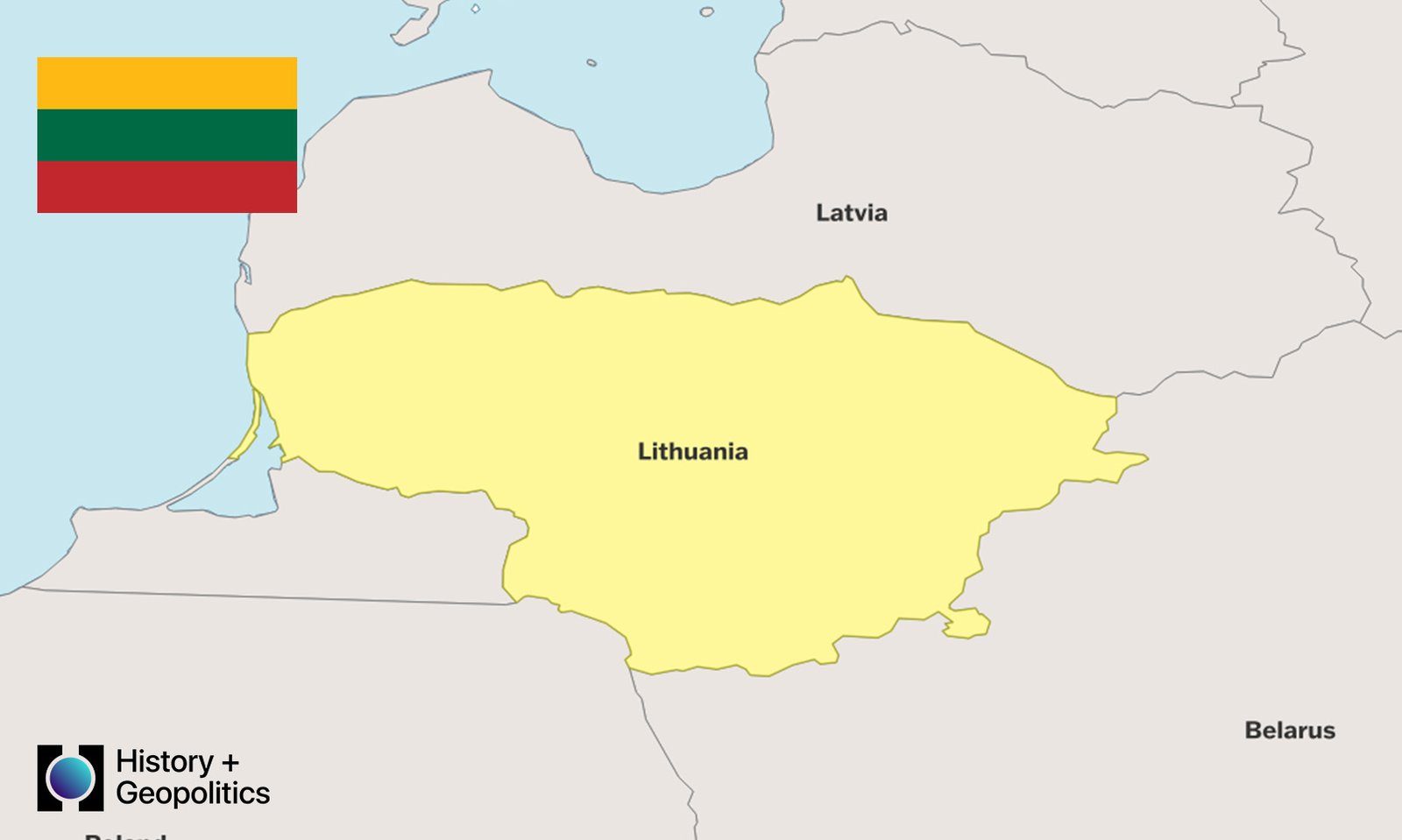
Lithuania is located in Northern Europe, the largest and southernmost of the three Baltic states. It is bordered by Latvia to the north, Belarus to the east and south, Poland to the southwest, and the Russian exclave of Kaliningrad to the west, with a short coastline along the Baltic Sea.
Lithuania Facts
- OFFICIAL NAME: Republic of Lithuania
- CAPITAL: Vilnius
- POPULATION: 2,797,338 (2026)
- AREA: 65,300 square kilometers
- OFFICIAL LANGUAGE: Lithuanian
- CURRENCY: Euro (EUR)
Lithuania Flag
The flag of Lithuania has three equal horizontal stripes — yellow on top, green in the middle, and red on the bottom. The yellow represents the golden fields, the sun, and the prosperity of the country. The green represents the forests, nature, hope, and the freedom of the Lithuanian people. The red represents the blood and courage of those who fought for the country’s independence and the love for the homeland. The tricolor was first adopted in 1918 when Lithuania declared independence and was restored in 1988 during the independence movement from the Soviet Union, becoming one of the symbols of the Singing Revolution.
Lithuania Geography
- Located in Northern Europe, the largest of the three Baltic states by land area and population.
- Borders: Latvia to the north, Belarus to the east and south, Poland to the southwest, and the Russian exclave of Kaliningrad to the west.
- The Baltic Sea forms a short coastline of approximately 90 kilometers in the northwest, including the Curonian Spit, a UNESCO World Heritage Site.
- The terrain is mostly flat lowland, with gentle hills in the west and east and numerous lakes in the east.
- Lithuania has approximately 3,000 lakes, with the Curonian Lagoon being the largest body of water.
- The highest point, Aukštojas Hill, rises to only 294 meters, making Lithuania one of the flattest countries in Europe.
- The Nemunas River is the most important waterway, flowing westward through the country to the Curonian Lagoon.
- Lithuania has a humid continental climate, with cold winters and warm summers.
- Forests cover approximately 33% of the country.
watch Lithuania geography on YouTube
Lithuania Government
- Lithuania is a semi-presidential republic.
- The President serves as head of state with significant authority in foreign and security policy.
- The Prime Minister serves as head of government, holding executive authority over domestic affairs.
- Lithuania has a unicameral parliament called the Seimas, consisting of 141 members.
- Gitanas Nausėda has served as President since 2019 and was re-elected in 2024.
- Lithuania joined both NATO and the European Union in 2004 and adopted the Euro in 2015.
- Lithuania has been among the most vocal European Union members in supporting Ukraine following Russia’s invasion in 2022.
History of Lithuania
- The Baltic peoples who became Lithuanians have inhabited the region since at least 3000 B.C.
- Lithuanian tribes resisted Christian crusaders longer than almost any other European people, with Lithuania being the last pagan state in Europe to convert to Christianity in 1387.
- The Grand Duchy of Lithuania, established in the 13th century, became one of the largest states in medieval Europe, stretching from the Baltic Sea to the Black Sea.
- In 1569, Lithuania entered the Polish-Lithuanian Commonwealth through the Union of Lublin, creating one of the largest and most powerful states in European history.
- The Commonwealth was gradually dismembered and partitioned among Russia, Prussia, and Austria in the late 18th century.
- Lithuania came under Russian Imperial rule in 1795 and remained part of the Russian Empire for over a century.
- Lithuania declared independence on February 16, 1918, following the collapse of the Russian Empire.
- The country maintained independence throughout the interwar period but was forcibly annexed by the Soviet Union in 1940 under the Molotov-Ribbentrop Pact.
- Lithuania was the first Soviet republic to declare independence, doing so on March 11, 1990.
- Soviet military attempts to suppress Lithuanian independence in January 1991 failed, and Lithuania’s independence was recognized internationally in September 1991.
- Lithuania joined NATO and the European Union in 2004, firmly anchoring itself in the Western community of nations.
- Lithuania’s population has declined by approximately 24% since independence due to emigration and low birth rates.
People and Culture of Lithuania
- Lithuanians make up approximately 84.6% of the population, with Polish and Russian minorities also present.
- Lithuanian is the official language and is one of the oldest living languages in the world, preserving ancient Indo-European linguistic features that have disappeared from other modern languages.
- Roman Catholicism is the predominant religion, practiced by approximately 74% of the population and deeply embedded in Lithuanian cultural identity.
- Cepelinai, large dumplings made from grated potatoes stuffed with minced meat and served with sour cream and bacon sauce, are considered the national dish of Lithuania.
- Šaltibarščiai, a cold bright-pink beet soup served with boiled potatoes, is one of Lithuania’s most distinctive and beloved summer dishes.
- The Song and Dance Festival, held every four years, is one of the largest folk music gatherings in the world and is shared with Latvia and Estonia as a UNESCO-recognized cultural heritage.
- The Hill of Crosses near Šiauliai, a pilgrimage site covered in hundreds of thousands of crosses, is one of Lithuania’s most powerful cultural and spiritual symbols.
Economy of Lithuania
- Lithuania has one of the fastest-growing economies in the European Union, driven by manufacturing, services, and technology.
- The manufacturing sector, including furniture, textiles, food processing, and chemicals, is a major contributor to exports.
- Lithuania has developed a strong information technology and financial technology sector, with Vilnius emerging as a significant fintech hub.
- The country has close trade ties with Germany, Latvia, Poland, and other EU member states.
- Lithuania adopted the Euro in 2015 and has maintained strong fiscal discipline.
- Despite economic growth, Lithuania continues to face demographic challenges from emigration and one of the lowest birth rates in the European Union.
Lithuania Resources
- Lithuania has limited mineral resources, with amber being the most distinctive, as the Baltic coast is one of the world’s most important sources of Baltic amber.
- The country has small deposits of peat, limestone, and clay used in construction.
- Fertile agricultural land supports grain, dairy, and sugar beet production.
- Forests covering approximately one third of the country provide timber resources.
- Lithuania has significant wind energy potential along the Baltic coast and is investing in offshore wind development.
Lithuania Wildlife
- Lithuania’s forests, wetlands, and coastal areas support a rich diversity of northern European wildlife.
- Brown bears, wolves, lynx, and wild boar inhabit the country’s forests, with Lithuania having healthy populations of large carnivores for a relatively small and densely populated country.
- The white stork is one of Lithuania’s most beloved animals, nesting widely across the countryside in summer, with Lithuania having one of the highest densities of nesting storks in Europe.
- The Curonian Spit is an internationally important bird migration corridor, with millions of birds passing through each spring and autumn.
- The Nemunas River delta and coastal wetlands provide important habitats for waterbirds and migratory species.
- Lithuania has established several national parks, including Aukštaitija, Žemaitija, Dzūkija, and Suvalkija, as well as the Curonian Spit National Park, to protect its diverse forest and coastal ecosystems.