Malta Country Profile
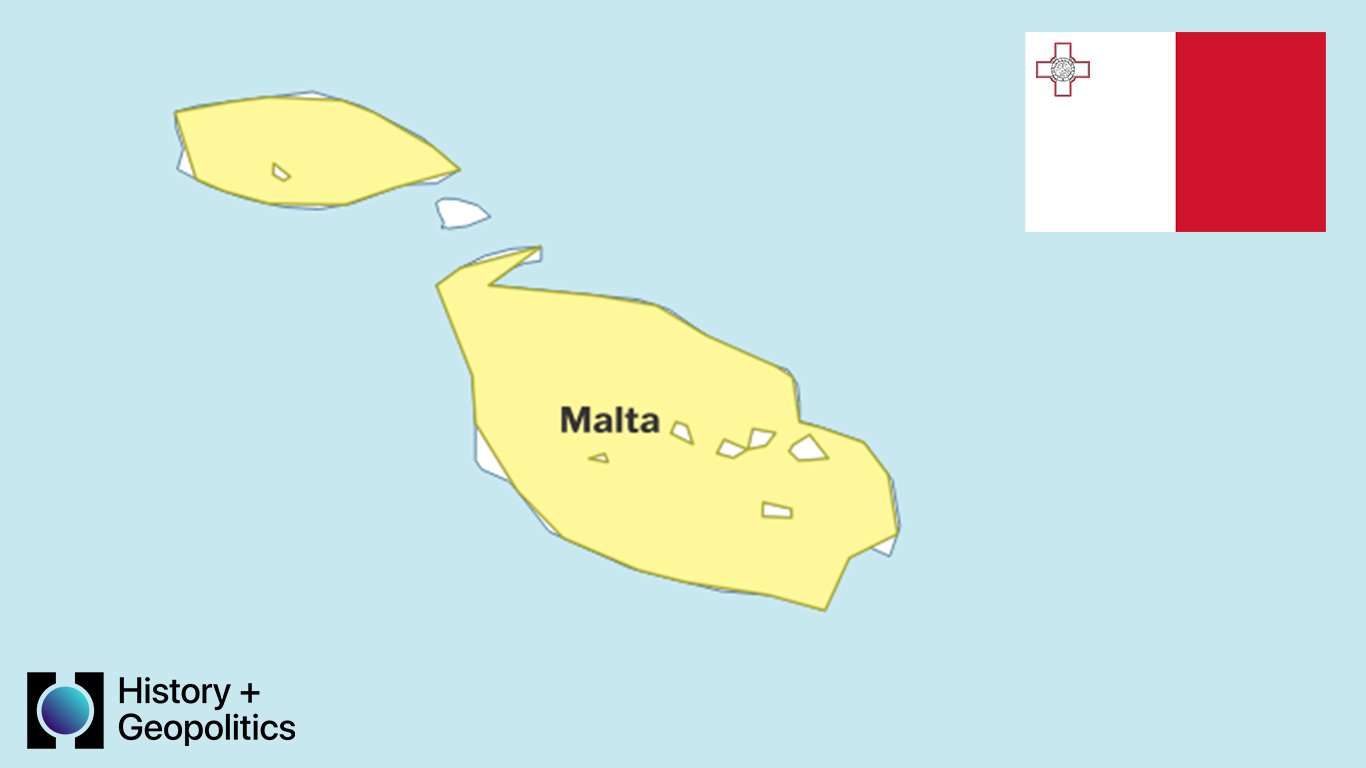
Malta is located in the Mediterranean Sea, a small island nation situated south of Sicily in Italy, north of Libya, and east of Tunisia. It has no land borders, surrounded entirely by the Mediterranean Sea.
Malta Facts
- OFFICIAL NAME: Republic of Malta
- CAPITAL: Valletta
- POPULATION: 549,011 (2026)
- AREA: 316 square kilometers
- OFFICIAL LANGUAGES: Maltese, English
- CURRENCY: Euro (EUR)
Malta Flag
The flag of Malta has two equal vertical stripes — white on the left and red on the right — with the George Cross depicted in the upper left corner of the white stripe, edged in red. The white and red colors have been associated with Malta since medieval times and are said to derive from the coat of arms given to the Maltese by Count Roger of Sicily in the 11th century. The George Cross, Britain’s highest civilian honor, was awarded to the entire island of Malta by King George VI in 1942 in recognition of the extraordinary bravery shown by the Maltese people during the siege of Malta in World War II. The cross was added to the flag upon independence in 1964.
Malta Geography
- Located in the central Mediterranean Sea, south of Sicily and north of Libya.
- No land borders, surrounded entirely by the Mediterranean Sea.
- Malta is one of the smallest and most densely populated countries in the world.
- The archipelago consists of three inhabited islands — Malta, Gozo, and Comino — along with several smaller uninhabited islets.
- The island of Malta is by far the largest and most populated, home to the capital Valletta and the majority of the population.
- The terrain is mostly low and rocky, with low hills and no permanent rivers or lakes.
- The highest point on the island rises to only 253 meters above sea level.
- Malta has a Mediterranean climate, with hot dry summers and mild wet winters.
- The island receives abundant sunshine throughout the year, one of the sunniest places in Europe.
- Malta’s strategic position in the center of the Mediterranean has made it a crossroads of civilizations throughout history.
Watch video on YouTube – Malta geography
Malta Government
- Malta is a parliamentary republic.
- The President serves as head of state with largely ceremonial duties.
- The Prime Minister serves as head of government, holding executive authority.
- Malta has a unicameral Parliament called the House of Representatives.
- Robert Abela has served as Prime Minister since 2020, leading the Labour Party.
- Malta joined the European Union in 2004 and adopted the Euro in 2008.
- Malta is a member of the Commonwealth of Nations, reflecting its historical ties to Britain.
History of Malta
- Malta has been inhabited since approximately 5900 B.C., making it one of the most ancient continuously inhabited places in the world.
- The Maltese megalithic temples, built between 3600 and 2500 B.C., are among the oldest freestanding structures in the world, older than Stonehenge and the Egyptian pyramids.
- The Phoenicians, Greeks, Carthaginians, and Romans all established a presence on Malta due to its strategic Mediterranean location.
- The Apostle Paul was shipwrecked on Malta in 60 A.D. according to the Bible, and is credited with bringing Christianity to the island.
- The Arabs controlled Malta from 870 to 1090 A.D., leaving a lasting influence on the Maltese language.
- The Normans conquered Malta in 1090, followed by successive rulers including the Aragonese, the Knights of St. John, Napoleon’s France, and finally the British.
- The Knights of St. John, also known as the Knights Hospitaller, ruled Malta from 1530 to 1798 and successfully defended the island against a massive Ottoman siege in 1565, known as the Great Siege of Malta.
- Britain took control of Malta in 1800 and developed it into a major naval base in the Mediterranean.
- The Siege of Malta during World War II, lasting from 1940 to 1942, saw the island endure intense bombing by the Axis powers due to its strategic importance.
- Malta gained independence from Britain on September 21, 1964, and became a republic in 1974.
- Malta joined the European Union in 2004, the smallest country to do so at the time.
People and Culture of Malta
- Maltese people make up the overwhelming majority of the population, with a growing community of expatriates from other EU countries and beyond.
- Maltese and English are both official languages, with Maltese being the national language and the only Semitic language written in the Latin alphabet.
- The Maltese language is a unique blend of Arabic, Italian, and English influences, reflecting the island’s rich and layered history.
- Roman Catholicism is the official state religion, practiced by approximately 90% of the population, and is deeply embedded in Maltese culture and daily life.
- Fenkata, a rabbit stew slow-cooked with wine, garlic, and herbs, is considered the national dish of Malta and has roots in the island’s history of rabbit hunting.
- Pastizzi, flaky diamond-shaped pastries filled with ricotta cheese or mushy peas, are Malta’s most iconic street food and snack.
- Valletta, the world’s smallest national capital by area, is a UNESCO World Heritage Site packed with baroque architecture, churches, and historic fortifications.
Economy of Malta
- Malta has a highly developed and diversified economy for its size, driven by tourism, financial services, manufacturing, and a rapidly growing technology sector.
- Tourism is the most important sector, with Malta attracting millions of visitors annually to its historic sites, clear Mediterranean waters, and diving locations.
- Financial services and online gaming have grown significantly, with Malta establishing itself as a major hub for both industries within the European Union.
- Manufacturing, particularly of pharmaceuticals, electronics, and plastics, is an important export sector.
- Malta has one of the fastest-growing economies in the European Union, with consistently high GDP growth in recent years.
- The country faces challenges from its small size, lack of natural resources, and heavy dependence on imported energy and food.
Malta Resources
- Malta has virtually no significant natural resources due to its small land area.
- The surrounding Mediterranean Sea provides some fishing resources, though the fishing industry is modest.
- Limestone, used extensively in Maltese architecture and construction, is the country’s most notable geological resource.
- Malta’s strategic location, Mediterranean climate, historic sites, and clear waters are its most economically valuable resources through tourism.
- Solar energy potential is significant given Malta’s high sunshine hours, and the country is investing in renewable energy to reduce dependence on imported fuel.
Malta Wildlife
- Malta’s small size and dense population limit its wildlife diversity, though the island’s Mediterranean location supports a variety of species.
- Malta lies along important bird migration routes between Europe and Africa, making it a significant stopover for migratory species including raptors, warblers, and herons.
- Bird hunting and trapping have historically been significant cultural activities in Malta, though increasingly regulated following EU accession.
- The Mediterranean monk seal, one of the world’s most endangered marine mammals, was once common around Malta but is now extremely rarely sighted.
- The surrounding Mediterranean waters support dolphins, loggerhead sea turtles, and diverse fish species.
- The Majjistral Nature and History Park in northwestern Malta is the country’s only national park, protecting coastal scrubland and providing habitat for migratory birds and native reptiles.