Libya Country Profile
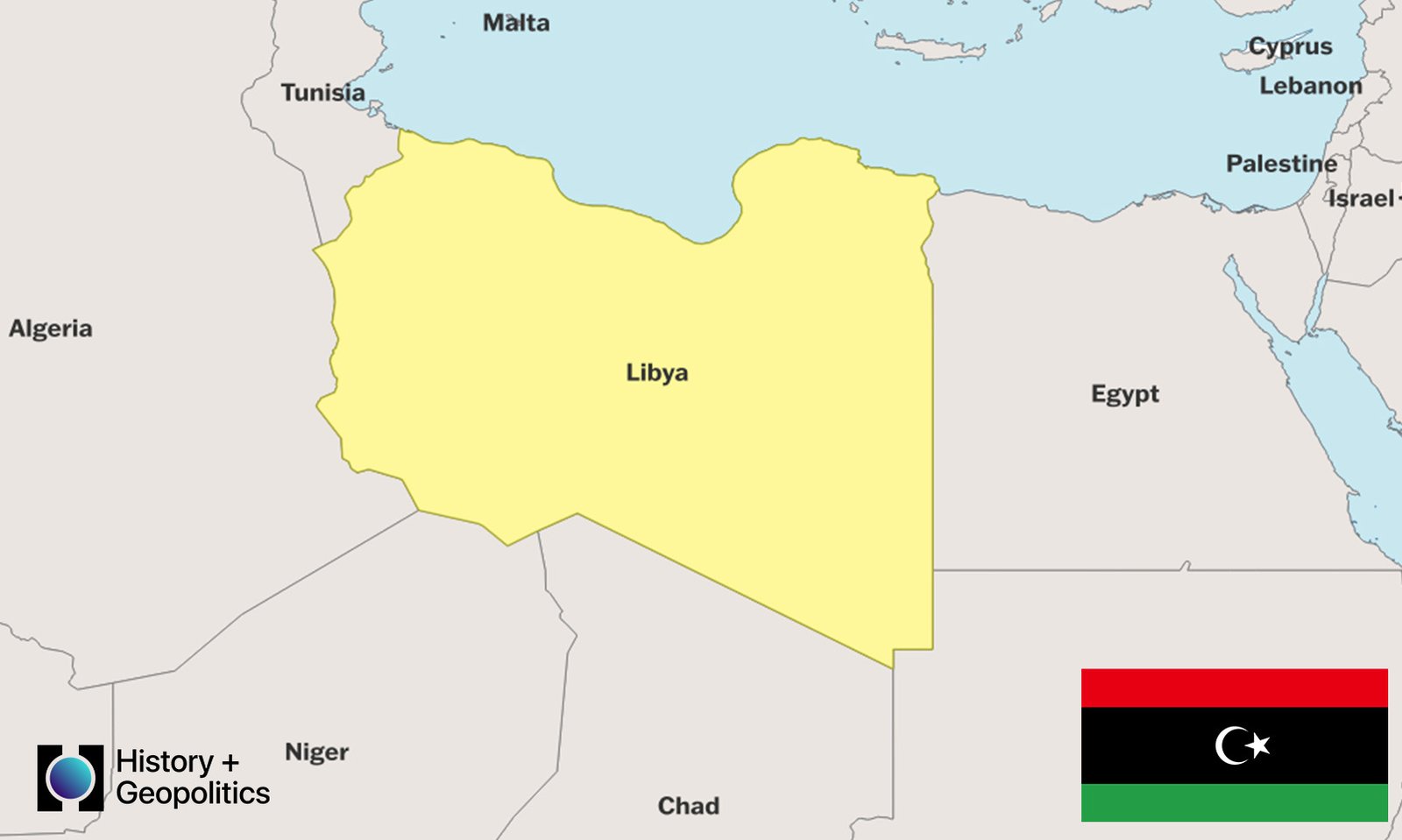
Libya is located in North Africa, bordered by Tunisia and Algeria to the west, Niger and Chad to the south, Sudan and Egypt to the east, and the Mediterranean Sea to the north.
Libya Facts
- OFFICIAL NAME: State of Libya
- CAPITAL: Tripoli
- POPULATION: 7,539,851 (2026)
- AREA: 1,759,541 square kilometers
- OFFICIAL LANGUAGE: Arabic
- CURRENCY: Libyan Dinar (LYD)
Libya Flag
The flag of Libya is a simple tricolor with three equal horizontal stripes — red on top, black in the middle, and green on the bottom — with a white crescent moon and a white five-pointed star centered on the black stripe. The red represents the blood of those who fought and died for the country, the black represents the dark period of foreign occupation, and the green represents Libya’s agricultural prosperity and the values of Islam. The white crescent and star are traditional symbols of Islam. The flag was originally used during the reign of King Idris and was restored after the fall of Muammar Gaddafi in 2011, replacing the all-green flag used during his rule.
Libya Geography
- Located in North Africa, the fourth largest country on the continent and the seventeenth largest in the world.
- Borders: Tunisia and Algeria to the west, Niger and Chad to the south, Sudan to the southeast, Egypt to the east.
- The Mediterranean Sea forms the entire northern coastline, stretching approximately 1,770 kilometers.
- Libya is dominated by the Sahara Desert, which covers approximately 90% of the country.
- The terrain is mostly barren flat plains and plateaus, with some hills along the Mediterranean coast.
- The Tibesti and Akakus mountain ranges rise in the south and southwest respectively.
- The highest peak, Bikku Bitti, rises to 2,267 meters in the far south near the Chad border.
- Most of the population is concentrated along the narrow fertile Mediterranean coastal strip.
- Libya has an extremely arid climate, with the Sahara interior receiving almost no rainfall and experiencing extreme temperatures.
- The country has no permanent rivers, relying instead on underground fossil water reserves for much of its fresh water supply.
Watch Libya geography on YouTube
Libya Government
- Libya has been in a state of political division since the overthrow of Muammar Gaddafi in 2011.
- The country is currently divided between two rival administrations — the internationally recognized Government of National Unity based in Tripoli in the west, and a competing administration aligned with the Libyan National Army led by Khalifa Haftar in the east.
- The Government of National Unity is led by Prime Minister Abdul Hamid Dbeibeh.
- Libya has no functioning unified parliament or head of state recognized by all parties.
- Multiple rounds of UN-facilitated peace negotiations have attempted to reunify the country without achieving a lasting settlement.
History of Libya
- Libya has been inhabited since prehistoric times, with ancient cave paintings in the Acacus Mountains dating back thousands of years.
- The Phoenicians established trading posts along the Mediterranean coast, followed by Greek colonists who founded cities in the east.
- Carthage, Rome, and later the Byzantine Empire all ruled parts of the Libyan coast.
- Arab armies conquered the region in the 7th century A.D., bringing Islam and the Arabic language.
- The Ottoman Empire controlled Libya from the 16th century until the early 20th century.
- Italy invaded and colonized Libya in 1911, establishing Italian control that lasted until World War II.
- Libya gained independence as a constitutional monarchy under King Idris on December 24, 1951, becoming the first country to gain independence through the United Nations.
- Muammar Gaddafi led a military coup in 1969 and governed Libya for over 42 years, using oil revenues to pursue socialist policies and pan-African ambitions.
- The Arab Spring of 2011 triggered a civil war that led to NATO military intervention and the overthrow and killing of Gaddafi in October 2011.
- Libya has experienced ongoing conflict, political fragmentation, and the rise of armed militias since 2011.
People and Culture of Libya
- Libyans are predominantly of Arab and Berber descent, with Arab-Berbers making up approximately 97% of the population.
- The Tuareg and Tebu peoples inhabit the southern desert regions and maintain distinct nomadic and semi-nomadic traditions.
- Arabic is the official language, with Berber languages also spoken by small communities in the southwest and west.
- Sunni Islam is practiced by approximately 97% of the population and is central to Libyan identity and culture.
- Asida, a thick porridge made from flour served with butter and honey or with meat stew, is a traditional Libyan staple.
- Bazeen, a hard dough made from barley flour served with a spiced meat and tomato sauce, is considered one of Libya’s most distinctive national dishes.
- Libyan culture reflects a blend of Arab, Berber, Ottoman, and Mediterranean influences accumulated over centuries of history.
Economy of Libya
- Libya’s economy is almost entirely dependent on oil, which accounts for the overwhelming majority of government revenue and export earnings.
- Libya holds the largest proven oil reserves in Africa, making it one of the most oil-rich countries in the world.
- Oil production has been severely disrupted by the ongoing political conflict and militia activity since 2011.
- Prior to the 2011 uprising, Libya had one of the highest standards of living in Africa due to oil wealth and extensive government subsidies.
- The political division and ongoing conflict have prevented economic recovery and development.
- Libya relies heavily on food imports given its vast desert terrain and very limited agricultural land.
Libya Resources
- Libya possesses the largest proven oil reserves in Africa, estimated at approximately 48 billion barrels, concentrated in the Sirte Basin.
- Natural gas reserves are also significant, found alongside oil fields in the north and northeast.
- The Great Man-Made River, one of the largest water infrastructure projects ever built, pumps ancient fossil water from underground aquifers in the Sahara to coastal cities.
- Limited agricultural land along the Mediterranean coast supports some olive, citrus, and grain production.
- The Sahara Desert contains significant deposits of iron ore, potash, and other minerals that remain largely unexploited.
Libya Wildlife
- Libya’s diverse environments, from the Mediterranean coast to the Sahara Desert, support a range of wildlife adapted to arid conditions.
- The Barbary lion, once native to North Africa including Libya, is now extinct in the wild.
- The Saharan cheetah survives in extremely small numbers in Libya’s remote southern desert regions.
- The Barbary sheep, also known as the aoudad, inhabits the rocky mountain ranges of the south.
- The Addax antelope and Dama gazelle, both critically endangered, are found in very small numbers in Libya’s Saharan regions.
- The Mediterranean coastline supports loggerhead sea turtles and various marine species, including dolphins and the occasional Mediterranean monk seal.
- Conservation efforts are severely hampered by the ongoing conflict, though Libya’s vast and remote Saharan interior has inadvertently provided some protection for its wildlife through sheer inaccessibility.