Andorra Country Profile
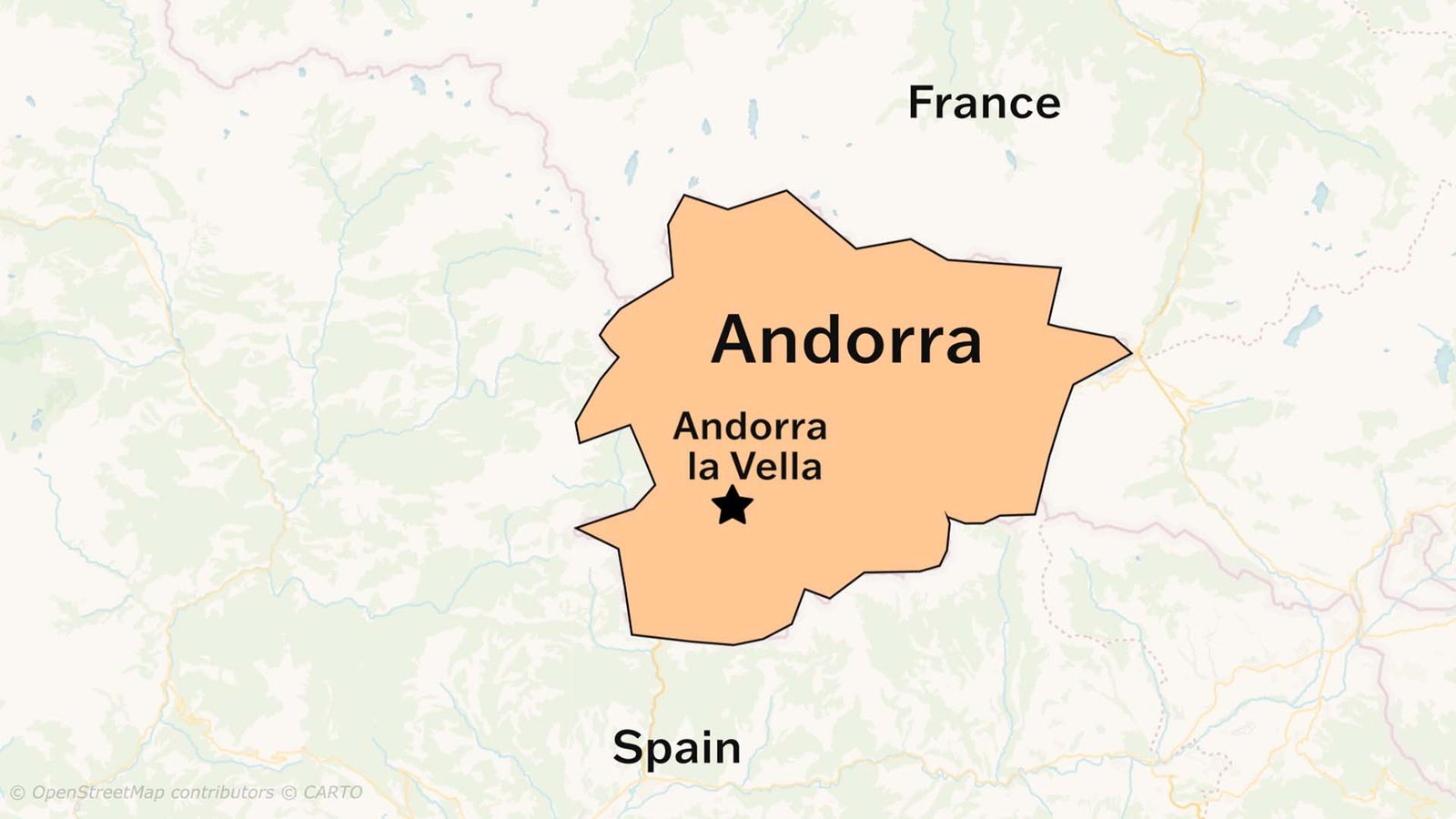
Andorra is located in Southwestern Europe, nestled in the eastern Pyrenees mountains. It is a landlocked microstate bordered by France to the north and Spain to the south, making it one of the smallest countries in the world.
Andorra Facts
- OFFICIAL NAME: Principality of Andorra
- CAPITAL: Andorra la Vella
- POPULATION: 83,753 (2026)
- AREA: 468 square kilometers
- OFFICIAL LANGUAGE: Catalan
- CURRENCY: Euro (EUR)
Andorra Flag
The flag of Andorra has three vertical stripes — blue on the left, yellow in the middle, and red on the right. In the center of the yellow stripe sits the national coat of arms. The blue and red colors are believed to come from France, while the yellow is associated with Spain, reflecting Andorra’s unique position between the two nations. The coat of arms features four quadrants representing the historical bonds of the country — a mitre and crozier for the Bishop of Urgell, a red cow for the County of Foix, two cows for the Viscounty of Béarn, and three vertical red stripes for Catalonia. Below the shield is the national motto, “Virtus Unita Fortior,” meaning “Strength United is Stronger.”
Andorra Geography
- Located in Southwestern Europe, nestled in the eastern Pyrenees mountains.
- Borders: France to the north and Spain to the south.
- Andorra is completely landlocked, with no access to the sea.
- It is one of the smallest countries in the world by both area and population.
- The terrain is rugged and mountainous, with deep valleys and high peaks.
- The highest point, Coma Pedrosa, rises to 2,942 meters above sea level.
- The lowest point in the country is still over 800 meters above sea level.
- Andorra has a mountain climate, with cold snowy winters and mild summers.
- The country’s high altitude makes it a popular destination for skiing and winter sports.
- Several rivers flow through Andorra’s valleys, including the Valira River, which eventually joins Spain’s river system.
- Andorra’s mountainous geography has historically made it difficult to access, helping preserve its independence for centuries.
Andorra Government
- Andorra is a parliamentary co-principality, a unique form of government.
- It has two heads of state, known as Co-Princes — the President of France and the Bishop of Urgell in Spain.
- The Co-Princes hold largely ceremonial roles, while real political power rests with the elected government.
- The Prime Minister, officially called the Head of Government, runs the day-to-day administration.
- Andorra’s parliament is called the General Council.
- This co-principality system dates back to a 1278 agreement that ended a dispute over the territory.
History of Andorra
- According to legend, Andorra’s independence was granted by Charlemagne in the 9th century in recognition for fighting against the Moors.
- In 1278, a dispute over control of Andorra between the Count of Foix and the Bishop of Urgell was resolved through a pareage agreement, establishing the co-principality system.
- For centuries, Andorra remained an isolated and largely self-governing territory in the Pyrenees.
- The country’s mountainous terrain helped it avoid major conflicts in European history.
- Andorra remained neutral during both World War I and World War II.
- In 1993, Andorra adopted its first modern constitution, becoming a parliamentary democracy while retaining the Co-Princes as heads of state.
- Andorra joined the United Nations in 1993.
- In recent decades, Andorra has developed as a major tourism and shopping destination.
People and Culture of Andorra
- Andorrans make up a relatively small share of the population, with many residents from Spain, Portugal, and France also living in the country.
- Catalan is the official language, though Spanish, French, and Portuguese are also widely spoken.
- The vast majority of the population identifies as Roman Catholic.
- Andorran culture is closely tied to Catalan traditions and customs.
- Escudella is a traditional Andorran stew made with meat, vegetables, and pasta, often considered a national dish.
- Festivals and traditional dances, such as the Marratxa, reflect the country’s Catalan heritage.
- Skiing and mountain sports are deeply embedded in the national lifestyle due to the alpine terrain.
- Andorra has one of the highest life expectancies in the world.
Economy of Andorra
- Andorra has a prosperous economy built mainly on tourism, retail, and banking.
- Tax-free shopping has historically attracted millions of visitors each year.
- Skiing and winter tourism are major contributors to the economy, with several popular ski resorts in the Pyrenees.
- The banking and financial services sector plays an important role in the economy.
- Andorra has a very low unemployment rate and a high standard of living.
- The country is not a member of the European Union but uses the Euro as its official currency.
- In recent years, Andorra has worked to diversify its economy and improve financial transparency.
Andorra Resources
- Andorra has limited natural resources due to its small size and mountainous terrain.
- Hydropower generated from its rivers and mountain streams provides a portion of domestic energy.
- Forests cover a significant part of the country and provide timber resources.
- The mountainous landscape itself is one of Andorra’s most valuable resources, fueling its tourism industry.
- Mineral resources are minimal, and the country imports most raw materials and goods.
Andorra Wildlife
- Andorra’s alpine environment supports a variety of mountain wildlife.
- The Pyrenean chamois, a goat-antelope species, is commonly found on the rocky slopes.
- Golden eagles and other birds of prey nest in the high mountain cliffs.
- Marmots are common in the alpine meadows during the warmer months.
- Wild boars inhabit the forested lower elevations.
- The country has several protected natural areas, including the Sorteny Valley Natural Park, which preserves alpine flora and fauna.
- Andorra’s clean mountain environment and limited industrialization have helped preserve much of its native wildlife.