Australia Country Profile
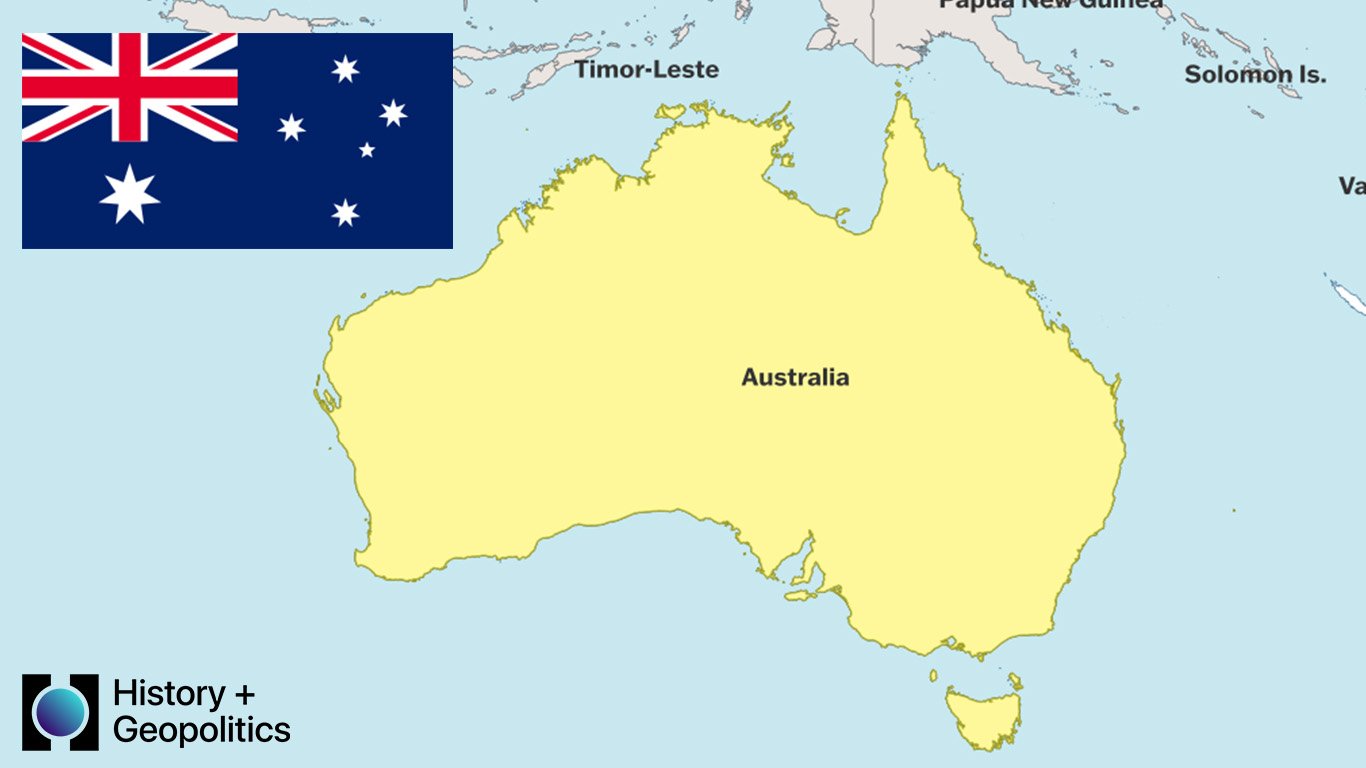
Australia is located in Oceania, occupying the entire Australian continent. It is surrounded entirely by water, with the Indian Ocean to the west and south, the Pacific Ocean to the east, the Tasman Sea to the southeast, and the Timor and Arafura Seas to the north, separating it from Indonesia and Papua New Guinea.
Australia Facts
- OFFICIAL NAME: Commonwealth of Australia
- CAPITAL: Canberra
- POPULATION: 27,227,096 (2026)
- AREA: 7,692,024 square kilometers
- OFFICIAL LANGUAGE: English
- CURRENCY: Australian Dollar (AUD)
Australia Flag
The flag of Australia features a dark blue background with the Union Jack in the upper left corner, a large white seven-pointed star beneath it known as the Commonwealth Star, and a constellation of five white stars representing the Southern Cross on the right side. The Union Jack reflects Australia’s historical ties to the United Kingdom. The Commonwealth Star represents the unity of the six states and territories of Australia. The Southern Cross is a prominent constellation visible from the Southern Hemisphere and is widely used as a national symbol across Australian culture.
Australia Geography
- Located in Oceania, occupying the entire Australian continent, making it the only country to cover a whole continent.
- Surrounded by the Indian Ocean to the west and south, the Pacific Ocean to the east, and the Timor and Arafura Seas to the north.
- Australia is the sixth largest country in the world by total area.
- A vast desert region known as the Outback covers much of the interior of the country.
- The Great Dividing Range runs along the eastern coast, separating the coastal plains from the interior.
- The Great Barrier Reef, the world’s largest coral reef system, lies off the northeastern coast.
- Australia has a wide range of climates, from tropical in the north to temperate in the south and arid in the central regions.
- Much of the interior receives very little rainfall, making large portions of the country sparsely populated.
- The Murray-Darling river system is the most significant river network, supporting agriculture in the southeast.
- Uluru, a massive sandstone rock formation, is one of the country’s most iconic natural landmarks.
Australia Government
- Australia is a federal parliamentary democracy and a constitutional monarchy.
- The British monarch is the ceremonial head of state, represented locally by a Governor-General.
- The Prime Minister serves as the head of government.
- Australia is made up of six states and several territories, each with its own government.
- The Federal Parliament consists of two houses — the House of Representatives and the Senate.
History of Australia
- Indigenous Australians, including Aboriginal peoples and Torres Strait Islanders, have inhabited the continent for over 65,000 years, making it home to one of the oldest continuous cultures in the world.
- Dutch explorers were among the first Europeans to chart parts of the Australian coastline in the early 17th century.
- British explorer Captain James Cook charted the eastern coastline in 1770 and claimed the land for Britain.
- The first British settlement was established in 1788 at Sydney Cove, initially as a penal colony.
- Throughout the 19th century, six separate British colonies were established across the continent.
- The six colonies federated to form the Commonwealth of Australia on January 1, 1901.
- Australia fought alongside Britain and Allied forces in both World War I and World War II.
- In the latter half of the 20th century, Australia gradually reduced formal constitutional and legal ties with Britain.
- Reconciliation efforts with Indigenous Australians have continued in recent decades, addressing historical injustices.
People and Culture of Australia
- Australia has a multicultural population, with significant communities tracing ancestry to the United Kingdom, as well as growing populations with Asian and other international heritage.
- Indigenous Australians make up a small but culturally significant percentage of the population, with diverse languages and traditions.
- English is the dominant language, though hundreds of Indigenous languages are also spoken across the country.
- Australia is known for a relaxed outdoor lifestyle, with beach culture playing a significant role in daily life.
- Vegemite, a savory spread made from yeast extract, is a distinctly Australian food staple.
- Sports such as cricket, Australian rules football, and rugby hold significant cultural importance.
- Indigenous art, including dot painting and storytelling traditions, remains an important part of Australia’s cultural identity.
Economy of Australia
- Australia has a highly developed, services-based economy with strong mining, agriculture, and finance sectors.
- The country is one of the world’s largest exporters of iron ore, coal, and natural gas.
- Agriculture, including wheat, wool, and beef production, plays a significant role in rural economies.
- Tourism is an important industry, with visitors drawn to natural attractions like the Great Barrier Reef and Uluru.
- Australia maintains strong trade relationships with countries across Asia, particularly China and Japan.
- The country has one of the highest standards of living in the world.
Australia Resources
- Australia possesses vast mineral wealth, including some of the world’s largest reserves of iron ore, coal, and bauxite.
- The country is a major global producer of gold, lithium, and uranium.
- Natural gas reserves, particularly offshore in the northwest, contribute significantly to export revenue.
- Agricultural resources support large-scale wheat, wool, and livestock industries.
- The Great Barrier Reef and other natural landmarks serve as significant resources for the tourism industry.
- Renewable energy potential, particularly solar and wind, is substantial due to Australia’s size and climate diversity.
Australia Wildlife
- Australia is home to a remarkable number of species found nowhere else on Earth, due to its long geographic isolation.
- Kangaroos and koalas are among the most iconic native marsupials.
- The platypus, an egg-laying mammal, is one of the most unique animals in the world and is found only in Australia.
- The Great Barrier Reef supports an extraordinary diversity of marine life, including sea turtles, dolphins, and thousands of fish species.
- Australia has some of the world’s most venomous snakes and spiders, adapted to its varied climates.
- The Tasmanian devil, a carnivorous marsupial, is native to the island of Tasmania.
- Conservation efforts across the country focus on protecting native species from threats such as habitat loss and invasive predators.