Bulgaria Country Profile
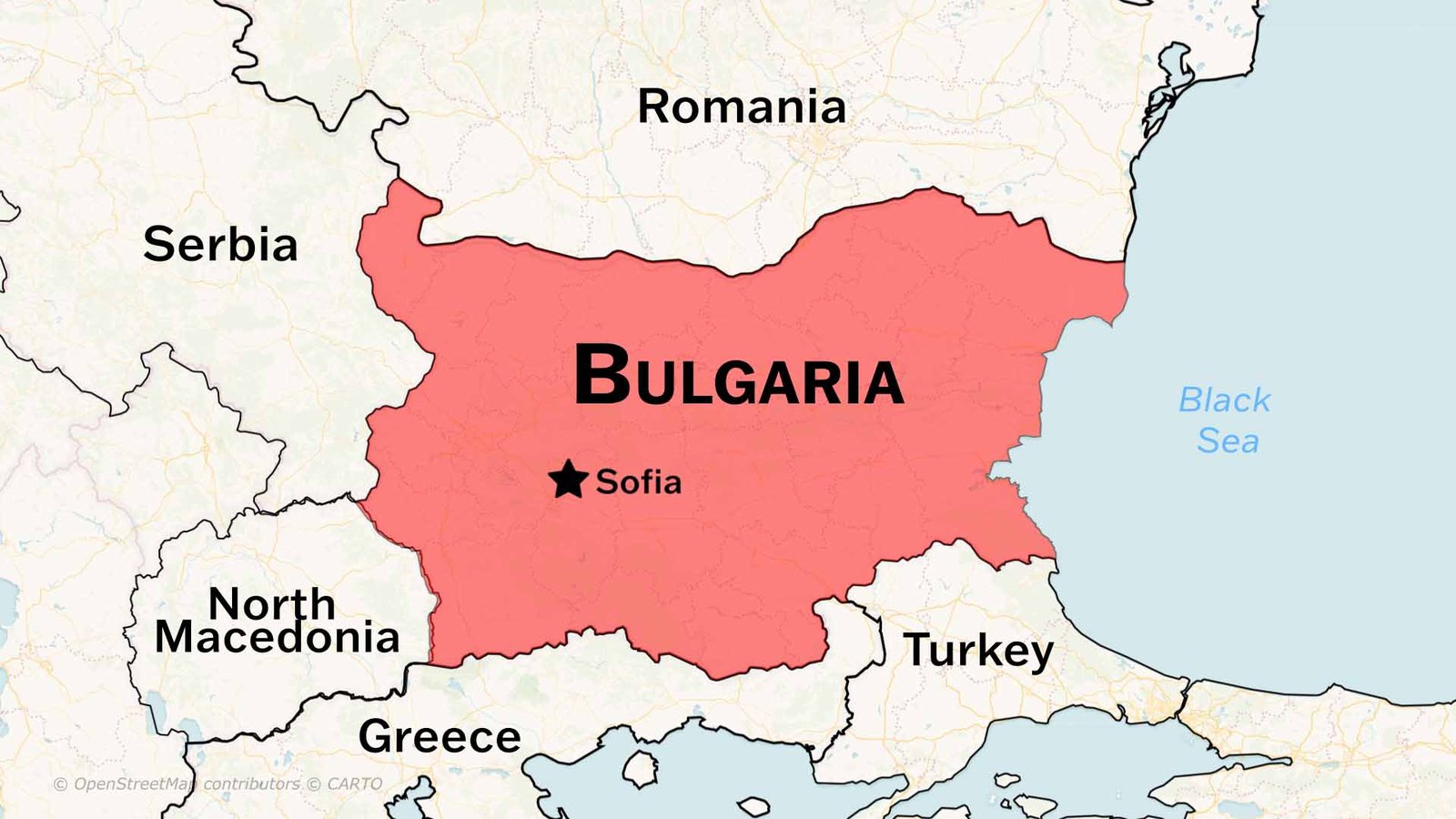
Bulgaria is located in Southeastern Europe, on the eastern part of the Balkan Peninsula. It is bordered by Romania to the north, Serbia and North Macedonia to the west, Greece and Turkey to the south, and the Black Sea to the east.
Bulgaria Facts
- OFFICIAL NAME: Republic of Bulgaria
- CAPITAL: Sofia
- POPULATION: 6,667,659 (2026)
- AREA: 110,879 square kilometers
- OFFICIAL LANGUAGE: Bulgarian
- CURRENCY: Bulgarian Lev (BGN)
Bulgaria Flag
The flag of Bulgaria has three equal horizontal stripes — white on top, green in the middle, and red on the bottom. The white represents peace, love, and freedom. The green symbolizes the agricultural wealth and forests of the country. The red represents the courage and sacrifice of the Bulgarian people in their struggle for independence. The flag’s design is based on the Russian flag, modified by replacing the blue stripe with green to reflect Bulgaria’s natural landscape. The flag was adopted after Bulgaria gained autonomy from the Ottoman Empire in 1878.
Bulgaria Geography
- Located in Southeastern Europe, on the eastern part of the Balkan Peninsula.
- Borders: Romania to the north, Serbia and North Macedonia to the west, Greece and Turkey to the south.
- The Black Sea forms Bulgaria’s eastern coastline, stretching approximately 378 kilometers.
- The terrain is diverse, featuring plains in the north and south, mountain ranges in the center, and a Black Sea coastline.
- The Balkan Mountains, known locally as Stara Planina, run east to west through the center of the country.
- The Rhodope Mountains in the south are the largest mountain range in Bulgaria and the Balkans.
- Musala Peak, located in the Rila Mountains, is the highest point in Bulgaria and the entire Balkan Peninsula, rising to 2,925 meters.
- The Danube River forms most of Bulgaria’s northern border with Romania.
- Bulgaria has a temperate continental climate, with hot summers and cold winters, varying with elevation.
Bulgaria Government
- Bulgaria is a parliamentary republic.
- The President serves as a largely ceremonial head of state.
- The Prime Minister holds executive authority and serves as head of government.
- Bulgaria has a unicameral parliament called the National Assembly.
- Bulgaria joined NATO in 2004 and became a member of the European Union in 2007.
- Bulgaria has experienced significant political instability in recent years, with multiple elections and coalition governments.
History of Bulgaria
- The region has been inhabited since prehistoric times, with Thracian tribes among the earliest known peoples.
- The First Bulgarian Empire was established in 681 A.D., making Bulgaria one of the oldest states in Europe.
- Bulgaria adopted Christianity in 865 A.D. under Tsar Boris I.
- The Cyrillic alphabet was developed in Bulgaria in the 9th century by the disciples of Saints Cyril and Methodius.
- Bulgaria fell under Ottoman rule in 1396 and remained part of the Ottoman Empire for nearly 500 years.
- The April Uprising of 1876 against Ottoman rule was brutally suppressed, drawing international attention.
- Bulgaria gained autonomy from the Ottoman Empire in 1878 following the Russo-Turkish War.
- Bulgaria declared full independence in 1908.
- Bulgaria fought in both World War I and World War II on the losing side, resulting in territorial losses.
- Bulgaria became a communist state after World War II under Soviet influence.
- The communist regime collapsed in 1989 and Bulgaria transitioned to a democratic system.
- Bulgaria joined the European Union in 2007.
People and Culture of Bulgaria
- The majority of the population is ethnically Bulgarian, with Turkish and Roma minorities also present.
- Bulgarian is the official language and uses the Cyrillic alphabet, which was developed in medieval Bulgaria.
- Eastern Orthodox Christianity is the predominant religion, practiced by the majority of Bulgarians.
- Banitsa, a flaky pastry filled with cheese and eggs, is one of Bulgaria’s most beloved traditional foods.
- Shopska salad, made with tomatoes, cucumbers, peppers, and white cheese, is one of Bulgaria’s most iconic dishes and is widely associated with Bulgarian cuisine internationally.
- Bulgaria is one of the world’s largest producers of rose oil, used in perfumery, and the Rose Valley near Kazanlak is internationally renowned.
- Traditional folk music and dance, including the complex rhythms of Bulgarian folk music, are recognized by UNESCO as part of the world’s cultural heritage.
Economy of Bulgaria
- Bulgaria has a developing market economy with industry, services, and agriculture as the main sectors.
- The country is a significant producer and exporter of chemicals, machinery, and metals.
- Information technology and software development have grown significantly in recent decades, attracting international investment.
- Tourism is an important sector, with visitors drawn to the Black Sea coast, ski resorts such as Bansko, and historical and cultural sites.
- Agriculture produces wheat, sunflowers, and vegetables, along with wine and rose oil exports.
- Bulgaria has one of the lowest costs of living in the European Union, making it an attractive destination for foreign investment and remote workers.
Bulgaria Resources
- Bulgaria has deposits of coal, copper, zinc, and lead, contributing to its mining industry.
- The country has significant agricultural land, particularly in the Danubian Plain in the north.
- Forests cover approximately 37% of the country, supporting a timber and wood processing industry.
- Bulgaria has hydropower potential from its mountain rivers, contributing to domestic energy production.
- Rose oil, extracted from the famous Damask rose grown in the Rose Valley, is one of Bulgaria’s most unique and valuable exports.
Bulgaria Wildlife
- Bulgaria’s varied landscapes, from mountains to wetlands and Black Sea coast, support a rich diversity of wildlife.
- Brown bears and wolves inhabit the remote Rhodope and Balkan mountain ranges.
- The Dalmatian pelican, one of the world’s largest flying birds, breeds in the Srebarna Nature Reserve, a UNESCO World Heritage Site.
- The European bison was reintroduced to Bulgaria’s Central Balkan National Park as part of conservation efforts.
- The Black Sea coast serves as an important staging area for migratory birds traveling between Europe and Africa.
- Bulgaria has several national parks and nature reserves protecting its diverse ecosystems and endemic species.
- Emigration and an aging population, rather than environmental pressures, pose the greatest challenges to Bulgaria’s human geography, while wildlife conservation efforts have shown notable successes.