Cambodia Country Profile
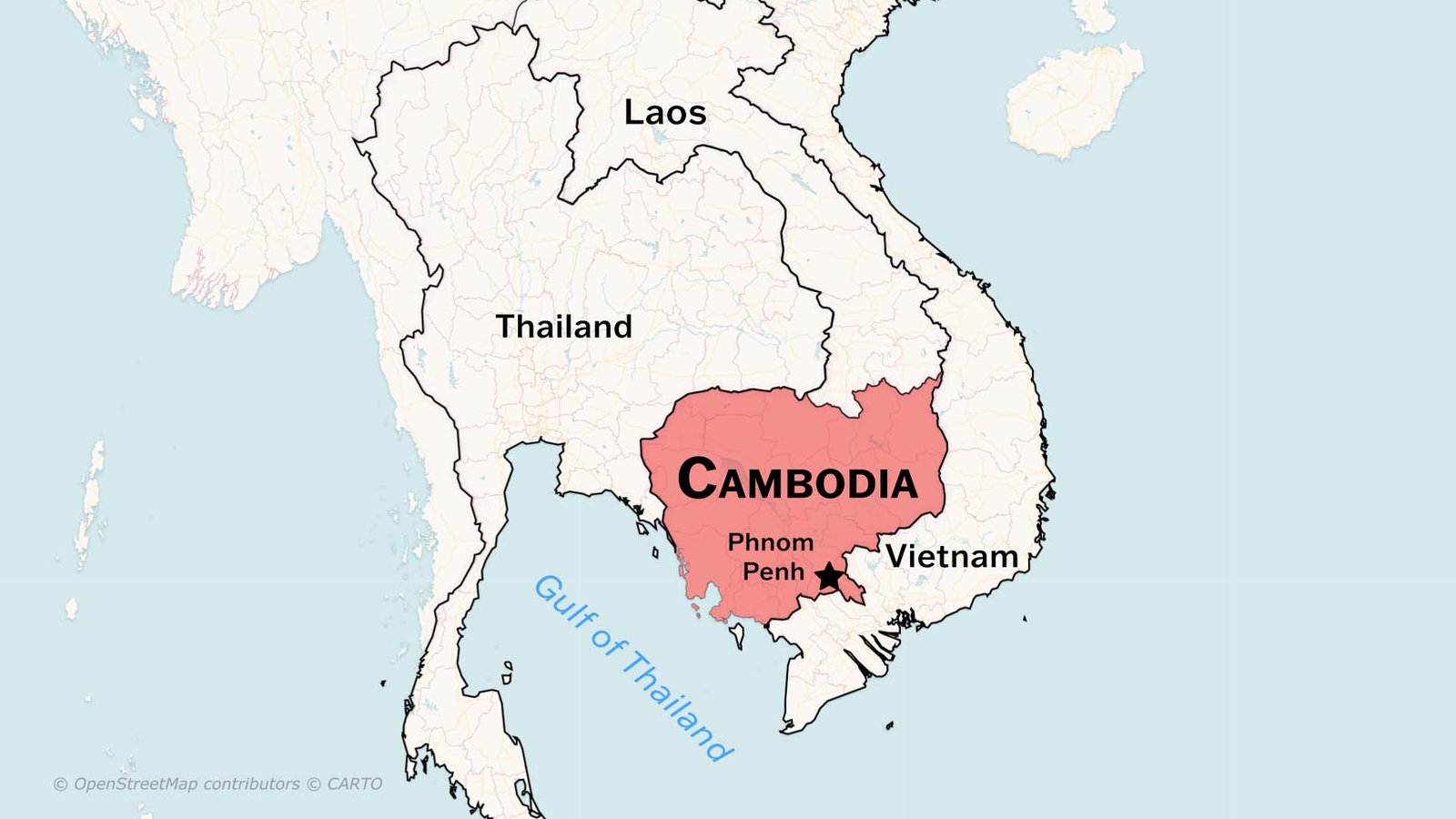
Cambodia is located in Southeast Asia, bordered by Thailand to the northwest, Laos to the northeast, Vietnam to the east, and the Gulf of Thailand to the southwest.
Cambodia Facts
- OFFICIAL NAME: Kingdom of Cambodia
- CAPITAL: Phnom Penh
- POPULATION: 18,051,219 (2026)
- AREA: 181,035 square kilometers
- OFFICIAL LANGUAGE: Khmer
- CURRENCY: Cambodian Riel (KHR)
Cambodia Flag
The flag of Cambodia has three horizontal stripes — blue on the top and bottom and red in the wider middle section. In the center of the red stripe sits a white depiction of Angkor Wat, the famous ancient temple complex. Cambodia is one of the very few countries in the world to feature a building on its national flag. The blue stripes represent the royalty, the red represents the nation, and the white Angkor Wat symbolizes the country’s rich cultural and religious heritage. Angkor Wat is considered the spiritual and historical heart of the Cambodian identity.
Cambodia Geography
- Located in Southeast Asia, in the southwestern part of the Indochina Peninsula.
- Borders: Thailand to the northwest, Laos to the northeast, Vietnam to the east.
- The Gulf of Thailand lies to the southwest, forming the country’s coastal region.
- The Mekong River runs through eastern Cambodia, one of the most important rivers in Southeast Asia.
- The Tonle Sap, the largest freshwater lake in Southeast Asia, sits at the heart of the country and expands dramatically during the monsoon season.
- The terrain consists of a large central lowland plain surrounding the Tonle Sap, ringed by mountains and highlands.
- The Cardamom Mountains rise in the southwest and the Dangrek Mountains form part of the northern border with Thailand.
- Cambodia has a tropical monsoon climate, with a distinct wet season from May to October and a dry season from November to April.
- The Mekong Delta begins in southeastern Cambodia before extending into Vietnam.
Cambodia Government
- Cambodia is a constitutional monarchy.
- The King serves as a largely ceremonial head of state and symbol of national unity.
- The Prime Minister holds executive authority and serves as head of government.
- Cambodia has a bicameral parliament consisting of the National Assembly and the Senate.
- The Cambodian People’s Party has dominated politics since the late 1980s.
- Hun Manet became Prime Minister in 2023, succeeding his father Hun Sen who had governed for nearly four decades.
History of Cambodia
- The Khmer people have inhabited the region for thousands of years, with evidence of early civilizations dating back over two millennia.
- The Khmer Empire, one of the most powerful empires in Southeast Asian history, flourished from approximately the 9th to the 15th century.
- At its height, the Khmer Empire controlled much of mainland Southeast Asia and built the magnificent temple complex of Angkor Wat in the 12th century.
- The empire declined in the 15th century following attacks from neighboring kingdoms.
- Cambodia became a French protectorate in 1863 and remained under French colonial control until independence in 1953.
- Cambodia gained independence from France on November 9, 1953, under King Norodom Sihanouk.
- During the Vietnam War, Cambodia was drawn into the conflict, suffering extensive US bombing campaigns.
- The Khmer Rouge, led by Pol Pot, seized power in 1975 and carried out one of the most devastating genocides of the 20th century, killing an estimated 1.7 to 2 million people between 1975 and 1979.
- Vietnamese forces overthrew the Khmer Rouge in 1979, ending the genocide.
- A UN-supervised peace agreement and elections in 1993 helped restore stability and a constitutional monarchy.
People and Culture of Cambodia
- The Khmer people make up the vast majority of the population, making Cambodia one of the most ethnically homogeneous countries in Southeast Asia.
- Small minorities include Vietnamese, Chinese, and Cham Muslim communities.
- Theravada Buddhism is the state religion and is practiced by the overwhelming majority of the population.
- Amok, a steamed fish curry wrapped in banana leaves, is considered the national dish of Cambodia.
- Cambodian classical dance, known as Apsara dance, is a UNESCO-recognized art form with roots in the ancient Khmer Empire.
- The legacy of the Khmer Rouge genocide continues to shape Cambodian society and collective memory.
- The Khmer New Year, celebrated in April, is the most important cultural festival in the country.
Economy of Cambodia
- Cambodia has one of the fastest-growing economies in Southeast Asia, driven by garment manufacturing, tourism, construction, and agriculture.
- The garment and textile industry is the largest export sector, employing millions of workers predominantly in factories around Phnom Penh.
- Tourism centered on Angkor Wat and the temples of Siem Reap is a significant source of revenue.
- Rice is the most important agricultural crop, with Cambodia being a notable rice exporter in the region.
- The economy has grown significantly since the 1990s, lifting many people out of poverty, though income inequality and corruption remain challenges.
Cambodia Resources
- Cambodia has significant potential for oil and natural gas, with offshore reserves in the Gulf of Thailand beginning to be developed.
- Gemstone deposits, including rubies and sapphires, are found in western Cambodia.
- The Mekong River and Tonle Sap provide extensive freshwater fishery resources, vital for the diet and livelihoods of millions of Cambodians.
- Fertile lowland plains support large-scale rice cultivation.
- Timber resources exist in forested areas, though deforestation has been a significant problem in recent decades.
Cambodia Wildlife
- Cambodia’s forests, wetlands, and coastal areas support a rich diversity of wildlife.
- The Irrawaddy dolphin, a critically endangered freshwater species, inhabits a small stretch of the Mekong River in northeastern Cambodia.
- Asian elephants roam the Cardamom Mountains and the eastern highlands in small but significant numbers.
- The giant ibis, Cambodia’s national bird, is one of the rarest and most endangered birds in the world.
- The Tonle Sap lake and river system supports one of the most productive freshwater fisheries in the world, with hundreds of fish species.
- Tigers were once present in Cambodia but are now effectively extinct in the wild within the country.
- Conservation efforts focus on protecting remaining forest habitats in the Cardamom Mountains and the Eastern Plains landscape.