Canada Country Profile
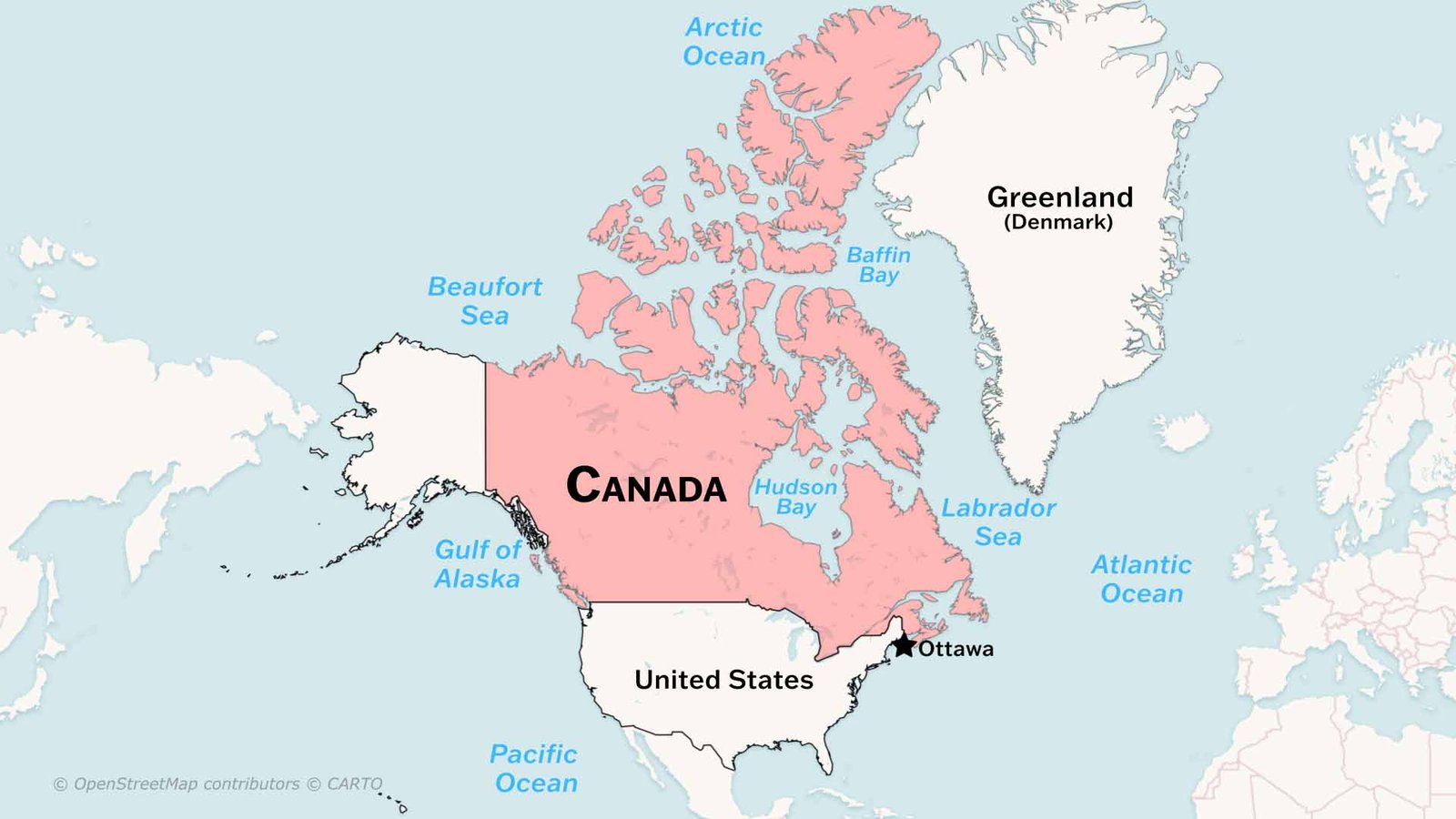
Canada is located in North America, the second largest country in the world by total area. It shares its southern border entirely with the United States, making it the longest international border in the world. To the north it extends to the Arctic Ocean, to the west lies the Pacific Ocean, and to the east lies the Atlantic Ocean.
Canada Facts
- OFFICIAL NAME: Canada
- CAPITAL: Ottawa
- POPULATION: 41,417,056 (2026)
- AREA: 9,984,670 square kilometers
- OFFICIAL LANGUAGES: English, French
- CURRENCY: Canadian Dollar (CAD)
Canada Flag
The flag of Canada, known as the Maple Leaf, has a red vertical stripe on the left, a white square in the center, and a red vertical stripe on the right, with a red eleven-pointed maple leaf at the center of the white section. The red and white colors have been associated with Canada since they were declared the national colors by King George V in 1921. The maple leaf has been a symbol of Canada for centuries, representing the country’s natural landscape. The flag was officially adopted on February 15, 1965, replacing the old Canadian Red Ensign that featured the Union Jack.
Canada Geography
- Located in North America, the second largest country in the world by total area.
- Shares its entire southern border with the United States, forming the world’s longest international land border.
- Bordered by the Pacific Ocean to the west, the Atlantic Ocean to the east, and the Arctic Ocean to the north.
- The terrain is extraordinarily diverse, ranging from the Rocky Mountains in the west to the vast boreal forests and prairies of the interior.
- The Canadian Shield, a massive ancient rock formation, covers much of central and eastern Canada.
- The Great Lakes, shared with the United States, form a significant part of the southern border.
- The St. Lawrence River connects the Great Lakes to the Atlantic Ocean and is one of the most important waterways in North America.
- Canada has the longest coastline of any country in the world, stretching over 202,000 kilometers.
- The far north includes vast Arctic tundra and numerous islands in the Arctic Archipelago.
- Canada has a wide range of climates, from temperate on the coasts to subarctic and arctic in the north.
Canada Government
- Canada is a federal parliamentary democracy and a constitutional monarchy.
- The British monarch is the head of state, represented locally by the Governor-General.
- The Prime Minister serves as the head of government and holds executive authority.
- Canada is made up of ten provinces and three territories, each with varying degrees of autonomy.
- The federal parliament is bicameral, consisting of the House of Commons and the Senate.
- Canada is a founding member of the United Nations, NATO, and the G7.
History of Canada
- Indigenous peoples have inhabited Canada for over 15,000 years, with hundreds of distinct nations and languages across the continent.
- Norse explorers briefly settled in Newfoundland around 1000 A.D., representing the first known European contact.
- French and British explorers and settlers arrived in the 16th and 17th centuries, establishing competing colonial claims.
- The Seven Years War ended in 1763 with Britain gaining control of most of the French territories in Canada.
- Canada gradually gained greater autonomy from Britain throughout the 19th and early 20th centuries.
- The Constitution Act of 1867 created the Dominion of Canada, uniting several British colonies into one country.
- Canada gained full legal independence from Britain with the Constitution Act of 1982.
- Canada has since developed into one of the world’s most prosperous, multicultural, and diverse nations.
People and Culture of Canada
- Canada is one of the most multicultural countries in the world, with a population drawn from virtually every nation on Earth.
- English and French are both official languages, reflecting the country’s dual colonial heritage.
- Indigenous peoples, including First Nations, Métis, and Inuit communities, represent a significant and culturally distinct part of the population.
- Canada has no single national religion, with Christianity historically predominant but religious diversity increasing significantly in recent decades.
- Poutine, a dish of french fries topped with cheese curds and gravy, is one of Canada’s most iconic foods, originating in Quebec.
- Ice hockey is considered the national sport and is central to Canadian cultural identity.
- Canada is internationally recognized for its multiculturalism policy, which officially encourages the preservation of cultural diversity.
Economy of Canada
- Canada has one of the largest and most advanced economies in the world, ranking among the G7 nations.
- Natural resources, including oil and gas, timber, minerals, and fish, play a major role in the economy.
- The Alberta oil sands contain one of the largest reserves of oil in the world.
- Manufacturing, financial services, and technology are major contributors to the economy.
- The United States is Canada’s largest trading partner, with the two countries sharing one of the world’s largest bilateral trade relationships.
- Canada is a leading exporter of wheat, potash, lumber, and natural gas.
Canada Resources
- Canada possesses vast natural resources, including the third largest oil reserves in the world, located primarily in the Alberta oil sands.
- The country has significant deposits of uranium, potash, nickel, gold, and copper.
- Canada’s forests, which cover approximately 35% of the country’s land area, represent one of the largest timber resources in the world.
- Hydroelectric power is a major energy source, with Canada being one of the world’s largest producers of hydroelectricity.
- Freshwater resources are enormous, with Canada holding approximately 20% of the world’s surface fresh water.
Canada Wildlife
- Canada’s vast and diverse landscapes support an extraordinary range of wildlife.
- Polar bears inhabit the Arctic regions, with the Hudson Bay area being one of the most important polar bear habitats in the world.
- Moose, caribou, and grizzly bears roam the boreal forests and tundra.
- The humpback whale and orca are commonly found in both the Pacific and Atlantic coastal waters.
- The beaver, Canada’s national animal, is found throughout the country’s lakes and rivers.
- Migratory birds travel through Canada in enormous numbers, making it one of the most important countries for bird conservation in the world.
- Canada has established an extensive network of national parks protecting some of the most spectacular wilderness areas on Earth.