Czech Republic Country Profile
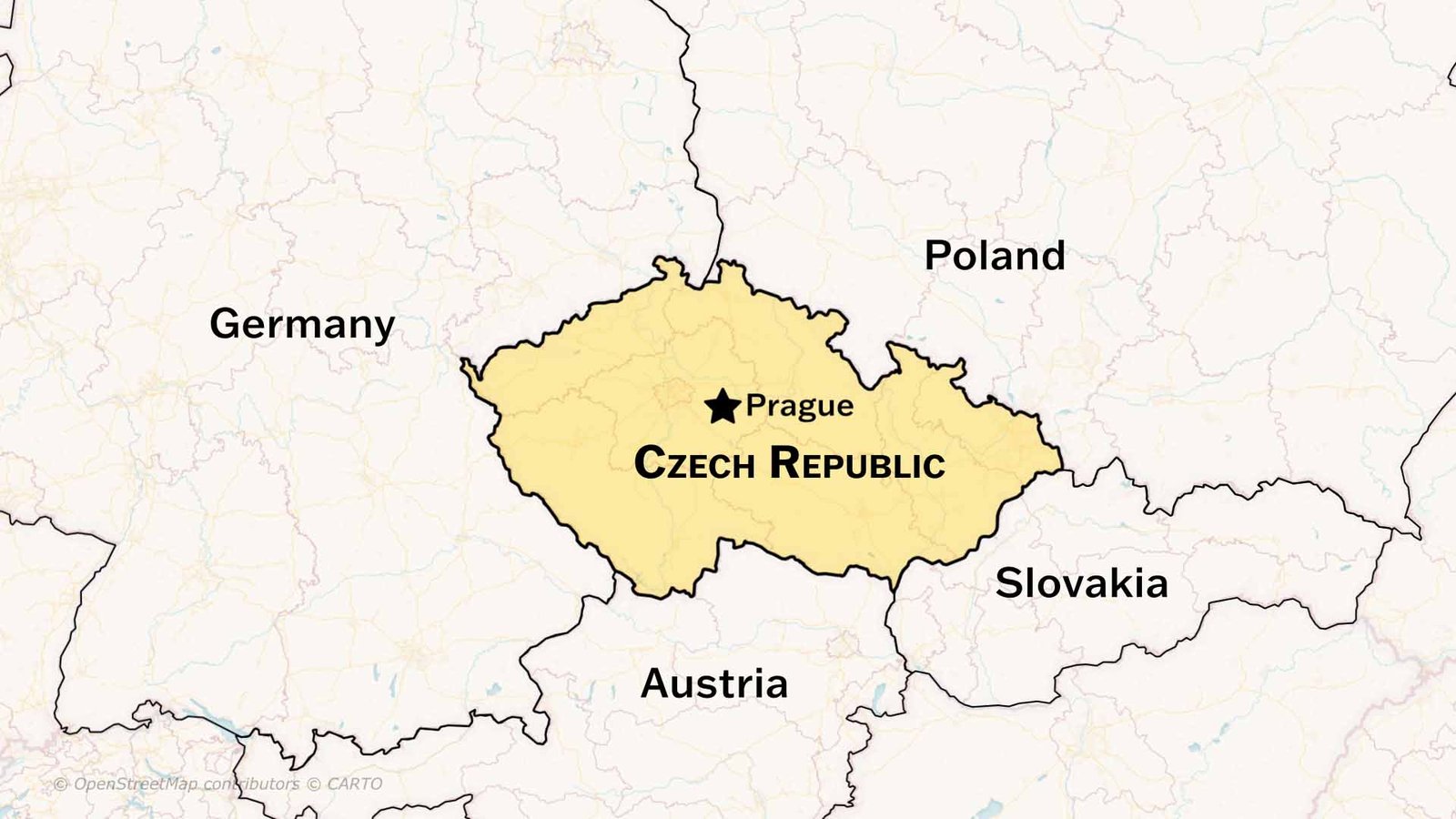
The Czech Republic is located in Central Europe, a landlocked country bordered by Germany to the west and northwest, Poland to the north, Slovakia to the east, and Austria to the south.
Czech Republic Facts
- OFFICIAL NAME: Czech Republic (also known as Czechia)
- CAPITAL: Prague
- POPULATION: 10,527,781 (2026)
- AREA: 78,866 square kilometers
- OFFICIAL LANGUAGE: Czech
- CURRENCY: Czech Koruna (CZK)
Czech Republic Flag
The flag of the Czech Republic has two equal horizontal stripes — white on top and red on the bottom — with a blue triangle extending from the hoist side to the center of the flag. The white and red colors are traditional Bohemian colors with roots going back to medieval heraldry. The blue triangle was added to distinguish the flag from that of Poland, which also uses white and red. The colors are Pan-Slavic colors shared by many Central and Eastern European nations. The flag was originally adopted by Czechoslovakia and retained by the Czech Republic when it separated from Slovakia in 1993.
Czech Republic Geography
- Located in Central Europe, completely landlocked with no access to the sea.
- Borders: Germany to the west and northwest, Poland to the north, Slovakia to the east, Austria to the south.
- The country consists of three historic regions — Bohemia in the west, Moravia in the east, and a small part of Silesia in the northeast.
- The Bohemian Massif, an ancient plateau ringed by mountain ranges, forms the geographical core of Bohemia.
- The Krkonoše Mountains along the northern border with Poland contain the highest peak, Sněžka, rising to 1,603 meters.
- The Morava and Elbe rivers are among the most important waterways, flowing outward to neighboring countries.
- The country has a temperate continental climate with warm summers and cold winters.
- The Bohemian Basin in the center is the most fertile and densely populated region.
- The Czech Republic has extensive forest cover, particularly in the mountain border regions.
Czech Republic Government
- The Czech Republic is a parliamentary republic.
- The President serves as head of state with largely ceremonial duties.
- The Prime Minister serves as head of government, holding executive authority.
- The country has a bicameral parliament consisting of the Chamber of Deputies and the Senate.
- The Czech Republic joined NATO in 1999 and the European Union in 2004.
- Petr Pavel has served as President since 2023.
History of the Czech Republic
- The region has been inhabited since prehistoric times, with Celtic and later Germanic and Slavic tribes settling the area over centuries.
- The Kingdom of Bohemia emerged as a significant European power in the medieval period, with Prague becoming one of the most important cities in the Holy Roman Empire.
- Charles IV, King of Bohemia and Holy Roman Emperor, made Prague a cultural and intellectual center in the 14th century.
- Jan Hus, a Czech religious reformer, was burned at the stake in 1415, sparking the Hussite Wars and foreshadowing the Protestant Reformation.
- The region came under Habsburg rule in the 16th century and remained part of the Austrian Empire for nearly 400 years.
- Czechoslovakia was founded in 1918 following the collapse of the Austro-Hungarian Empire after World War I.
- Nazi Germany occupied Czechoslovakia in 1938 and 1939, with the Czech lands incorporated into the Third Reich.
- After World War II, Czechoslovakia came under Soviet influence and a communist government took power in 1948.
- The Prague Spring of 1968, a period of political liberalization, was crushed by a Soviet-led invasion.
- The Velvet Revolution of 1989 peacefully ended communist rule and restored democracy.
- Czechoslovakia peacefully dissolved into the Czech Republic and Slovakia on January 1, 1993, in what became known as the Velvet Divorce.
People and Culture of the Czech Republic
- Czechs make up the large majority of the population, with Slovak, Ukrainian, and other minority communities also present.
- Czech is the official language, a West Slavic language written in the Latin alphabet.
- The Czech Republic is one of the most secular countries in the world, with a large proportion of the population identifying as non-religious.
- Svíčková, a dish of marinated beef sirloin served with creamy sauce, bread dumplings, and cranberries, is one of the most beloved national dishes.
- The Czech Republic holds the world record for the highest beer consumption per capita, and Czech beer, particularly from Pilsen and České Budějovice, is internationally renowned.
- Prague, the capital, is one of the best-preserved medieval cities in Europe and a major center of art, architecture, and culture.
- Classical music has deep roots in Czech culture, with composers such as Antonín Dvořák and Bedřich Smetana among the most celebrated in European history.
Economy of the Czech Republic
- The Czech Republic has one of the most developed and prosperous economies in Central and Eastern Europe.
- Manufacturing, particularly the automotive industry, is the backbone of the economy, with major international manufacturers operating large plants in the country.
- The country is a significant exporter of machinery, electronics, and vehicles.
- Tourism is an important sector, with Prague attracting millions of visitors annually as one of Europe’s most popular city destinations.
- The Czech Republic has strong trade ties with Germany and other EU member states.
- The country maintains its own currency, the Czech Koruna, and has not yet adopted the Euro.
Czech Republic Resources
- The Czech Republic has deposits of coal, particularly brown coal or lignite, which has historically been an important energy source.
- The country has limited mineral resources but some deposits of uranium, kaolin, and graphite.
- Forests cover approximately one third of the country and support a significant timber industry.
- Fertile agricultural land in the Bohemian and Moravian lowlands supports grain, hops, and sugar beet production.
- Hops cultivation is particularly significant, with Czech hops used in brewing some of the world’s most famous beers.
Czech Republic Wildlife
- The Czech Republic’s forests, rivers, and mountain regions support a variety of Central European wildlife.
- Eurasian lynx and wolves have been gradually returning to the country’s border mountain ranges after long absences.
- Red deer, roe deer, and wild boar are common throughout the country’s extensive forests.
- The white-tailed eagle and black stork inhabit forested and wetland areas, particularly in southern Bohemia.
- The Šumava National Park along the German and Austrian borders is the largest protected area in the country and one of the most important forest wilderness areas in Central Europe.
- The country has established several national parks and protected landscape areas to preserve its remaining natural habitats and biodiversity.