Denmark Country Profile
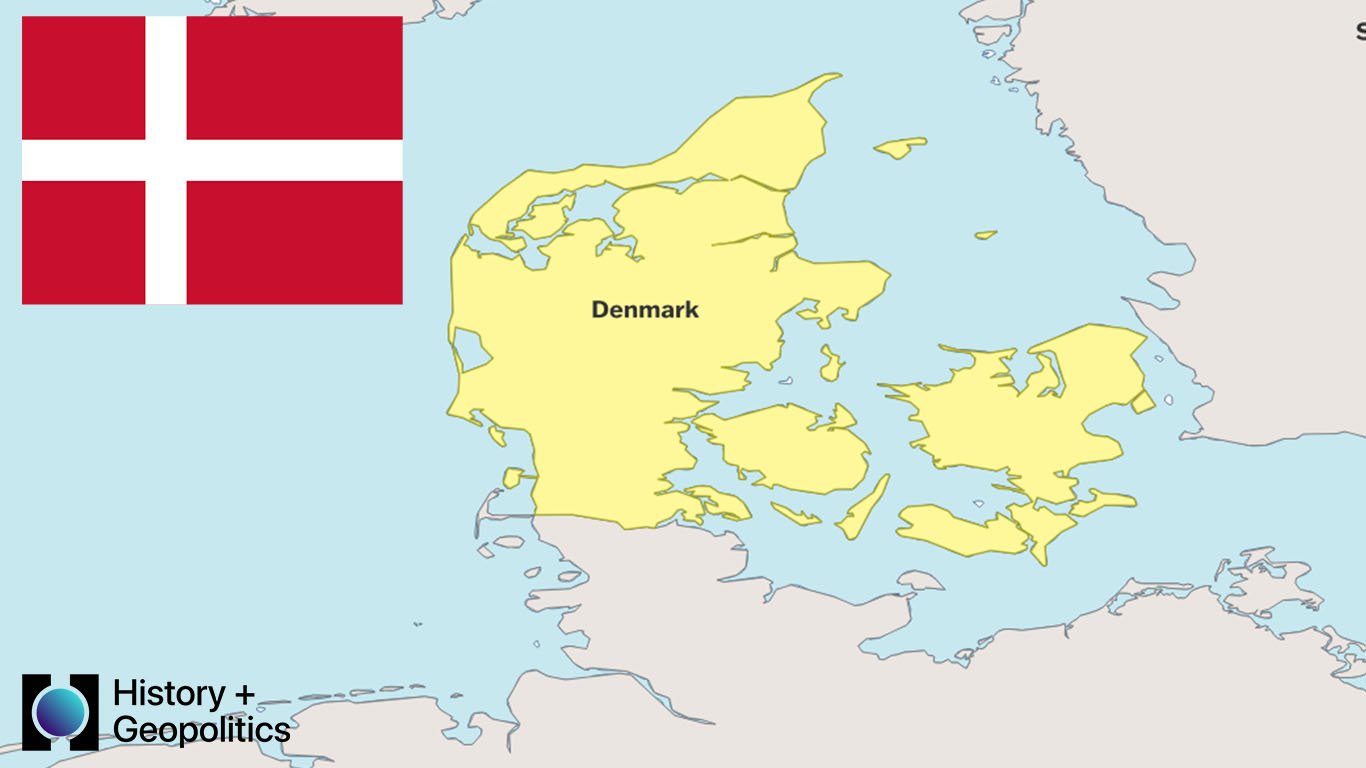
Denmark is located in Northern Europe, a Nordic country consisting of the Jutland Peninsula and an archipelago of islands. It borders Germany to the south, its only land border, and is surrounded by the North Sea to the west and the Baltic Sea to the east.
Denmark Facts
- OFFICIAL NAME: Kingdom of Denmark
- CAPITAL: Copenhagen
- POPULATION: 6,023,520 (2026)
- AREA: 42,924 square kilometers
- OFFICIAL LANGUAGE: Danish
- CURRENCY: Danish Krone (DKK)
Denmark Flag
The flag of Denmark, known as the Dannebrog, is one of the oldest national flags in the world still in use. It has a red background with a white Nordic cross that extends to the edges of the flag, with the vertical bar of the cross positioned slightly to the left of center. According to legend, the flag fell from the sky during the Battle of Lyndanisse in Estonia in 1219, inspiring the Danish forces to victory. The Dannebrog served as the template for the flags of the other Nordic countries — Norway, Sweden, Finland, and Iceland — all of which use variations of the same Nordic cross design.
Denmark Geography
- Located in Northern Europe, consisting of the Jutland Peninsula and an archipelago of over 400 islands.
- Shares its only land border with Germany to the south.
- Surrounded by the North Sea to the west and the Baltic Sea to the east.
- The Øresund Strait separates Denmark from Sweden to the northeast.
- Denmark is the smallest and most southerly of the Scandinavian countries.
- The terrain is almost entirely flat to gently rolling, with no significant mountain ranges.
- The highest natural point, Møllehøj, rises to only 171 meters above sea level.
- Denmark has an extensive coastline of approximately 7,314 kilometers due to its many islands.
- The country has a temperate oceanic climate, with mild winters and cool summers influenced by the surrounding seas.
- Denmark also administers two autonomous territories — Greenland and the Faroe Islands — which are geographically and culturally distinct from mainland Denmark.
Denmark Government
- Denmark is a constitutional monarchy and a parliamentary democracy.
- The monarch serves as the ceremonial head of state.
- The Prime Minister serves as the head of government, holding executive authority.
- Denmark has a unicameral parliament called the Folketing, consisting of 179 members.
- Denmark is a founding member of NATO and joined the European Union in 1973.
- Denmark is known internationally for its strong welfare state, high levels of social trust, and consistently high rankings in quality of life and happiness indexes.
History of Denmark
- Denmark has one of the longest continuous histories of any European state, with roots tracing back to the Viking Age.
- The Vikings, seafaring Norse peoples, originated largely from the Danish peninsula and raided, traded, and settled across Europe, the North Atlantic, and beyond from the 8th to the 11th centuries.
- The Kingdom of Denmark was established as a unified state in the 10th century under Harald Bluetooth.
- Denmark controlled much of Scandinavia and parts of England during the medieval period.
- The Kalmar Union, formed in 1397, united Denmark, Norway, and Sweden under Danish leadership.
- Denmark was a significant colonial power, with territories in the Caribbean, Africa, and Asia.
- Denmark sold its Caribbean colonies, including what is now the US Virgin Islands, to the United States in 1917.
- Denmark was occupied by Nazi Germany from 1940 to 1945 during World War II.
- Following the war, Denmark became a founding member of NATO in 1949 and later joined the European Community.
- Denmark has developed into one of the world’s most prosperous and socially progressive nations in the postwar period.
People and Culture of Denmark
- The population is predominantly ethnic Danish, with growing communities of immigrants from the Middle East, Eastern Europe, and other regions.
- Danish is the official language, a North Germanic language closely related to Swedish and Norwegian.
- The Evangelical Lutheran Church is the official state church, though religious practice has declined significantly in recent decades.
- Smørrebrød, open-faced rye bread sandwiches topped with various ingredients such as herring, roast beef, or eggs, is one of Denmark’s most iconic traditional foods.
- The concept of hygge, a Danish word describing a feeling of coziness, comfort, and convivial togetherness, has become internationally recognized as central to Danish culture.
- Denmark has a strong tradition in design, architecture, and furniture, with Danish modern design internationally celebrated.
- Fairy tale author Hans Christian Andersen and philosopher Søren Kierkegaard are among Denmark’s most celebrated cultural figures.
Economy of Denmark
- Denmark has one of the highest standards of living in the world, underpinned by a mixed economy with a strong welfare state.
- Key industries include pharmaceuticals, maritime shipping, food processing, and renewable energy.
- Denmark is a world leader in wind energy technology, with Danish companies at the forefront of the global wind power industry.
- Agriculture, particularly dairy and pork production, contributes significantly to exports despite the country’s small land area.
- Denmark has important offshore oil and natural gas reserves in the North Sea, though production has been declining.
- The country consistently ranks among the least corrupt and most competitive economies in the world.
Denmark Resources
- Denmark has offshore oil and natural gas reserves in the North Sea, which have contributed significantly to the economy since the 1970s.
- Wind energy resources are exceptional, with Denmark generating a high proportion of its electricity from wind power.
- Fertile agricultural land supports intensive farming, particularly of pigs, dairy cattle, and grain crops.
- The surrounding seas provide significant fishery resources, including herring, cod, and salmon.
- Denmark’s clean energy expertise and technology represent an increasingly valuable intellectual and industrial resource for the global green transition.
Denmark Wildlife
- Denmark’s flat landscape, coastal areas, and forests support a variety of northern European wildlife.
- Red deer and roe deer are common in Denmark’s forests and heathlands.
- The white-tailed eagle has made a strong comeback in Denmark after near extinction and is now regularly seen around coastal and lake areas.
- Harbor porpoises and harbor seals are found in significant numbers in Danish coastal waters.
- Denmark’s wetlands and coastal areas are important stopover points for migratory birds traveling along the East Atlantic Flyway between breeding grounds in the Arctic and wintering areas in Africa.
- The country has established several national parks, including Thy National Park, Denmark’s first, to protect its coastal and heathland ecosystems.