Djibouti Country Profile
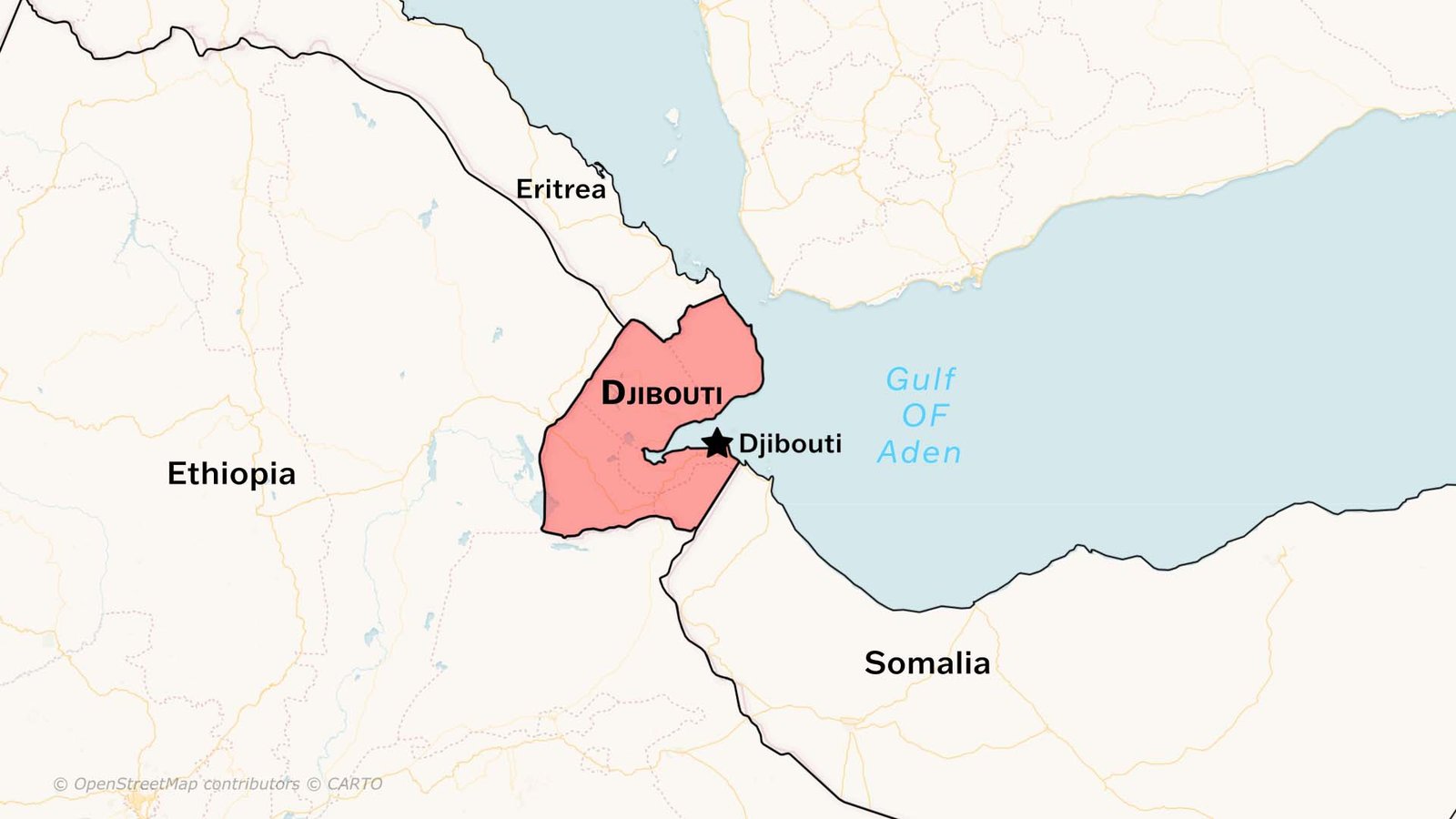
Djibouti is located in the Horn of Africa, a small country bordered by Eritrea to the north, Ethiopia to the west and southwest, and Somalia to the southeast. To the east lies the Gulf of Aden and to the northeast the Bab-el-Mandeb Strait, one of the world’s most strategically important waterways connecting the Red Sea to the Indian Ocean.
Djibouti Facts
- OFFICIAL NAME: Republic of Djibouti
- CAPITAL: Djibouti City
- POPULATION: 1,199,459 (2026)
- AREA: 23,200 square kilometers
- OFFICIAL LANGUAGES: French, Arabic
- CURRENCY: Djiboutian Franc (DJF)
Djibouti Flag
The flag of Djibouti has two equal horizontal stripes — light blue on top and green on the bottom — with a white triangle on the hoist side containing a red five-pointed star. The light blue represents the sky and the sea as well as the Issa Somali community. The green represents the earth and the Afar community. The white triangle symbolizes peace. The red star represents unity and the blood shed by the nation’s martyrs in the struggle for independence. Together the colors and symbols reflect the country’s two main ethnic communities and its aspirations for peace and unity.
Djibouti Geography
- Located in the Horn of Africa, at the southern entrance to the Red Sea.
- Borders: Eritrea to the north, Ethiopia to the west and southwest, Somalia to the southeast.
- The Gulf of Aden lies to the east and the Bab-el-Mandeb Strait to the northeast.
- Djibouti is one of the smallest countries in Africa by land area.
- The terrain is mostly desert and semi-arid, with volcanic rock formations, salt lakes, and coastal plains.
- Lake Assal, located in the Afar Depression, is the lowest point in Africa at 155 meters below sea level and one of the saltiest bodies of water on Earth.
- The Afar Depression is one of the most geologically active regions in the world, where three tectonic plates meet.
- The country has a hot and arid climate, with extremely high temperatures and very little rainfall.
- Djibouti City, the capital, is home to the vast majority of the country’s population.
Djibouti Government
- Djibouti is a presidential republic.
- The President serves as both head of state and head of government with extensive executive authority.
- Ismail Omar Guelleh has served as President since 1999.
- Djibouti has a bicameral parliament consisting of the National Assembly and the Senate.
- The ruling People’s Rally for Progress party has dominated politics since independence.
History of Djibouti
- The region has been inhabited for thousands of years by the Afar and Issa Somali peoples.
- The area was an important trading post along ancient maritime routes connecting the Arabian Peninsula, East Africa, and South Asia.
- France established a presence in the region in the 1860s, eventually creating the colony of French Somaliland.
- The territory was renamed the French Territory of the Afars and Issas in 1967.
- Djibouti gained independence from France on June 27, 1977.
- Since independence, Djibouti has maintained close political and military ties with France.
- The country experienced a civil conflict between the government and the Afar-based Front for the Restoration of Unity and Democracy in the early 1990s.
- Djibouti’s strategic location has made it a host for foreign military bases from multiple nations, including the United States, France, China, and Japan.
People and Culture of Djibouti
- The Issa Somali and the Afar are the two main ethnic groups, each making up a significant portion of the population.
- French and Arabic are the official languages, while Somali and Afar are widely spoken in daily life.
- Sunni Islam is practiced by approximately 94% of the population and is central to daily life and culture.
- Skudahkharis, a slow-cooked rice and meat dish seasoned with spices, is one of the most traditional dishes in Djibouti.
- Djibouti has a strong tradition of oral poetry, particularly among the Afar and Somali communities.
- The country’s location at a major global shipping crossroads has given it a cosmopolitan character, with a significant expatriate and military community.
- Camel herding and nomadic traditions remain an important part of cultural identity among rural communities.
Economy of Djibouti
- Djibouti’s economy is driven primarily by its strategic location as a major port and logistics hub in the Horn of Africa.
- The Port of Djibouti is one of the busiest in East Africa and serves as the primary trade gateway for landlocked Ethiopia, which handles the majority of its imports and exports through Djibouti.
- Foreign military bases provide a significant source of rental income and employment for the government.
- The Doraleh Container Terminal, developed with Chinese investment, has significantly expanded the country’s port capacity.
- Djibouti has limited agricultural capacity due to its arid climate and relies heavily on food imports.
- The government has invested in infrastructure including rail links and free trade zones to develop Djibouti as a regional logistics and financial hub.
Djibouti Resources
- Djibouti has limited natural resources due to its arid terrain and small land area.
- Geothermal energy potential is significant due to the country’s location in the volcanically active Afar Depression.
- Salt and other minerals are extracted from Lake Assal, one of the world’s most saline lakes.
- The surrounding waters of the Gulf of Aden provide fishing resources, though the industry remains underdeveloped.
- Djibouti’s most valuable resource is its strategic geographic location controlling access to the Red Sea and the Bab-el-Mandeb Strait.
Djibouti Wildlife
- Djibouti’s harsh desert environment supports a limited but unique range of wildlife adapted to arid conditions.
- The Afar Depression and surrounding areas are home to various reptile species, including monitor lizards and several endemic lizard species.
- The Gulf of Tadjoura and surrounding waters are home to whale sharks, which aggregate seasonally in the bay and attract growing ecotourism interest.
- Dolphins and various marine species inhabit the coastal waters of the Gulf of Aden.
- The Day Forest National Park, a small area of highland woodland, provides habitat for birds and small mammals in an otherwise arid landscape.
- Djibouti is located along important bird migration routes, and numerous migratory species pass through the country seasonally.
- Conservation efforts are limited by the country’s economic challenges, though ecotourism based around whale shark watching has been growing.