Finland Country Profile
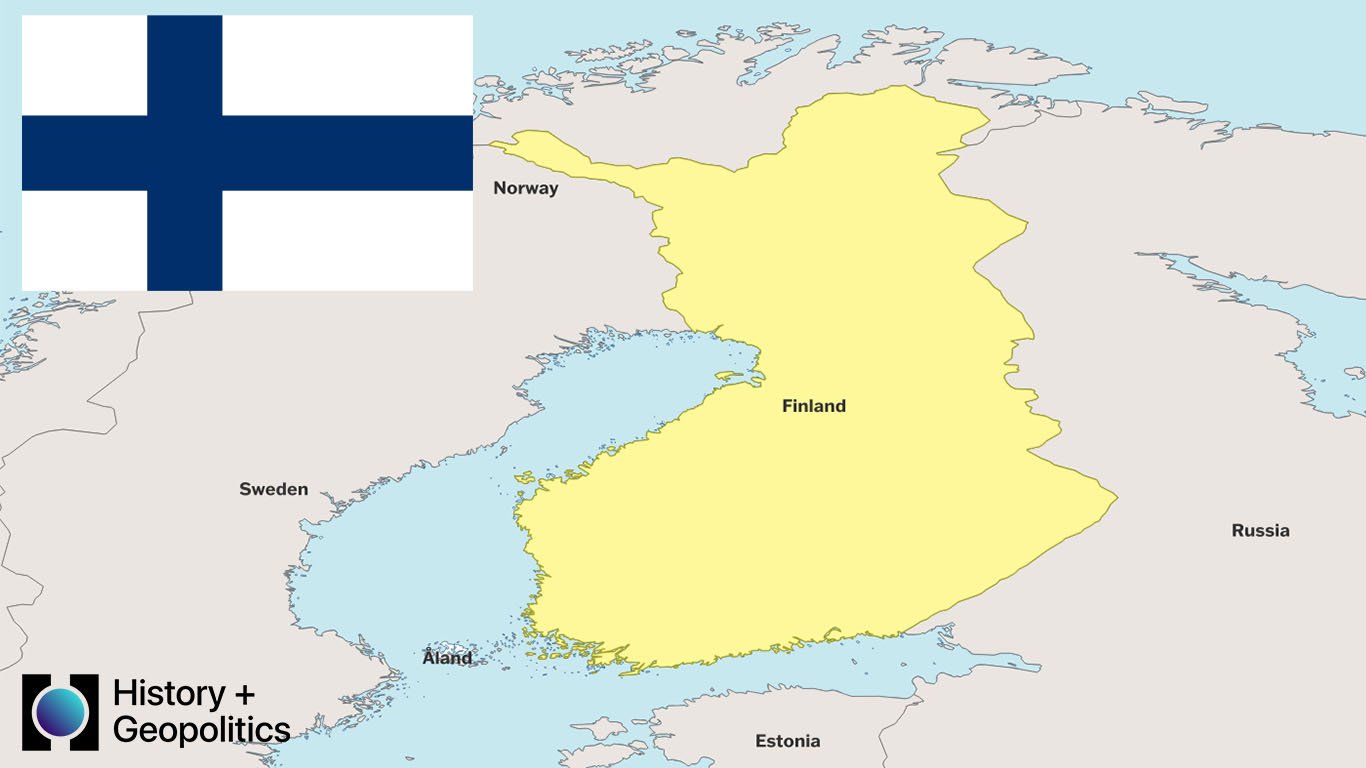
Finland is located in Northern Europe, a Nordic country bordered by Sweden to the west, Norway to the north, and Russia to the east. To the south lies the Gulf of Finland, separating it from Estonia, and to the southwest lies the Baltic Sea.
Finland Facts
- OFFICIAL NAME: Republic of Finland
- CAPITAL: Helsinki
- POPULATION: 5,621,739 (2026)
- AREA: 338,145 square kilometers
- OFFICIAL LANGUAGES: Finnish, Swedish
- CURRENCY: Euro (EUR)
Finland Flag
The flag of Finland has a white background with a blue Nordic cross extending to the edges, with the vertical bar positioned slightly to the left of center. The blue represents the numerous lakes and waterways of Finland as well as the sky. The white represents the snow that covers the country during its long winters. The Nordic cross design is shared with the other Scandinavian and Nordic nations — Denmark, Sweden, Norway, and Iceland — reflecting their shared cultural and historical heritage. The flag was officially adopted in 1918 following Finland’s declaration of independence.
Finland Geography
- Located in Northern Europe, one of the most northerly countries in the world.
- Borders: Sweden to the west, Norway to the north, Russia to the east.
- The Gulf of Finland lies to the south and the Baltic Sea to the southwest.
- Finland is one of the largest countries in Europe by land area, yet one of the most sparsely populated.
- The terrain is mostly flat to gently rolling, dominated by vast forests and thousands of lakes.
- Finland has approximately 188,000 lakes, earning it the nickname the “Land of a Thousand Lakes.”
- The archipelago of the Åland Islands lies in the southwestern Baltic Sea and is an autonomous region of Finland.
- The highest point, Halti, rises to 1,324 meters on the border with Norway in the far north.
- Lapland, in the far north, extends above the Arctic Circle, experiencing the midnight sun in summer and polar nights in winter.
- Finland has a subarctic climate in the north and a humid continental climate in the south, with cold winters and mild summers.
Finland Government
- Finland is a parliamentary republic.
- The President serves as head of state, with significant authority in foreign policy.
- The Prime Minister serves as head of government, leading the cabinet.
- Finland has a unicameral parliament called the Eduskunta, consisting of 200 members.
- Finland joined the European Union in 1995 and adopted the Euro in 2002.
- In a historic shift, Finland joined NATO in April 2023, ending decades of military non-alignment following Russia’s invasion of Ukraine.
- Alexander Stubb has served as President since March 2024.
History of Finland
- The region has been inhabited since the end of the last Ice Age, approximately 9,000 years ago, with the Sami people among the earliest known inhabitants of northern Finland.
- Finland came under Swedish rule in the 12th and 13th centuries, remaining part of the Swedish kingdom for approximately 600 years.
- During Swedish rule, Finnish culture, language, and Lutheran Christianity became deeply established.
- Russia defeated Sweden in the Finnish War of 1808 to 1809, and Finland became the Grand Duchy of Finland under Russian rule.
- Finland enjoyed significant autonomy as a grand duchy, developing its own institutions and national identity during the 19th century.
- Finnish independence was declared on December 6, 1917, following the Russian Revolution.
- A brief but devastating civil war in 1918 between Red and White factions resulted in a White victory and the establishment of a republic.
- During World War II, Finland fought two wars against the Soviet Union — the Winter War of 1939 to 1940 and the Continuation War of 1941 to 1944 — suffering significant territorial losses but maintaining its independence.
- In the postwar period, Finland maintained a policy of neutrality and carefully balanced its relations between the Western world and the Soviet Union.
- Following the collapse of the Soviet Union, Finland joined the European Union in 1995 and steadily deepened its integration with the West.
- Finland’s accession to NATO in 2023 marked the most significant shift in the country’s foreign and security policy in its modern history.
People and Culture of Finland
- Finns make up the overwhelming majority of the population, with a small Swedish-speaking minority of approximately 5% who have official status.
- The indigenous Sami people inhabit the northern Lapland region and maintain a distinct language and cultural heritage.
- Finnish and Swedish are both official languages, with Finnish spoken by the vast majority as their first language.
- Lutheranism is the largest religious denomination, though Finland is one of the more secular countries in Europe.
- Karjalanpiirakka, Karelian pasties made from rye pastry filled with rice porridge, are one of Finland’s most iconic traditional foods.
- Salmiakki, a strongly flavored salty liquorice, is a beloved and distinctly Finnish treat.
- Sauna culture is central to Finnish life, with Finland having approximately 3 million saunas for a population of 5.6 million — one of the highest sauna-to-person ratios in the world. The Finnish sauna tradition is recognized by UNESCO as intangible cultural heritage.
- Finland has been ranked the happiest country in the world for several consecutive years in the World Happiness Report.
Economy of Finland
- Finland has a highly developed, knowledge-based economy with strong technology, manufacturing, and services sectors.
- The technology sector is prominent, with Finland being the birthplace of Nokia, once the world’s largest mobile phone manufacturer, and home to numerous successful technology companies and game developers.
- Forest industries, including paper, pulp, and timber products, have historically been central to the Finnish economy.
- Engineering and manufacturing, particularly in the marine, energy, and machinery sectors, are significant contributors to exports.
- Finland has a strong welfare state with high-quality public healthcare, education, and social services funded by relatively high taxation.
- The country faces demographic challenges including an aging population and one of the lowest birth rates in Europe.
Finland Resources
- Finland has significant forest resources, with forests covering approximately 75% of the country’s land area, among the highest proportions in Europe.
- The country has deposits of copper, zinc, nickel, and chromium, supporting a modest but significant mining industry.
- Hydropower and wind energy contribute to Finland’s renewable electricity generation, complemented by nuclear power.
- Finland has extensive peat deposits, historically used as an energy source, though their use is being phased out for environmental reasons.
- The country’s thousands of lakes and rivers provide fresh water resources and support a freshwater fishing industry.
Finland Wildlife
- Finland’s vast forests, wetlands, and Arctic landscapes support a rich diversity of northern European wildlife.
- Brown bears, wolves, lynx, and wolverines inhabit the forests and wilderness areas, with Finland having some of the healthiest large carnivore populations in the European Union.
- The reindeer, herded by the Sami people in Lapland, is both a culturally significant and ecologically important animal in the north.
- The whooper swan, Finland’s national bird, nests on the country’s many lakes and is a beloved symbol of Finnish nature.
- The Saimaa ringed seal, found only in Lake Saimaa in southeastern Finland, is one of the rarest seals in the world with a population of only a few hundred individuals.
- Migratory birds travel through Finland in enormous numbers each spring and autumn, making it an important country for bird conservation.
- Finland has established an extensive network of national parks and protected areas, including Urho Kekkonen National Park in Lapland, to preserve its wilderness ecosystems.