Gabon Country Profile
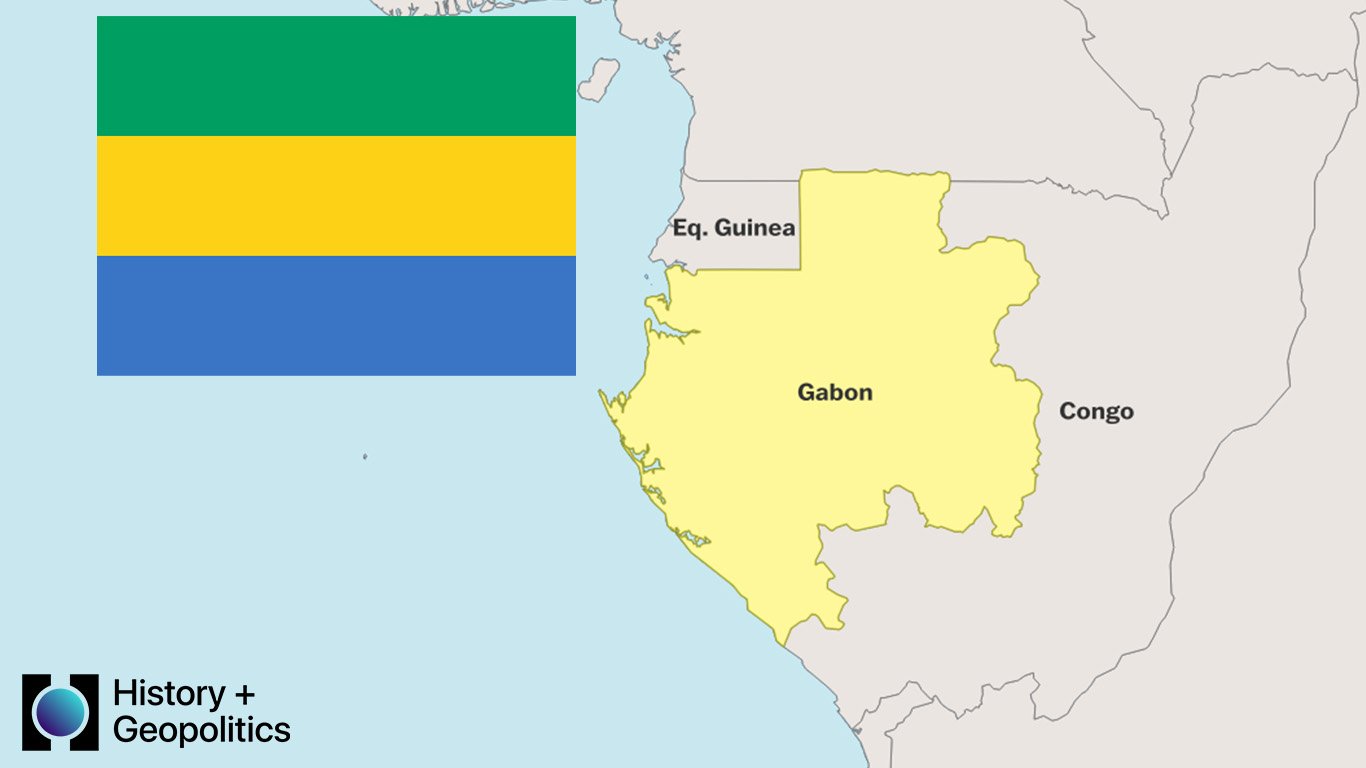
Gabon is located in Central Africa, bordered by Equatorial Guinea and Cameroon to the north, the Republic of the Congo to the east and south, and the Atlantic Ocean to the west.
Gabon Facts
- OFFICIAL NAME: Gabonese Republic
- CAPITAL: Libreville
- POPULATION: 2,647,399 (2026)
- AREA: 267,668 square kilometers
- OFFICIAL LANGUAGE: French
- CURRENCY: Central African CFA Franc (XAF)
Gabon Flag
The flag of Gabon has three equal horizontal stripes — green on top, yellow in the middle, and blue on the bottom. The green represents the forests that cover the majority of the country. The yellow symbolizes the equator passing through Gabon and the mineral wealth of the nation. The blue represents the Atlantic Ocean along the western coastline. The flag was adopted upon independence from France in 1960 and reflects Gabon’s natural identity as a country defined by its forests, equatorial location, and Atlantic coastline.
Gabon Geography
- Located in Central Africa, straddling the equator on the Atlantic coast.
- Borders: Equatorial Guinea and Cameroon to the north, Republic of the Congo to the east and south.
- The Atlantic Ocean forms the entire western coastline, stretching approximately 885 kilometers.
- Gabon is one of the most heavily forested countries in the world, with tropical rainforest covering approximately 85% of the land area.
- The terrain consists of a narrow coastal plain rising to a central plateau, with hills and mountains in the north and east.
- Mount Iboundji is the highest peak, rising to 1,575 meters in the east of the country.
- The Ogooué River is the most important waterway, flowing westward through the heart of the country to the Atlantic Ocean.
- Gabon has an equatorial climate, hot and humid throughout the year with heavy rainfall.
- The country is one of the most sparsely populated in Africa despite being relatively large, with vast uninhabited forest regions.
Gabon Government
- Gabon is currently governed by a military transitional government following a coup in August 2023.
- General Brice Oligui Nguema led the coup that ousted President Ali Bongo Ondimba and serves as transitional President.
- The coup ended over 55 years of rule by the Bongo family dynasty, which had governed Gabon since 1967.
- The military government has suspended the constitution and promised a transition back to civilian rule.
- Gabon was previously a presidential republic in which the President held extensive executive authority.
History of Gabon
- The region has been inhabited for thousands of years by various Bantu and Pygmy peoples, with the Baka among the earliest known inhabitants of the forests.
- Portuguese explorers arrived along the Gabonese coast in the late 15th century, initiating trade relationships.
- France established a presence along the coast in the 19th century, using Libreville as a settlement for freed enslaved people.
- Gabon became part of French Equatorial Africa under colonial administration.
- Gabon gained independence from France on August 17, 1960.
- Léon M’ba became the first president, followed by Omar Bongo in 1967, who would go on to rule for over 41 years until his death in 2009.
- Ali Bongo Ondimba succeeded his father Omar Bongo and governed until the military coup of August 2023.
- The discovery of oil in the 1970s transformed Gabon into one of sub-Saharan Africa’s wealthier nations, though the benefits were unevenly distributed.
- The 2023 coup ended the Bongo dynasty’s decades-long grip on power.
People and Culture of Gabon
- Gabon has over 40 ethnic groups, with the Fang being the largest, making up approximately 23% of the population.
- Other significant groups include the Punu, Nzebi, and Myene peoples, along with a significant community of foreign nationals from neighboring countries.
- French is the official language and the primary language of education, government, and business, while numerous Bantu languages are spoken in daily life.
- Roman Catholicism is the largest religion, followed by other Christian denominations and Islam.
- Nyembwe chicken, a dish of chicken cooked in palm nut sauce, is considered a national dish of Gabon.
- Traditional mask ceremonies and dances, particularly the Bwiti spiritual tradition of the Fang and related peoples, are important aspects of Gabonese cultural identity.
- Gabon’s high urbanization rate, with the majority of the population living in cities, distinguishes it from many of its Central African neighbors.
Economy of Gabon
- Gabon has one of the highest per capita incomes in sub-Saharan Africa, driven primarily by oil production.
- Oil has been the dominant export since the 1970s, though production has been declining as reserves mature.
- Manganese mining is a significant and growing sector, with Gabon being one of the world’s leading manganese producers.
- Timber from Gabon’s vast rainforests has historically been an important export, though logging restrictions have been introduced to protect forest cover.
- Agriculture is limited, with the country importing much of its food despite having fertile soils.
- The government has been working to diversify the economy beyond oil through investment in agriculture, tourism, and processing industries.
Gabon Resources
- Gabon has significant offshore oil and natural gas reserves, though production has been declining since the 1990s peak.
- The country holds some of the world’s largest manganese deposits, found primarily in the southeast near Moanda.
- Vast tropical rainforests represent an enormous timber resource, though their conservation value is increasingly recognized.
- Iron ore deposits in the north, particularly at Belinga, represent a significant undeveloped mineral resource.
- The Ogooué River and other waterways provide hydropower potential and freshwater fishery resources.
Gabon Wildlife
- Gabon is one of the most important countries for wildlife conservation in Africa, with its vast intact rainforests sheltering extraordinary biodiversity.
- The country has one of the largest forest elephant populations in Africa, with tens of thousands inhabiting the rainforests.
- Western lowland gorillas and chimpanzees are found throughout Gabon’s forests in significant numbers.
- The Atlantic coastline and offshore islands provide nesting grounds for three species of sea turtles, including the leatherback, making Gabon one of the most important sea turtle nesting sites in the world.
- Gabon established a network of 13 national parks in 2002, covering approximately 11% of the country’s land area, in a landmark conservation decision.
- The Lopé National Park, a UNESCO World Heritage Site, protects a unique transition zone between rainforest and savanna, supporting forest elephants, gorillas, and numerous endemic species.
- Gabon’s commitment to conservation, supported by international partnerships, has made it a model for rainforest protection in Central Africa.