Hungary Country Profile
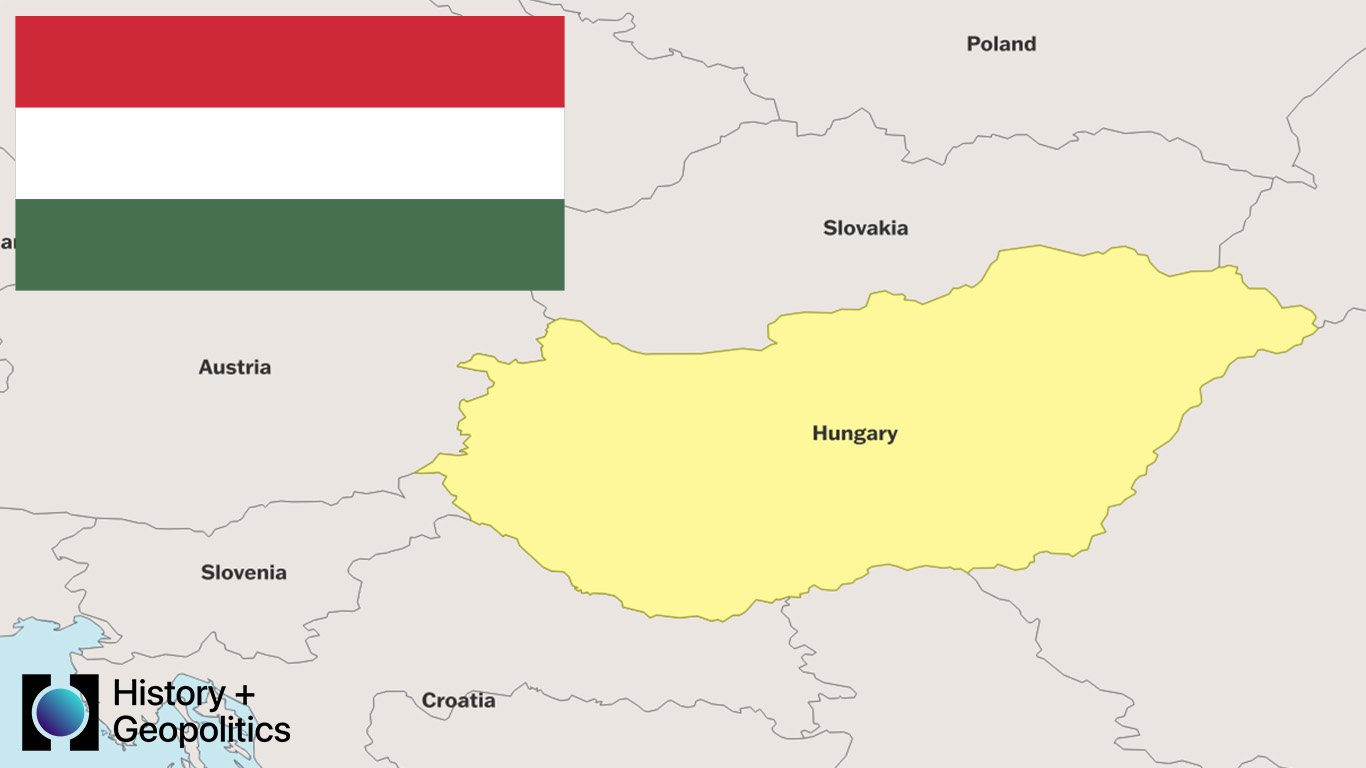
Hungary is located in Central Europe, a landlocked country bordered by Austria to the west, Slovakia to the north, Ukraine to the northeast, Romania to the east, Serbia to the south, Croatia to the southwest, and Slovenia to the northwest.
Hungary Facts
- OFFICIAL NAME: Hungary
- CAPITAL: Budapest
- POPULATION: 9,585,818 (2026)
- AREA: 93,028 square kilometers
- OFFICIAL LANGUAGE: Hungarian
- CURRENCY: Hungarian Forint (HUF)
Hungary Flag
The flag of Hungary has three equal horizontal stripes — red on top, white in the middle, and green on the bottom. The red represents strength and the blood shed in defense of the nation, the white represents faithfulness and the rivers of Hungary, and the green represents hope and the fertile land of the country. The colors have been associated with Hungary since the medieval period and were adopted as the national colors during the Hungarian Revolution of 1848 against Habsburg rule. The flag is almost identical to that of Bulgaria and Iran when viewed at certain angles, but Hungary’s tricolor is one of the oldest in Europe with its origins firmly rooted in the nation’s medieval heraldic tradition.
Hungary Geography
- Located in Central Europe, completely landlocked with no access to the sea.
- Borders: Austria to the west, Slovakia to the north, Ukraine to the northeast, Romania to the east, Serbia to the south, Croatia to the southwest, Slovenia to the northwest.
- Hungary lies almost entirely within the Carpathian Basin, a large, flat, fertile lowland region.
- The Great Hungarian Plain, known as the Alföld, dominates the eastern and central part of the country.
- The Transdanubian Hills and the Northern Hungarian Mountains provide the main upland areas in the west and north.
- The highest point, Kékes, rises to 1,014 meters in the Mátra range in the north.
- The Danube River flows through the country from north to south, dividing Transdanubia in the west from the Great Plain in the east.
- The Tisza River, the longest river flowing entirely through Hungary, crosses the eastern half of the country.
- Lake Balaton in western Hungary is the largest lake in Central Europe and a major recreational destination.
- Hungary has a continental climate, with cold winters and hot dry summers.
Hungary Government
- Hungary is a parliamentary republic.
- The President serves as a largely ceremonial head of state.
- The Prime Minister serves as head of government, holding executive authority.
- Hungary has a unicameral National Assembly.
- Viktor Orbán has served as Prime Minister since 2010 and leads the Fidesz party.
- Hungary joined NATO in 1999 and the European Union in 2004.
- Hungary has been the subject of ongoing disputes with the European Union over concerns related to the rule of law, judicial independence, and press freedom.
History of Hungary
- The Carpathian Basin has been inhabited since prehistoric times, with various peoples including Celts and Romans settling the region.
- The Romans established the province of Pannonia in the western part of present-day Hungary.
- The Magyar tribes, the ancestors of modern Hungarians, arrived in the Carpathian Basin in 895 A.D. under the leadership of Árpád.
- King Stephen I, later canonized as Saint Stephen, founded the Kingdom of Hungary in the year 1000 A.D. and adopted Christianity.
- The medieval Kingdom of Hungary became one of the most powerful states in Central Europe.
- The Mongol invasion of 1241 caused devastating destruction across the country.
- Hungary suffered a catastrophic defeat at the Battle of Mohács in 1526 against the Ottoman Empire, leading to over 150 years of Ottoman occupation of central Hungary.
- The Habsburg dynasty gradually reconquered Hungary from the Ottomans by the early 18th century.
- The Hungarian Revolution of 1848, led by figures including Lajos Kossuth, sought independence from Habsburg rule but was ultimately suppressed with Russian assistance.
- The Austro-Hungarian Compromise of 1867 created the Dual Monarchy of Austria-Hungary, granting Hungary significant autonomy.
- Austria-Hungary collapsed at the end of World War I in 1918, and Hungary lost approximately two-thirds of its territory under the Treaty of Trianon in 1920.
- Hungary allied with Nazi Germany in World War II, suffering enormous losses and the Holocaust of its Jewish population.
- After World War II, Hungary became a communist state under Soviet influence.
- The Hungarian Revolution of 1956, a nationwide revolt against Soviet rule, was crushed by Soviet military intervention.
- Hungary transitioned peacefully to democracy in 1989 as communism collapsed across Eastern Europe.
- Hungary joined NATO in 1999 and the European Union in 2004.
People and Culture of Hungary
- Hungarians, also known as Magyars, make up approximately 85% of the population, with Roma, Germans, and other minorities also present.
- Hungarian, also known as Magyar, is the official language and is a Finno-Ugric language unrelated to the surrounding Slavic and Germanic languages of Central Europe.
- Roman Catholicism is the largest religion, with Reformed Calvinist and Lutheran communities also significant.
- Gulyás, a hearty beef and vegetable soup seasoned with paprika, is Hungary’s most internationally recognized dish and considered the national dish.
- Lángos, deep-fried flatbread topped with sour cream and cheese, is one of the most beloved street foods.
- Hungary has a rich tradition in classical music, with composers Franz Liszt and Béla Bartók among the most celebrated figures in European musical history.
- Paprika is central to Hungarian cuisine and culture, with Hungary producing some of the finest paprika in the world.
Economy of Hungary
- Hungary has a developed open market economy, one of the more prosperous in Central and Eastern Europe.
- Manufacturing is the backbone of the economy, particularly the automotive industry, with major international car manufacturers including Mercedes-Benz, Audi, and BMW operating significant production facilities in the country.
- Electronics and chemical manufacturing are also important export sectors.
- Hungary is a significant recipient of foreign direct investment within the European Union.
- The services sector, including tourism and financial services, contributes significantly to GDP.
- Hungary faces demographic challenges including a declining and aging population, with the government implementing pro-natalist policies to encourage higher birth rates.
Hungary Resources
- Hungary has limited mineral resources but has deposits of bauxite, coal, and natural gas.
- The country has significant geothermal energy potential, with numerous natural hot springs used for both energy and spa tourism.
- Fertile agricultural land in the Great Hungarian Plain supports wheat, corn, sunflower, and wine production.
- Hungary is an internationally recognized wine producer, with the Tokaj wine region, producing the famous Tokaji sweet wine, designated a UNESCO World Heritage Site.
- The Danube and Tisza rivers provide water resources for agriculture and limited hydropower generation.
Hungary Wildlife
- Hungary’s lowland plains, wetlands, river valleys, and upland forests support a diverse range of Central European wildlife.
- The great bustard, the world’s heaviest flying bird, has one of its most important surviving populations on the Hungarian Great Plain.
- The white-tailed eagle has recovered strongly in Hungary and is now commonly seen near rivers, lakes, and wetlands.
- The Hungarian meadows and puszta, or open steppe grasslands, are home to grey cattle, Racka sheep, and Hungarian Puli horses, all traditional breeds integral to Hungarian rural heritage.
- The Hortobágy National Park, the largest natural grassland in Europe and a UNESCO World Heritage Site, protects the unique puszta ecosystem and supports thousands of migratory cranes and other waterbirds.
- Wolves and lynx have occasionally been recorded in the northern mountain forests, gradually returning from neighboring countries.
- Hungary has established several national parks and Natura 2000 protected areas to conserve its grassland, wetland, and forest ecosystems.