Iraq Country Profile
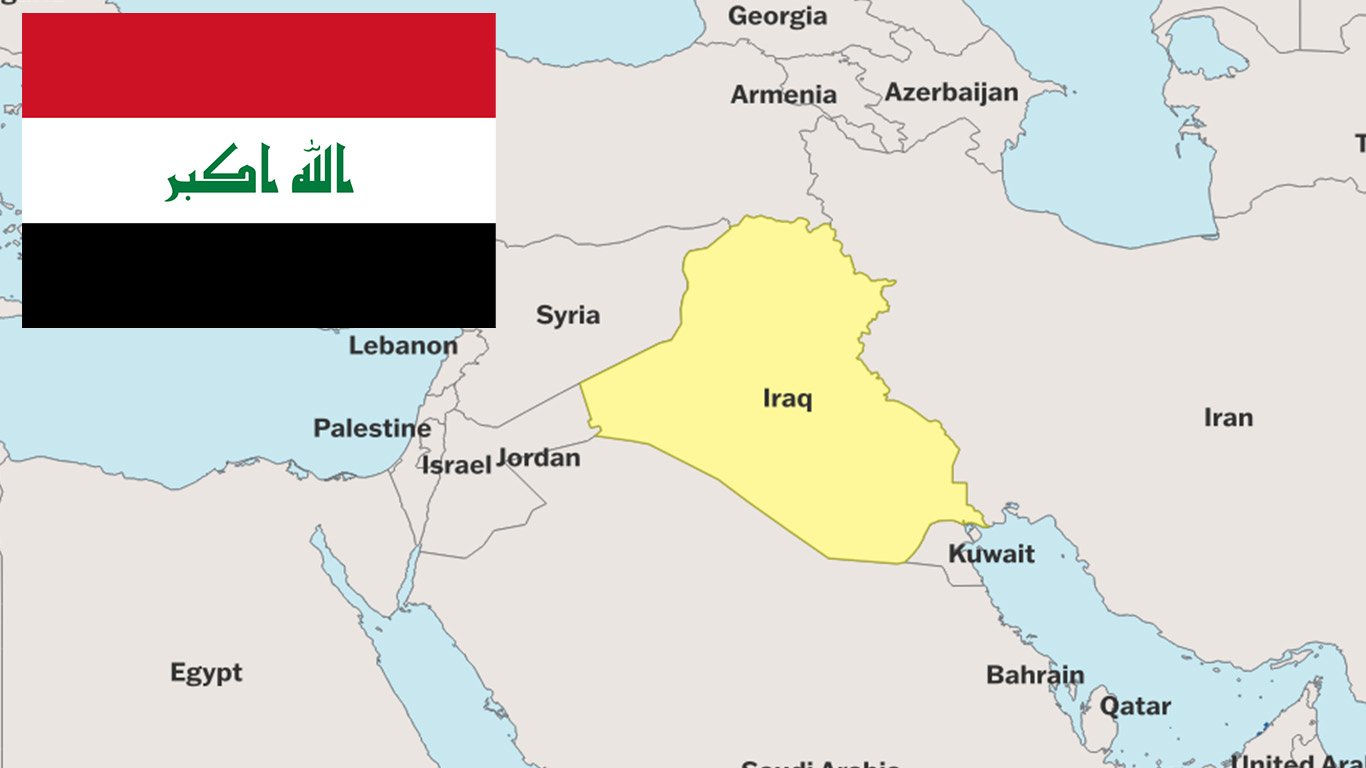
Iraq is located in Western Asia, bordered by Turkey to the north, Iran to the east, Kuwait to the southeast, Saudi Arabia to the south, Jordan to the west, and Syria to the northwest. To the southeast lies a narrow coastline along the Persian Gulf.
Iraq Facts
- OFFICIAL NAME: Republic of Iraq
- CAPITAL: Baghdad
- POPULATION: 48,007,437 (2026)
- AREA: 438,317 square kilometers
- OFFICIAL LANGUAGES: Arabic, Kurdish
- CURRENCY: Iraqi Dinar (IQD)
Iraq Flag
The flag of Iraq has three equal horizontal stripes — red on top, white in the middle, and black on the bottom — with the Takbir, the phrase “Allahu Akbar” meaning “God is Great,” written in green Arabic script in the center of the white stripe. The red represents courage and the willingness to shed blood in defense of the nation, the white represents generosity and the bright future of Iraq, and the black represents the dark era of oppression that was overcome. The green Arabic inscription was added to reflect the country’s Islamic identity. The flag’s Pan-Arab colors of red, white, black, and green are shared with several other Arab nations, reflecting a broader sense of Arab identity and unity.
Iraq Geography
- Located in Western Asia, at the heart of the Middle East.
- Borders: Turkey to the north, Iran to the east, Kuwait to the southeast, Saudi Arabia to the south, Jordan to the west, Syria to the northwest.
- Has a narrow coastline along the Persian Gulf in the far southeast.
- Iraq is dominated by the Mesopotamian Plain, one of the most historically significant river plains in the world.
- The Tigris and Euphrates rivers flow through the heart of the country from northwest to southeast, converging near Basra to form the Shatt al-Arab waterway before emptying into the Persian Gulf.
- The land between the Tigris and Euphrates, known as Mesopotamia, is widely regarded as the cradle of human civilization.
- The terrain ranges from the mountains and highlands of Kurdistan in the north to the fertile plains of the center and the desert of the west and south.
- The Zagros Mountains form a significant portion of the northeastern border with Iran.
- Iraq has a mostly desert climate, extremely hot and dry in summer, with cold winters in the north and mountainous regions.
- The southern marshlands, one of the world’s most important wetland ecosystems, lie near the confluence of the Tigris and Euphrates.
Iraq Government
- Iraq is a federal parliamentary republic.
- The President serves as head of state with largely ceremonial duties.
- The Prime Minister serves as head of government, holding executive authority.
- Iraq has a Council of Representatives as its unicameral legislature.
- Abdul Latif Rashid has served as President since 2022.
- Mohammed Shia’ Al-Sudani has served as Prime Minister since 2022.
- Iraq has a federal system that grants significant autonomy to the Kurdistan Region in the north.
- Iraq conducted its first comprehensive national census in November 2024, the first since 1987.
History of Iraq
- Iraq is home to Mesopotamia, one of the world’s oldest and most significant civilizations, dating back over 7,000 years.
- The Sumerian civilization, which emerged around 3500 B.C. in southern Mesopotamia, developed the world’s first writing system, known as cuneiform.
- Babylon, one of the ancient world’s greatest cities, was located near present-day Hillah and was home to the legendary Hanging Gardens, one of the Seven Wonders of the Ancient World.
- The Assyrian Empire and later the Babylonian Empire ruled the region before the Persian Achaemenid conquest in 539 B.C.
- Alexander the Great conquered the territory in 331 B.C., and Mesopotamia later became part of the Parthian and Sassanid Persian empires.
- Arab Muslim armies conquered Mesopotamia in 637 A.D., establishing Baghdad in 762 A.D. as the capital of the Abbasid Caliphate.
- Baghdad became the largest city in the world during the Islamic Golden Age, a center of science, medicine, philosophy, and trade.
- The Mongol invasion of 1258, led by Hulagu Khan, destroyed Baghdad and ended the Abbasid Caliphate, causing immense devastation.
- The region came under Ottoman rule in the 16th century and remained part of the Ottoman Empire until World War I.
- Britain occupied the territory during World War I and established the Kingdom of Iraq in 1921 under a British mandate.
- Iraq gained formal independence in 1932 and became a republic in 1958 following a military coup that overthrew the monarchy.
- Saddam Hussein rose to power within the Baath Party and became President in 1979, ruling the country with an iron fist.
- Iraq invaded Iran in 1980, starting the Iran-Iraq War which lasted until 1988 and caused enormous casualties on both sides.
- Iraq invaded Kuwait in 1990, triggering the Gulf War of 1991 in which a US-led coalition expelled Iraqi forces from Kuwait.
- International sanctions following the Gulf War severely impacted the Iraqi economy and civilian population throughout the 1990s.
- The US-led invasion of Iraq in 2003 overthrew Saddam Hussein, who was later captured and executed in 2006.
- The power vacuum following the invasion led to sectarian violence, insurgency, and the rise of extremist groups.
- The Islamic State (ISIS) seized large areas of northern and western Iraq in 2014, declaring a caliphate, before being militarily defeated by 2017.
- Iraq has been working to rebuild stability and infrastructure in the years since, though political tensions and security challenges persist.
People and Culture of Iraq
- Arabs make up the majority of the population at approximately 75 to 80%, while Kurds form the largest minority at approximately 15 to 20%.
- Smaller communities include Turkmen, Assyrians, Yazidis, and other ethnic and religious minorities.
- Arabic and Kurdish are both official languages, with Turkmen and Assyrian also recognized in certain areas.
- Islam is practiced by approximately 95% of the population, with Shia Muslims forming the majority at around 60 to 65% and Sunni Muslims at around 32 to 37%.
- Masgouf, a slow-grilled river fish traditionally prepared along the banks of the Tigris River, is considered the national dish of Iraq.
- Samoon, a distinctive diamond-shaped Iraqi bread, is a staple of daily life found in bakeries across the country.
- Iraq has a rich tradition of poetry, music, and storytelling, with the Maqam al-Iraqi, a classical musical tradition, recognized by UNESCO as intangible cultural heritage.
Economy of Iraq
- Iraq has one of the largest oil reserves in the world, and oil exports account for the overwhelming majority of government revenue and foreign exchange earnings.
- Iraq is one of the largest oil producers in OPEC and the world, with major oil fields concentrated in the south near Basra.
- The economy is heavily dependent on oil, making it vulnerable to fluctuations in global oil prices.
- Agriculture along the Tigris and Euphrates rivers supports wheat, barley, rice, and date palm production, with Iraq historically one of the world’s largest date exporters.
- Iraq has been investing heavily in infrastructure reconstruction following decades of war and sanctions.
- High unemployment, particularly among young people, corruption, and inadequate public services remain significant challenges.
Iraq Resources
- Iraq holds the world’s fifth largest proven oil reserves, concentrated primarily in the southern Basra region and the northern Kurdistan Region.
- Natural gas reserves are significant, though much of the associated gas from oil production is still flared rather than captured.
- The Tigris and Euphrates rivers provide vital fresh water resources for agriculture and human consumption.
- Fertile alluvial soils in the Mesopotamian Plain historically supported some of the world’s most productive agriculture.
- Iraq’s date palm groves, though significantly reduced from their historic peak, remain a culturally and economically important agricultural resource.
Iraq Wildlife
- Iraq’s diverse environments, from the Kurdistan mountains to the southern marshlands, support a range of wildlife.
- The Mesopotamian Marshes in southern Iraq, drained under Saddam Hussein and partially restored after 2003, are now a UNESCO World Heritage Site and one of the most important wetland ecosystems in Western Asia.
- The marshes support the Smooth-coated otter, various species of waterbirds including pelicans and herons, and endemic fish species.
- The Arabian oryx and other desert-adapted mammals inhabit Iraq’s western desert regions.
- The Kurdistan Region in the north supports brown bears, wolves, and wild goats in its mountain forests.
- The Euphrates soft-shelled turtle, a critically endangered species, inhabits the rivers of Iraq.
- Conservation efforts have focused on restoring the Mesopotamian Marshes and protecting the unique biodiversity of one of the world’s most historically significant wetland systems.