Ireland Country Profile
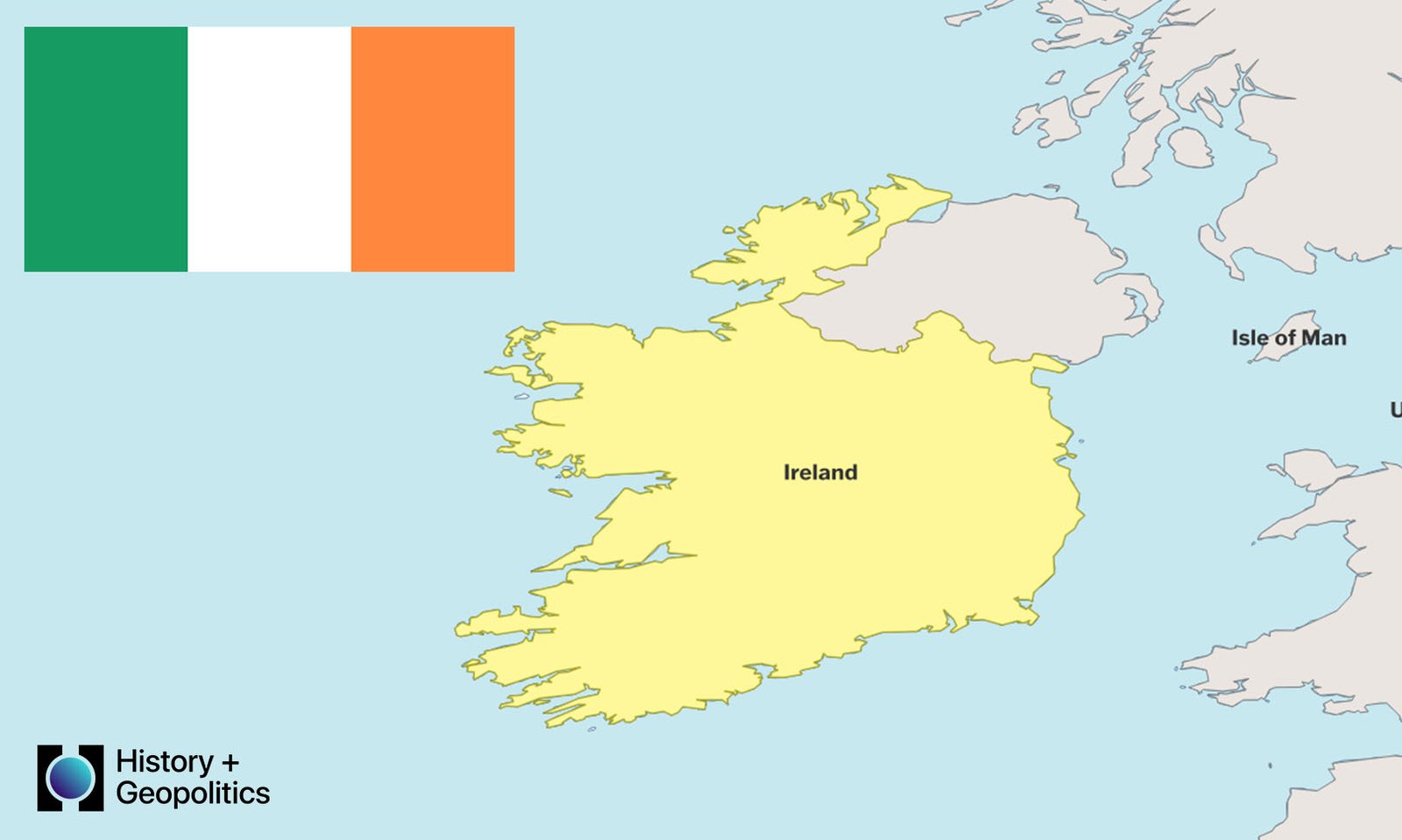
Ireland is located in Northwestern Europe, an island nation in the North Atlantic Ocean. It occupies most of the island of Ireland, sharing the island with Northern Ireland, which is part of the United Kingdom, to the northeast. The Atlantic Ocean lies to the west, the Celtic Sea to the south, and the Irish Sea separates Ireland from Great Britain to the east.
Ireland Facts
- OFFICIAL NAME: Ireland (Éire)
- CAPITAL: Dublin
- POPULATION: 5,440,000 (2025, Eurostat — UN mid-year 2026 estimate: 5,356,950)
- AREA: 70,273 square kilometers
- OFFICIAL LANGUAGES: Irish (Gaelic), English
- CURRENCY: Euro (EUR)
Ireland Flag
The flag of Ireland has three equal vertical stripes — green on the left, white in the middle, and orange on the right. The green represents the Gaelic and Catholic traditions of the Irish people, the orange represents the Protestant community and the followers of William of Orange in Ireland, and the white in the center represents the hope for lasting peace and unity between the two communities. The tricolor was first used during the Irish Rebellion of 1848, inspired by the French Tricolore, and was officially adopted as the national flag in the 1937 constitution.
Ireland Geography
- Located in Northwestern Europe, occupying most of the island of Ireland in the North Atlantic Ocean.
- Shares the island with Northern Ireland, a constituent country of the United Kingdom, to the northeast.
- Surrounded by the Atlantic Ocean to the west, the Celtic Sea to the south, and the Irish Sea to the east.
- Ireland is the third largest island in Europe and the twentieth largest in the world.
- The terrain consists of a central lowland plain ringed by coastal mountains and hills.
- The highest peak, Carrauntoohil in the MacGillycuddy’s Reeks range in County Kerry, rises to 1,041 meters.
- Ireland has an extensive coastline featuring dramatic cliffs, particularly along the Wild Atlantic Way on the western coast.
- The Shannon River, the longest river in Ireland and on the island of Britain and Ireland, flows southward through the center of the country.
- Ireland has a mild temperate oceanic climate, with abundant rainfall, mild temperatures, and overcast skies throughout the year, which gives the country its distinctive green landscape.
- The country is frequently affected by Atlantic weather systems bringing wind and rain from the west.
Ireland Government
- Ireland is a parliamentary republic.
- The President serves as head of state with largely ceremonial duties.
- The Taoiseach serves as head of government, holding executive authority.
- Ireland has a bicameral parliament known as the Oireachtas, consisting of the Dáil Éireann and the Seanad Éireann.
- Micheál Martin has served as Taoiseach since January 2025 following the 2024 general election.
- Ireland joined the European Economic Community, now the European Union, in 1973.
- Ireland maintains a policy of military neutrality and is not a member of NATO.
History of Ireland
- Ireland has been inhabited since approximately 10,500 B.C., following the retreat of the last Ice Age.
- Celtic tribes arrived on the island around 600 B.C., establishing a culture, language, and traditions that would define Irish identity for millennia.
- Christianity arrived in Ireland in the 5th century A.D., with Saint Patrick playing a central role in the conversion of the Irish people.
- Irish monasteries became centers of learning during the Early Middle Ages, preserving classical knowledge during the turbulent period in Europe known as the Dark Ages.
- Viking raids beginning in the 8th century led to the establishment of several towns, including Dublin, Waterford, and Cork.
- The Anglo-Norman invasion of 1169 began centuries of English involvement in Ireland that would shape the country’s history profoundly.
- England gradually extended its control over Ireland, and by the 17th century Protestant settlers from Britain had been planted in large numbers, particularly in Ulster.
- The Great Famine of 1845 to 1852, caused by a potato blight, killed approximately one million people and caused another million to emigrate, reducing the island’s population by roughly 25%.
- The famine triggered waves of emigration that continued for decades and created a large Irish diaspora, particularly in the United States, Australia, and Britain.
- The Easter Rising of 1916 in Dublin was a pivotal moment in the Irish independence movement, with its leaders executed by British authorities becoming national martyrs.
- Ireland gained independence from Britain in 1922, initially as the Irish Free State, with Northern Ireland remaining part of the United Kingdom.
- The Republic of Ireland was officially declared in 1949, severing the last constitutional ties with Britain.
- The Troubles, a period of ethno-nationalist conflict in Northern Ireland, lasted from the late 1960s to 1998 and had significant impact on the Republic.
- The Good Friday Agreement of 1998 brought an end to the main period of violence and established a power-sharing government in Northern Ireland.
- Ireland experienced rapid economic growth during the Celtic Tiger period of the 1990s and early 2000s, transforming from one of Europe’s poorer nations to one of its wealthiest.
- A severe banking crisis in 2008 led to an international bailout, from which Ireland recovered strongly to become one of the fastest-growing economies in the EU.
People and Culture of Ireland
- Irish people make up approximately 76% of the population, with a growing proportion of immigrants from other EU countries, particularly from Eastern Europe, as well as from Asia and elsewhere.
- English is the most widely spoken language in daily life, while Irish, the native Celtic language, is an official language and is spoken as a community language in areas known as the Gaeltacht along the western coast.
- Roman Catholicism has historically been the dominant religion, though its influence has declined significantly, with secularism growing rapidly in recent decades.
- Irish stew, a hearty dish of lamb or beef with potatoes, onions, and carrots, is one of Ireland’s most traditional and beloved dishes.
- Soda bread, made without yeast using baking soda as a leavening agent, is a distinctly Irish bread found in every home and bakery.
- Ireland has a rich literary tradition, producing four Nobel Prize winners in Literature — William Butler Yeats, George Bernard Shaw, Samuel Beckett, and Seamus Heaney.
- Traditional Irish music, featuring the fiddle, uilleann pipes, tin whistle, and bodhrán drum, is deeply embedded in Irish cultural life and has influenced folk music traditions worldwide.
Economy of Ireland
- Ireland has one of the most prosperous and fastest-growing economies in the European Union.
- The country has attracted enormous foreign direct investment, particularly from US technology and pharmaceutical companies, drawn by its low corporate tax rate and skilled English-speaking workforce.
- Major multinational companies including Apple, Google, Meta, and numerous pharmaceutical giants have established European headquarters or major operations in Ireland.
- The pharmaceutical and medical device sectors are among the largest contributors to export revenue.
- Agriculture, including dairy and beef production, remains an important sector, with Irish food and drink internationally recognized for quality.
- Ireland’s population grew by 1.6% in 2025, four times the EU average, driven by immigration and natural increase, reflecting its strong economic performance.
Ireland Resources
- Ireland has modest deposits of zinc and lead, with the Tara Mine in County Meath being one of the largest zinc mines in Europe.
- Peat, traditionally cut from extensive boglands, has historically been used as a domestic and industrial fuel, though its extraction is being phased out for environmental reasons.
- Agricultural land supports dairy, beef, and tillage farming across the fertile central plain.
- Ireland has significant renewable energy potential, particularly from wind energy generated by Atlantic winds, and is investing heavily in offshore wind development.
- The country’s landscapes, particularly the Wild Atlantic Way, Ring of Kerry, and Cliffs of Moher, are among its most valuable resources for tourism.
Ireland Wildlife
- Ireland’s mild, moist climate and green landscapes support a range of wildlife, though the island has fewer species than Great Britain due to its post-Ice Age island isolation.
- Red deer, the largest native land mammal in Ireland, inhabit Killarney National Park and other areas, representing the only population of native deer in Ireland.
- The Irish hare, a distinct subspecies of the mountain hare, is found across the island and is one of Ireland’s most iconic native mammals.
- The white-tailed eagle was hunted to extinction in Ireland but has been successfully reintroduced and is now breeding in several locations.
- The Atlantic coastline supports grey seals, harbour seals, and significant populations of dolphins and whales, including humpback and fin whales.
- Ireland’s boglands, rivers, and coastal habitats are important for numerous bird species, including the corncrake, which uses Irish grasslands as a vital breeding habitat.
- Conservation efforts focus on the restoration of native woodlands, boglands, and the continued reintroduction of species such as the white-tailed eagle and red kite.