Mali Country Profile
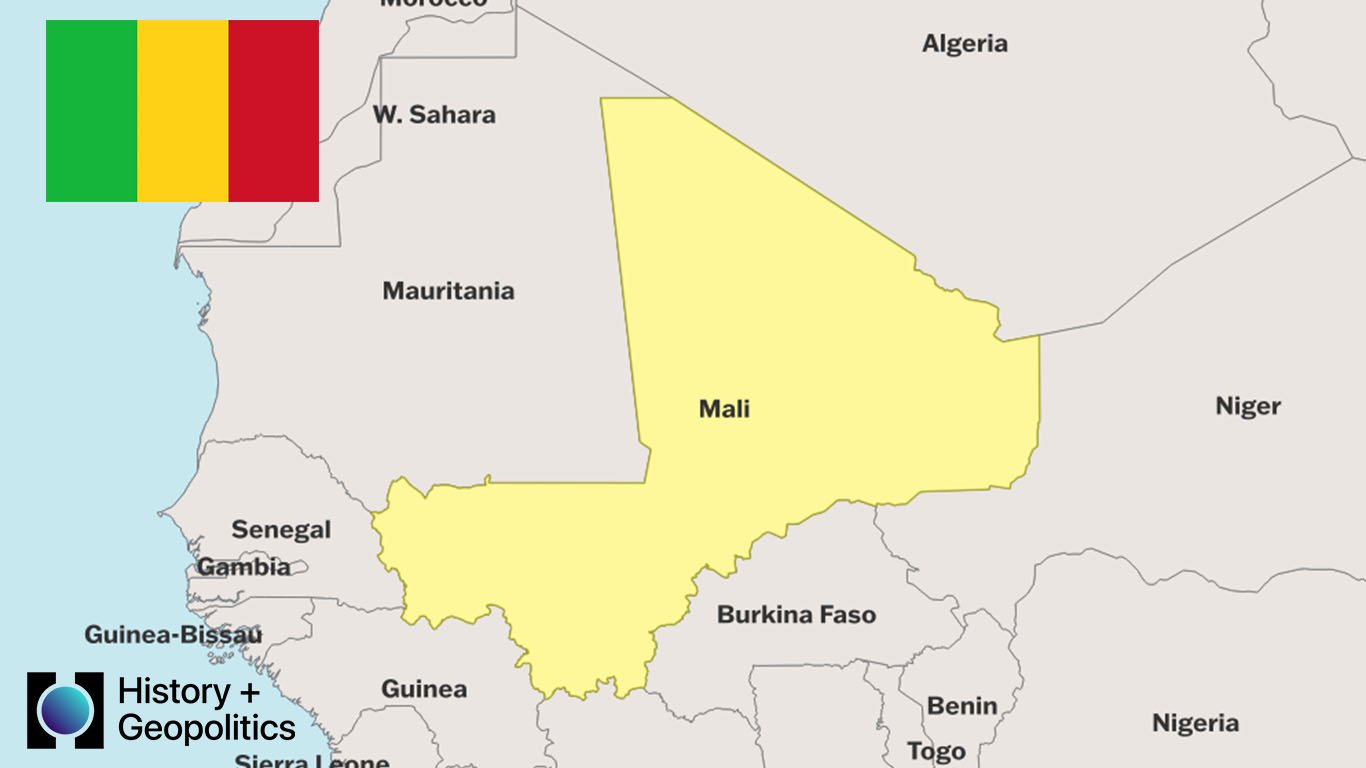
Mali is located in West Africa, a landlocked country bordered by Algeria to the north, Niger to the east, Burkina Faso and Côte d’Ivoire to the south, Guinea and Senegal to the southwest, and Mauritania to the west.
Mali Facts
- OFFICIAL NAME: Republic of Mali
- CAPITAL: Bamako
- POPULATION: 25,932,275 (2026)
- AREA: 1,240,192 square kilometers
- OFFICIAL LANGUAGE: French
- CURRENCY: West African CFA Franc (XOF)
Mali Flag
The flag of Mali has three equal vertical stripes — green on the left, yellow in the middle, and red on the right. The green represents hope, fertility, and the forests and agricultural wealth of the country. The yellow symbolizes the mineral wealth, particularly gold, and the purity of the people. The red represents the blood shed in the struggle for independence and the courage of those who fought for freedom. The Pan-African colors reflect Mali’s solidarity with the broader African independence movement. The flag was adopted upon independence from France in 1960 and is similar to the flags of several neighboring West African nations.
Mali Geography
- Located in West Africa, one of the largest countries on the continent and the eighth largest in Africa by land area.
- Completely landlocked with no access to the sea.
- Borders: Algeria to the north, Niger to the east, Burkina Faso and Côte d’Ivoire to the south, Guinea and Senegal to the southwest, Mauritania to the west.
- The terrain is predominantly flat, transitioning from the Sahara Desert in the north to the Sahel and savanna in the south.
- The Niger River, one of the most important rivers in West Africa, flows through the country in a distinctive arc, creating a vast inland delta known as the Niger Inland Delta.
- The Niger Inland Delta, one of the largest floodplains in the world, is a critical ecosystem and agricultural zone.
- The Adrar des Ifoghas mountains rise in the northeast near the Algerian border.
- Mali has an extremely hot and arid climate in the north, transitioning to a tropical climate with a rainy season in the south.
- The harmattan, a dry and dusty wind from the Sahara, affects much of the country during the dry season.
Watch video on YouTube: Mali geography
Mali Government
- Mali is currently governed by a military transitional government following coups in 2020 and 2021.
- Colonel Assimi Goïta led the second coup in May 2021 and serves as transitional President.
- The military government has expelled French forces and the UN peacekeeping mission MINUSMA from the country.
- Mali has aligned itself more closely with Russia, with Russian Wagner Group mercenaries playing a significant security role.
- The country has experienced prolonged political instability and a jihadist insurgency linked to groups in the wider Sahel region since 2012.
History of Mali
- The region was home to some of the most powerful empires in African history, including the Ghana Empire, the Mali Empire, and the Songhai Empire.
- The Mali Empire, founded in the 13th century under Sundiata Keita, became one of the wealthiest and most powerful states in the medieval world.
- Emperor Mansa Musa, who ruled the Mali Empire in the 14th century, was reputedly the wealthiest person in human history, with gold reserves so vast his pilgrimage to Mecca in 1324 caused inflation across North Africa and the Middle East.
- Timbuktu, located in present-day Mali, was a major center of Islamic scholarship and trade during the medieval period, home to one of the world’s earliest universities.
- The Songhai Empire succeeded the Mali Empire and became the largest empire in West African history before its collapse in the late 16th century.
- France established colonial control over the territory in the late 19th century, naming it French Sudan.
- Mali gained independence from France on September 22, 1960.
- Following independence, Mali experienced military coups and periods of authoritarian rule alternating with attempts at democratic governance.
- A Tuareg and jihadist rebellion in 2012 led to the collapse of northern Mali, with extremist groups briefly controlling major cities including Timbuktu.
- French military intervention in 2013 pushed back the jihadist advance, but instability has continued throughout the Sahel region.
- Military coups in 2020 and 2021 brought the current transitional government to power.
People and Culture of Mali
- The Bambara are the largest ethnic group, making up approximately 35% of the population, followed by the Fula, Senufo, Soninke, Tuareg, and Songhai peoples.
- French is the official language, while Bambara serves as the most widely spoken lingua franca across the country.
- Islam is practiced by approximately 94% of the population and is deeply embedded in daily life and culture.
- Tô, a thick porridge made from millet or sorghum served with various sauces, is a staple food across much of Mali.
- Tigadèguèna, a groundnut stew served with rice or tô, is one of the most beloved traditional dishes.
- Mali has a rich tradition of music and oral history, with the griot tradition of hereditary musicians and storytellers playing a central role in preserving cultural heritage.
- The kora, a 21-string instrument unique to West Africa, is closely associated with Malian musical tradition and has gained international recognition.
Economy of Mali
- Mali is one of the poorest countries in the world, with an economy heavily dependent on agriculture and gold mining.
- Gold is the most important export commodity, with Mali being one of the largest gold producers in Africa.
- Cotton is the most important agricultural export, with Mali being one of Africa’s leading cotton producers.
- Subsistence farming of millet, sorghum, and rice employs the majority of the rural population.
- The ongoing jihadist insurgency and political instability have severely disrupted economic activity, particularly in the north.
- Mali relies heavily on foreign aid, though international assistance has been reduced following the military coups and the expulsion of Western partners.
Mali Resources
- Gold deposits are Mali’s most significant mineral resource, found primarily in the southwestern part of the country.
- The Niger River and its inland delta are vital water resources supporting agriculture and fishing for millions of people.
- Cotton-growing agricultural land in the south is an important economic resource.
- Mali is believed to have deposits of phosphates, kaolin, salt, and lithium, though many remain underdeveloped.
- The cultural and historical heritage of Timbuktu and the ancient Mali Empire represents a potential tourism resource that has been severely impacted by insecurity.
Mali Wildlife
- Mali’s diverse landscapes, from the Sahara in the north to the savanna and Niger Delta in the south, support a range of wildlife.
- The Niger Inland Delta is one of the most important wetland ecosystems in West Africa, supporting enormous flocks of migratory waterbirds and a rich fishery.
- The West African manatee inhabits the Niger River and its tributaries.
- The African wild dog and various antelope species are found in the southern savanna regions.
- The desert regions of the north support addax antelope, Dama gazelle, and the Saharan cheetah in very small numbers.
- The Gourma elephant population in central Mali is one of the most northerly elephant populations in Africa, surviving in a semi-arid environment.
- The ongoing security crisis has severely impacted wildlife conservation efforts, with protected areas inaccessible and poaching largely unchecked across much of the country.